One page, six boxes and a very large space to explain yourself in. It is what Michigan accepts instead of a tidy correction, and since the line printed above the assignment on every Michigan title says that any alteration or erasure voids it, this is the difference between a mistake and a dead certificate.
Written against TR-34 (Rev 2/26), issued under Public Act 300 of 1949, as amended. Do not use this to explain away an alteration nobody has to know about. It is a declaration signed under the same Act as the title, and the sentence printed above the assignment on the certificate names forgery and false statement in the same breath as alteration.
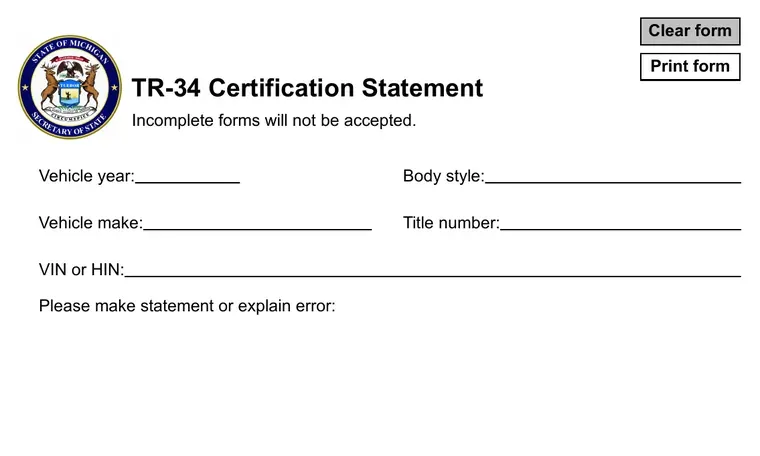
Two documents, and they are not the same thing. Take the blank TR-34 from the michigan.gov copy so you get the revision that is current today.
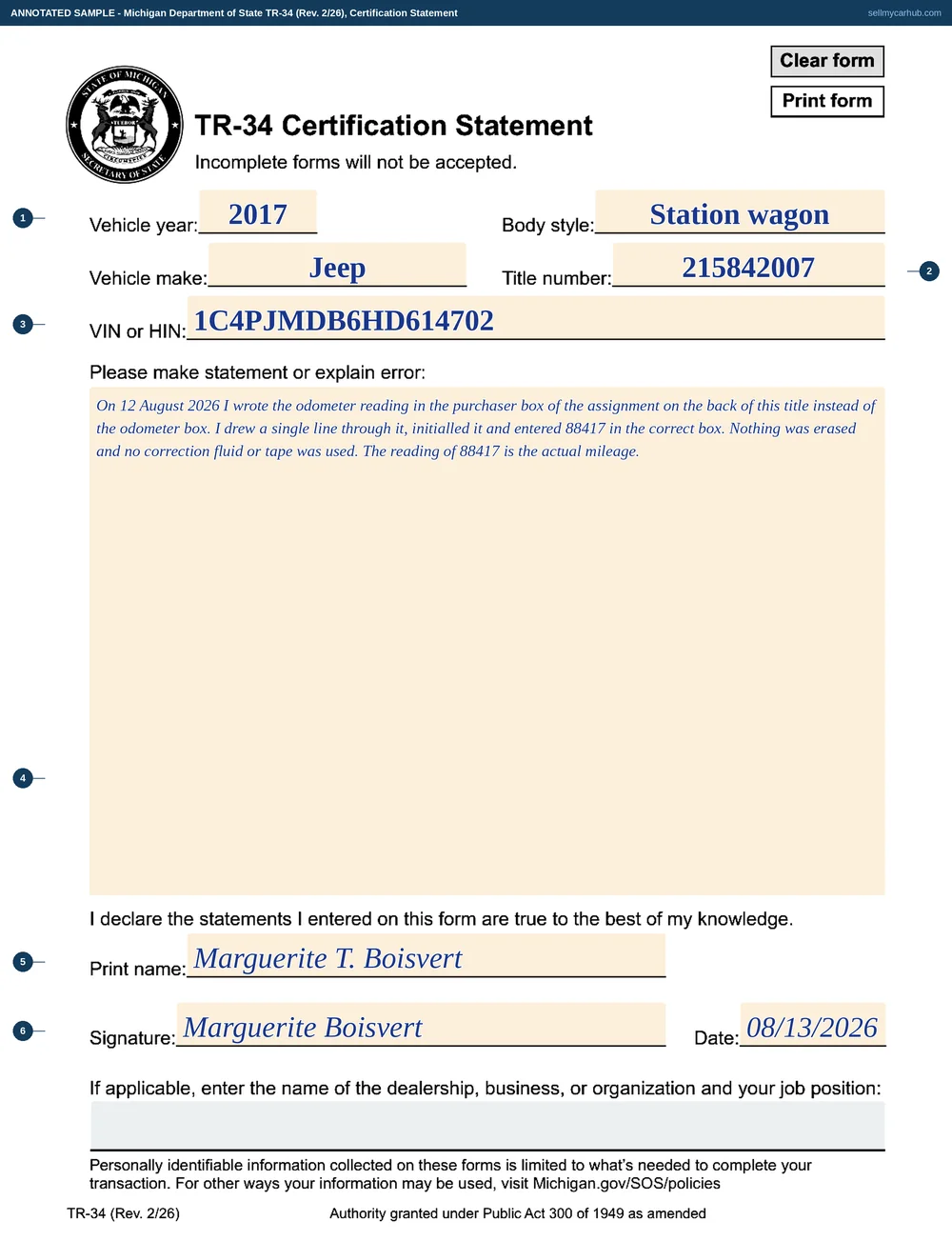
This is the actual TR-34, rendered from the PDF the Michigan Department of State publishes and completed end to end: letterhead, every field, and the blocks at the foot.
The top row of the form.
Watch out: Copy them from the certificate you are writing about, not from a listing. This form is matched to a title record.
The department's own number for the certificate, printed on its face.
Watch out: It is the fastest way for an examiner to find the record, and leaving it blank makes an incomplete form of an otherwise good explanation.
One wide box across the form, under the make and title number.
Watch out: HIN appears because the same certification covers watercraft. For a car it is the seventeen-character VIN and nothing else.
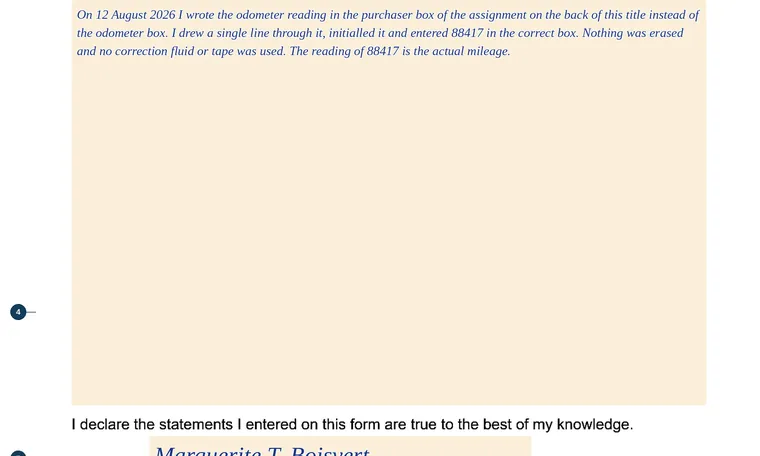
The large box that fills the middle of the page.
Watch out: Write the sequence: what you entered, which box it went in, what it should have been, and that you drew a single line through it and initialled it. An examiner is being asked to accept a document with two answers visible on it.
Your name, printed, above the signature row.
Watch out: As it appears on the title. The certification is worth nothing if the department cannot tie it to an owner of record.
Your signature and the date, under the printed declaration.
Watch out: The declaration above it is a statement of truth. The last line of the form, for a dealership or business and your job position, stays empty for a private sale.
| On the form | What to put in it |
|---|---|
| Vehicle year and body style | The top row, two boxes. |
| Vehicle make and title number | The second row. The title number is the department's own reference for the certificate you are writing about. |
| VIN or HIN | One wide box across the form. HIN is there because the same form covers watercraft. |
| Please make statement or explain error | A single box occupying more than half the page. Everything the form is for happens here. |
| Print name and signature | Your printed name on one row, your signature and the date on the next, under one printed declaration: I declare the statements I entered on this form are true to the best of my knowledge. |
| Name of dealership, business, or organization and your job position | The last line, marked if applicable. A private seller leaves it empty. |
Every line here was read off TR-34 (Rev 2/26) itself — the PDF is here — and off the Michigan Department of State pages. This is plain-language help with a form, not legal advice, and where our wording and the agency's differ, theirs governs.
Back to all Michigan seller paperwork, or what selling a car in Michigan involves.