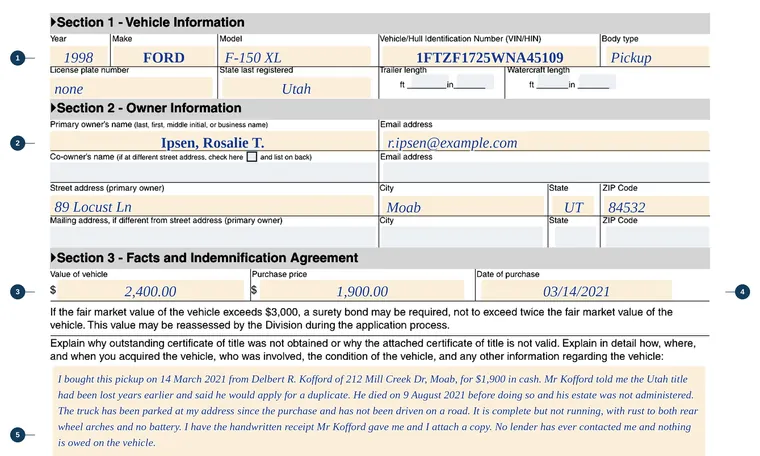
The sworn story of how a vehicle came into your hands when no certificate can be produced. It is the centre of what the Division calls the Insufficient Evidence of Ownership process, and its central box is not a tick or a number - it is a deep free-text field asking you to explain in detail how, where, and when you acquired the vehicle, who was involved, the condition of the vehicle, and any other information regarding the vehicle. Three of its other fields decide whether you also have to buy a bond.
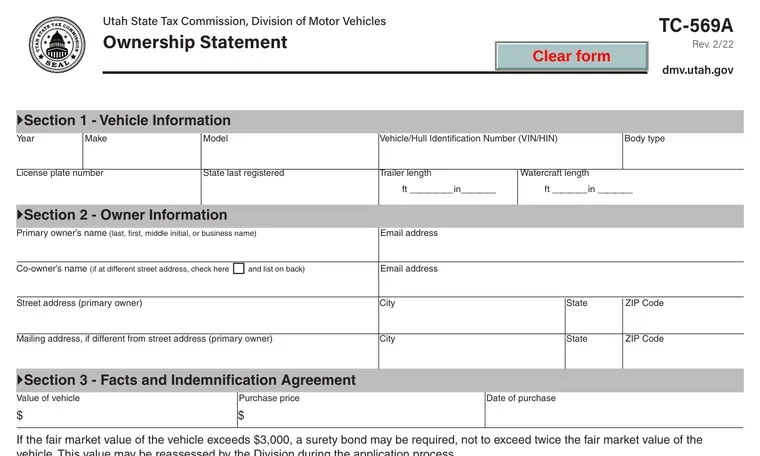
Written against TC-569A (Rev 2/22), issued under Utah Code 41-1a-509(3). This is a sworn statement about liens as well as ownership. It says the vehicle is free and clear of encumbrances and not in any existing or pending litigation, which is a strong claim about a vehicle whose history you may not know. If there is a lender somewhere in the story, say so in the explanation rather than swearing there is not.
Two documents, and they are not the same thing. Take the blank TC-569A from the files.tax.utah.gov copy so you get the revision that is current today.
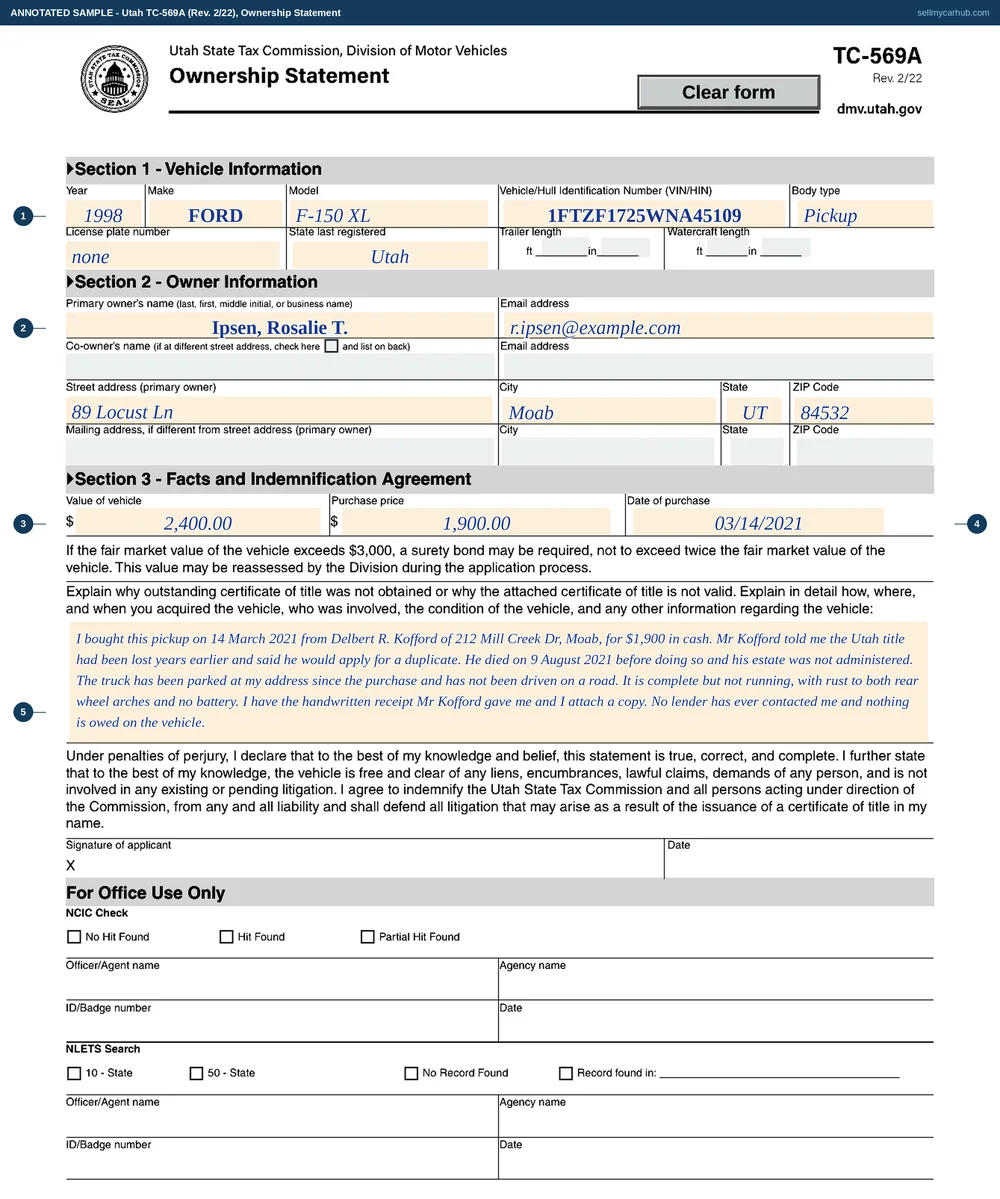
This is the actual TC-569A, rendered from the PDF the Utah State Tax Commission, Motor Vehicle Division publishes and completed end to end: letterhead, every field, and the blocks at the foot.
Year, make, model, identification number and body type, with the last plate and state if you know them.
Watch out: If the identification number is unreadable, this is not the form to start with - the number has to be established first, and that is a different application.
Name, email and address, plus a co-owner block if two of you will be on the title.
Watch out: Whoever signs the statement is who the title will issue to. Adding a name here that was not part of the story makes the explanation harder to believe.
What the vehicle is honestly worth today.
Watch out: This is the number the bond question hangs on, and the form warns that the Division may reassess it. An implausibly low figure invites exactly the scrutiny it is trying to avoid.
What you paid and when.
Watch out: Nothing and years ago are both acceptable answers. What is not acceptable is leaving them blank, because the dates are how the Division works out who else might have a claim.
How, where and when the vehicle was acquired, who was involved, and what condition it is in.
Watch out: Write more than feels necessary. Names, dates, addresses and the reason no title changed hands are what turn this from an assertion into evidence.
One signature under the perjury declaration and the agreement to indemnify the Tax Commission.
Watch out: You are also promising to defend any litigation that follows from the title being issued. That is not boilerplate on a vehicle whose past owner may still be findable.
| On the form | What to put in it |
|---|---|
| Section 1 - Vehicle Information | Year, make, model, identification number and body type, with trailer and watercraft length boxes for the other things Utah titles. |
| License plate number and State last registered | Where the vehicle was last on a road, if anybody knows. |
| Section 2 - Owner Information | The applicant's name and email, a co-owner block with a tick for a different address, and both a street address and a mailing address. |
| Section 3 - Facts and Indemnification Agreement: Value of vehicle | What the vehicle is worth. This is the figure the bond question turns on. |
| Purchase price and Date of purchase | What you paid and when - which may be nothing, and may be years ago. |
| The bond warning, printed between the boxes | If the fair market value of the vehicle exceeds $3,000, a surety bond may be required, not to exceed twice the fair market value of the vehicle. This value may be reassessed by the Division during the application process. |
| Explain why outstanding certificate of title was not obtained | The long box, and the point of the form. The prompt asks for how, where and when, who was involved, and the condition of the vehicle. |
| The indemnification, above the signature | A declaration under penalties of perjury, plus a statement that to the best of the applicant's knowledge the vehicle is free and clear of any liens, encumbrances, lawful claims, demands of any person, and is not involved in any existing or pending litigation. |
| The agreement to defend | An agreement to indemnify the Utah State Tax Commission and all persons acting under direction of the Commission from any and all liability, and to defend all litigation that may arise as a result of the issuance of a certificate of title in the applicant's name. |
| Signature of applicant and Date | One rule at the foot of Section 3, with a printed X in front of it. |
| For Office Use Only: NCIC Check and NLETS Search | Two bands recording a national crime database check and a multi-state record search, each with an officer or agent name, an agency, a badge number and a date. Not the applicant's to fill in. |
Every line here was read off TC-569A (Rev 2/22) itself — the PDF is here — and off the Utah State Tax Commission, Motor Vehicle Division pages. This is plain-language help with a form, not legal advice, and where our wording and the agency's differ, theirs governs.
Back to all Utah seller paperwork, or what selling a car in Utah involves.