Sell My Car Hub

How to fill out Utah TC-162

For a vehicle whose identification number is gone, unreadable, or was never issued. Four reasons are printed at the top - a number altered, missing or defaced; a reconstructed vehicle; a newly constructed vehicle with the date it was completed; or Other - and the rest of the sheet records every number that can still be found on the thing, has an inspector confirm them, and then has a second inspector confirm that the Utah-assigned number has been riveted on. Selling a vehicle in this state is not possible until it has been through the process, because there is nothing to write on a bill of sale.
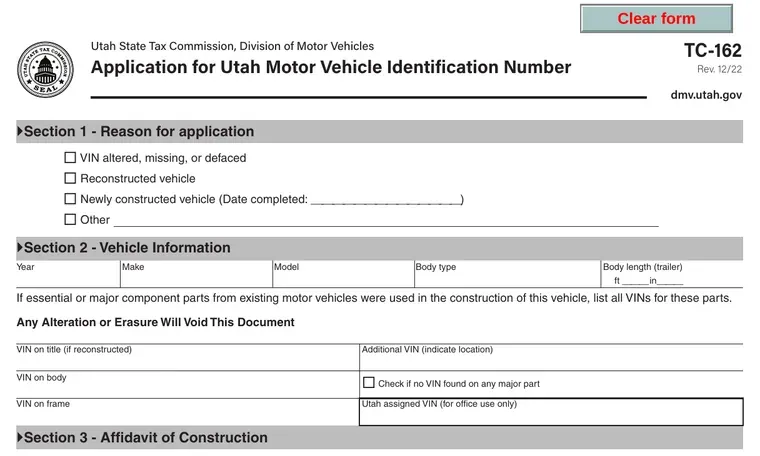
Written against TC-162 (Rev 12/22), issued under Utah Code 41-1a-511. Reconstructed is a wider word here than most people expect. The definition printed at the foot reaches any vehicle materially altered from its original construction by the removal, addition or substitution of essential parts, new or used - which can include a rebuild that the owner thinks of as a repair.

Two documents, and they are not the same thing. Take the blank TC-162 from the files.tax.utah.gov copy so you get the revision that is current today.

Filled in

What a completed one looks like

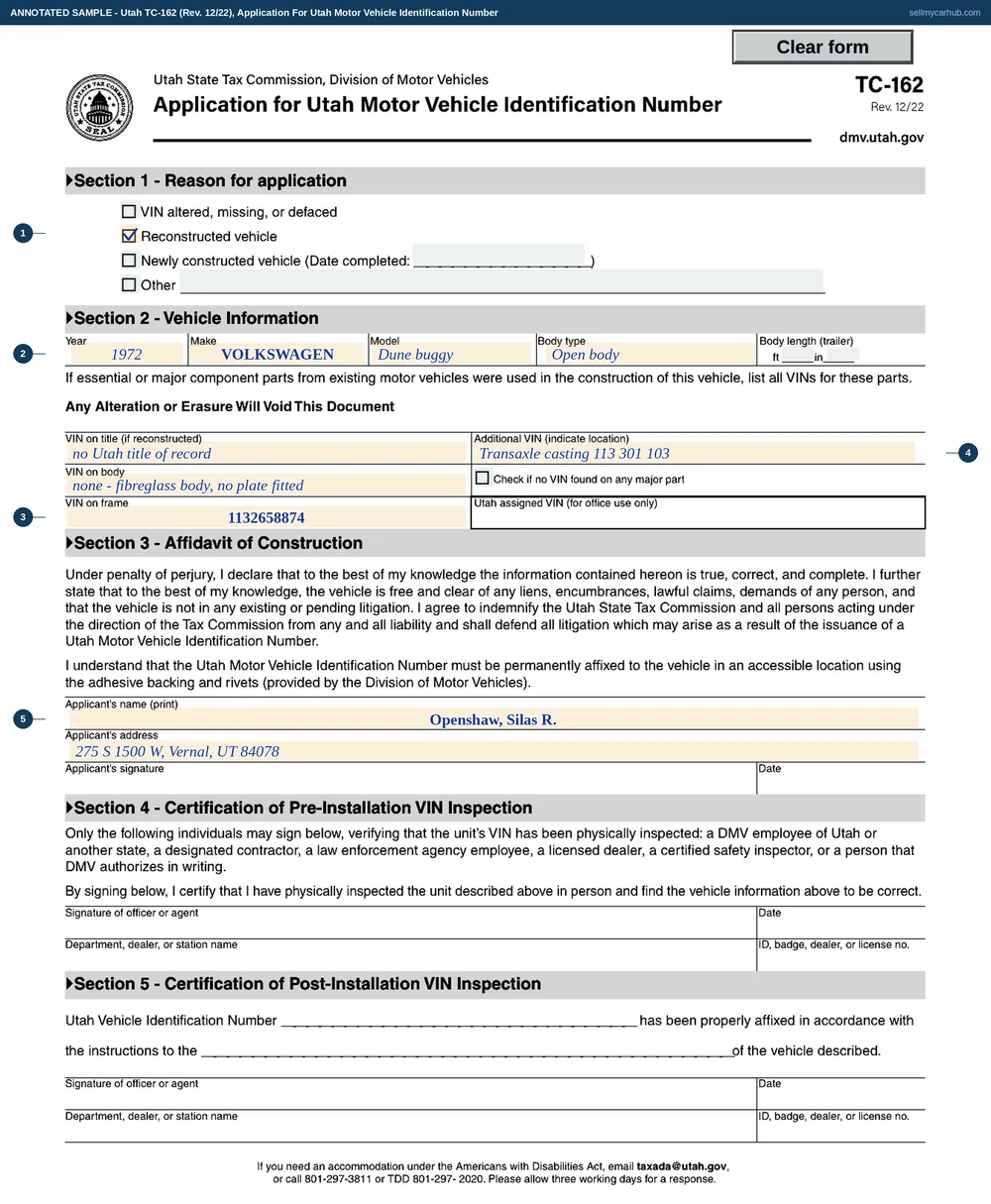
This is the actual TC-162, rendered from the PDF the Utah State Tax Commission, Motor Vehicle Division publishes and completed end to end: letterhead, every field, and the blocks at the foot.

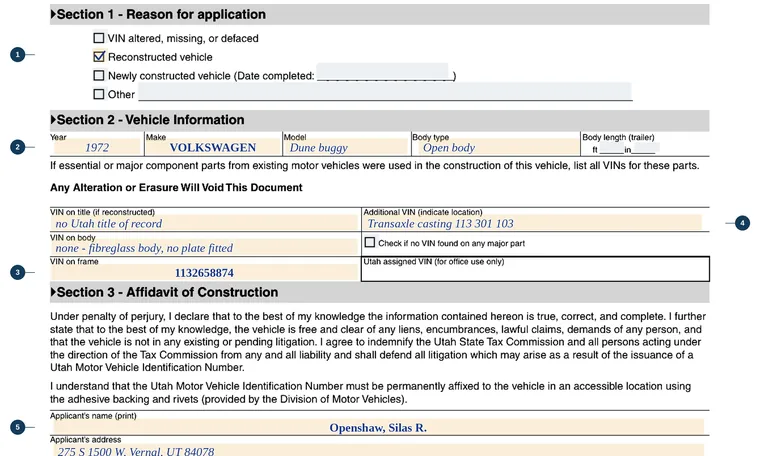
Utah form TC-162 filled in for a reconstructed vehicle: the reconstructed box ticked, a 1972 Volkswagen-based dune buggy described in Section 2 with the pan number recorded as the VIN on frame and no number found on the body, and the affidavit of construction signed by Silas R. Openshaw of Vernal.
The reason ticked at the top decides how the rest of the sheet is read. Both inspection certifications are washed grey because neither is the applicant's to complete.
Field by field

Every line, in the order you meet it

  1. 1
    You fill this in

    Section 1, the reason

    One tick of four, with a date if the vehicle was newly constructed.

    Watch out: Reconstructed and newly constructed are different things and the Division treats them differently. The definitions at the foot of the sheet are the test, not what you would call it in conversation.

  2. 2
    You fill this in

    Section 2, the vehicle

    Year, make, model and body type, with a length for a trailer.

    Watch out: The year on a reconstructed vehicle is normally the year of the frame or pan the build is based on. Guessing here contradicts the numbers you are about to write down.

  3. 3
    You fill this in

    The numbers that still exist

    Any number on the title, on the body, on the frame, and any additional one with its location noted.

    Watch out: If nothing can be found on any major part, tick the box that says so rather than leaving the whole block empty. An empty block reads as unfinished; a ticked box reads as a finding.

  4. 4
    You fill this in

    Component parts

    The identification numbers of essential or major component parts taken from other vehicles.

    Watch out: This is what stops a rebuild looking like a stolen car. Missing them out is the fastest way to have the application stall while somebody runs record checks.

  5. 5
    You fill this in

    Section 3, the affidavit

    Printed name, address and signature under the perjury declaration and the indemnity.

    Watch out: You are also undertaking to rivet the assigned number on where the Division tells you to. That undertaking is what Section 5 later checks.

  6. 6
    Somebody else fills this in

    Sections 4 and 5, the two inspections

    A certification before the number is fitted and a second one after it, each signed by somebody on the printed list.

    Watch out: They can be the same person on different days, but they cannot be one certification. The second one records where on the vehicle the plate ended up.

At a glance

What goes where

On the formWhat to put in it
Any Alteration or Erasure Will Void This DocumentPrinted inside Section 2 rather than at the top, immediately above the number boxes it governs.
Section 1 - Reason for applicationFour ticks: VIN altered, missing, or defaced; Reconstructed vehicle; Newly constructed vehicle with a date completed; or Other, with a comment line.
Section 2 - Vehicle InformationYear, make, model, body type and a body length in feet and inches for a trailer.
If essential or major component parts from existing motor vehicles were usedAn instruction to list all identification numbers for those parts - which is what turns a rebuild into a traceable vehicle.
VIN on title (if reconstructed), Additional VIN (indicate location)Two boxes for numbers that already exist on paper or elsewhere on the vehicle.
VIN on body, VIN on frameTwo more, and a tick box reading Check if no VIN found on any major part.
Utah assigned VIN (for office use only)The number the Division issues. Not the applicant's to write.
Section 3 - Affidavit of ConstructionA declaration under penalty of perjury that the information is true, that the vehicle is free and clear of liens, encumbrances, lawful claims and demands, and that it is not in any existing or pending litigation, with an agreement to indemnify the Tax Commission and defend any litigation arising from the number being issued.
The rivet undertakingIn the same block: an acknowledgement that the Utah Motor Vehicle Identification Number must be permanently affixed to the vehicle in an accessible location using the adhesive backing and rivets provided by the Motor Vehicle Division.
Applicant's name, address and signatureThree rules at the foot of Section 3.
Section 4 - Certification of Pre-Installation VIN InspectionThe same closed list of people who may inspect: a DMV employee of Utah or another state, a designated contractor, a law enforcement agency employee, a licensed dealer, a certified safety inspector, or a person that DMV authorizes in writing.
Section 5 - Certification of Post-Installation VIN InspectionA second inspection, after the plate has been riveted on, recording the assigned number and where on the vehicle it was affixed.
The definitions at the footEssential Parts, Major Component Parts and Reconstructed Vehicle, each set out in full - and the third is the one that catches people: a vehicle materially altered from its original construction by the removal, addition, or substitution of essential parts, new or used.

What gets this one rejected

Rules that decide whether it is accepted

Every line here was read off TC-162 (Rev 12/22) itself — the PDF is here — and off the Utah State Tax Commission, Motor Vehicle Division pages. This is plain-language help with a form, not legal advice, and where our wording and the agency's differ, theirs governs.

Back to all Utah seller paperwork, or what selling a car in Utah involves.

Want the paperwork handled instead?

Get My Instant Offer → Online · about 2 minutes · free

Or send the details — we'll come to you

Project vehicle with no number and no patience left? We buy them unfinished, paperwork and all.

or call/text (877) 405-1808