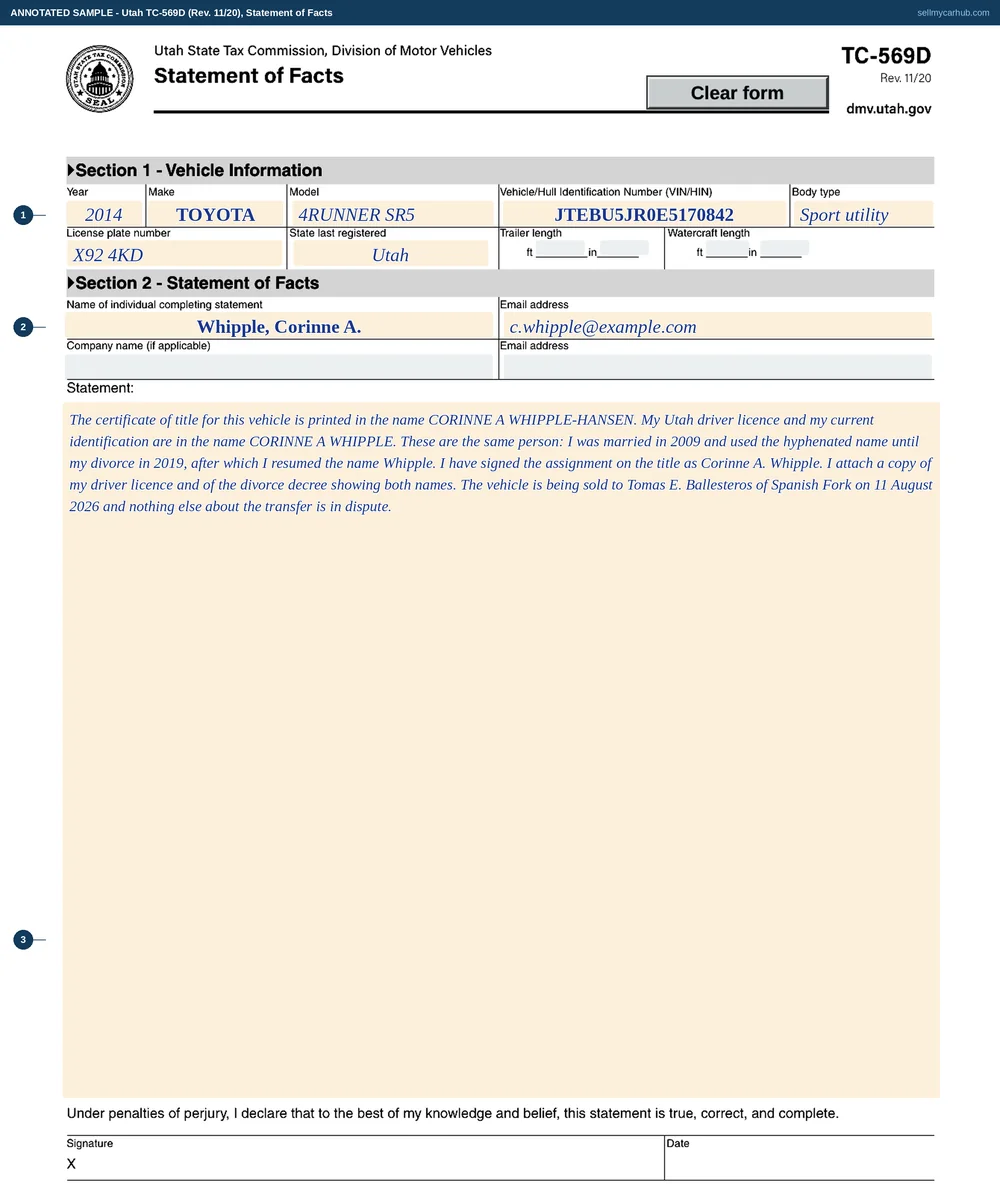
One page, one enormous box, and a perjury clause. It is the Division's general-purpose explanation form: a vehicle identified at the top, a person or company identified in the middle, and then a Statement field deep enough to swallow several paragraphs. A private seller reaches for it when something about the paperwork needs saying out loud - two spellings of one name, a signature written in the wrong lane, a purchase price that was recorded wrongly - and the Division also names it for a use nobody would guess: recording that a vehicle has been restored and modified with modern emissions control technology.
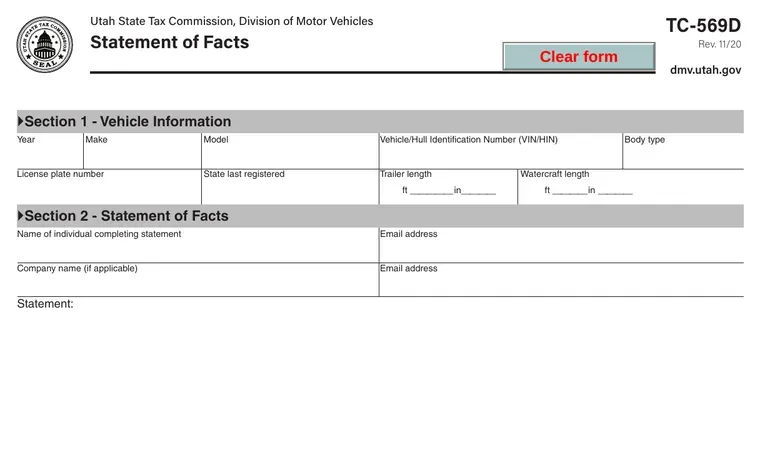
Written against TC-569D (Rev 11/20), issued under Utah Code 41-1a-512. The certification is the same penalties-of-perjury clause the ownership statement carries, and it is what makes a written explanation acceptable at a counter at all. Treat the box as evidence rather than as a covering letter: dull, specific and dated beats fluent every time.
Two documents, and they are not the same thing. Take the blank TC-569D from the files.tax.utah.gov copy so you get the revision that is current today.
This is the actual TC-569D, rendered from the PDF the Utah State Tax Commission, Motor Vehicle Division publishes and completed end to end: letterhead, every field, and the blocks at the foot.
Year, make, model, identification number, body type, plate number and the state it was last registered in.
Watch out: Fill in the plate as well as the identification number. It is what lets a clerk pull the live record rather than searching for the vehicle.
Your name and email, or the company name and its email if the statement is a business's.
Watch out: One statement, one voice. If a seller and a buyer each need to explain something, that is two forms.
What happened, in as much detail as it takes.
Watch out: Name the documents. A clerk holding a title that says one name and a licence that says another wants a sentence that quotes both, not a sentence that says they are the same.
One signature under the perjury declaration, with the date.
Watch out: There is no notary line and none is wanted. What gives the statement its weight is the declaration printed above the signature.
| On the form | What to put in it |
|---|---|
| Section 1 - Vehicle Information | Year, make, model, identification number and body type across one rule, with trailer and watercraft length boxes beside them. |
| License plate number and State last registered | Two more boxes on the same block, which is how the Division ties a loose statement to a live record. |
| Section 2 - Name of individual completing statement | The person swearing to it, with an email address beside the name. |
| Company name (if applicable), and its email | A second rule, for a statement made on behalf of a business. |
| Statement | The box that is the form. It runs most of the height of the page and it has no prompts, no headings and no tick boxes. |
| The certification | Under penalties of perjury, I declare that to the best of my knowledge and belief, this statement is true, correct, and complete. |
| Signature and Date | One line, marked with a printed X. There is no notary block and no witness line anywhere on the sheet. |
Every line here was read off TC-569D (Rev 11/20) itself — the PDF is here — and off the Utah State Tax Commission, Motor Vehicle Division pages. This is plain-language help with a form, not legal advice, and where our wording and the agency's differ, theirs governs.
Back to all Utah seller paperwork, or what selling a car in Utah involves.