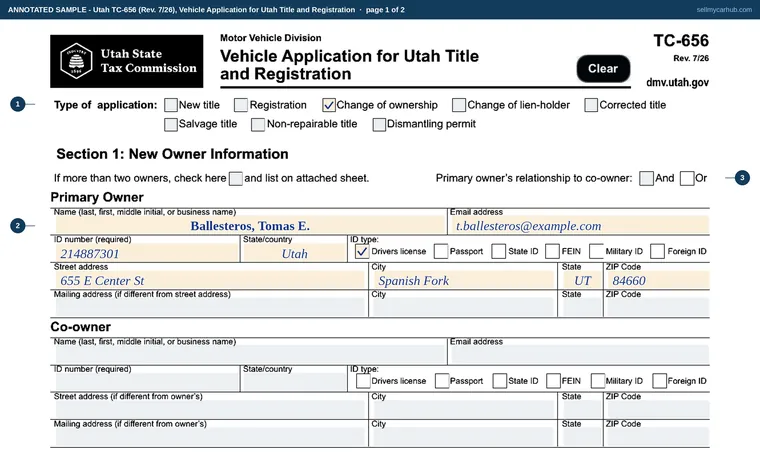
The cover sheet for a Utah title packet, and the one document in a private sale that a seller normally never touches. Two pages and seven sections, opening with a row of tick boxes that decides what the whole application is - new title, registration, change of ownership, change of lien-holder, corrected title, salvage title, non-repairable title or dismantling permit. A seller should still know it exists, because the Division names it as the form that stands in for an owner who cannot be at the counter, including on a virtual appointment.
Written against TC-656 (Rev 7/26), issued under Utah Code 41-1a-512 and 41-1a-703. The purchase price in Section 3 is what the Division works the sales and use tax from. It should be the figure on the bill of sale and on the ownership document, and where it is absent or unsupported the Division falls back on fair market value instead of on what was actually paid.
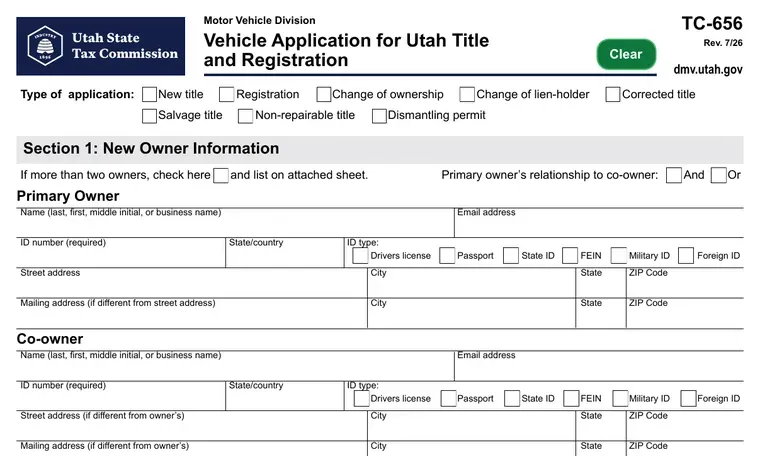
Two documents, and they are not the same thing. Take the blank TC-656 from the files.tax.utah.gov copy so you get the revision that is current today.
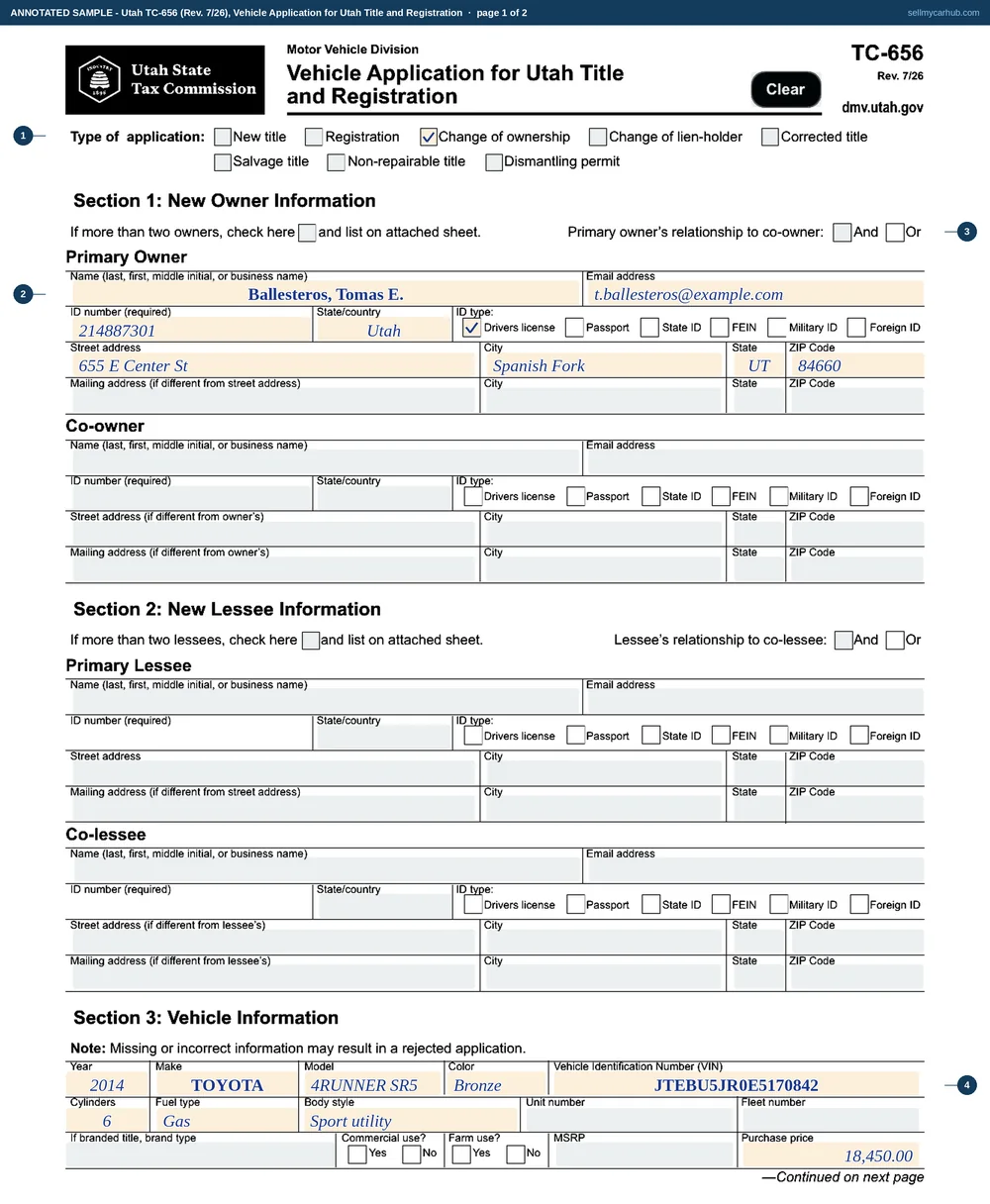
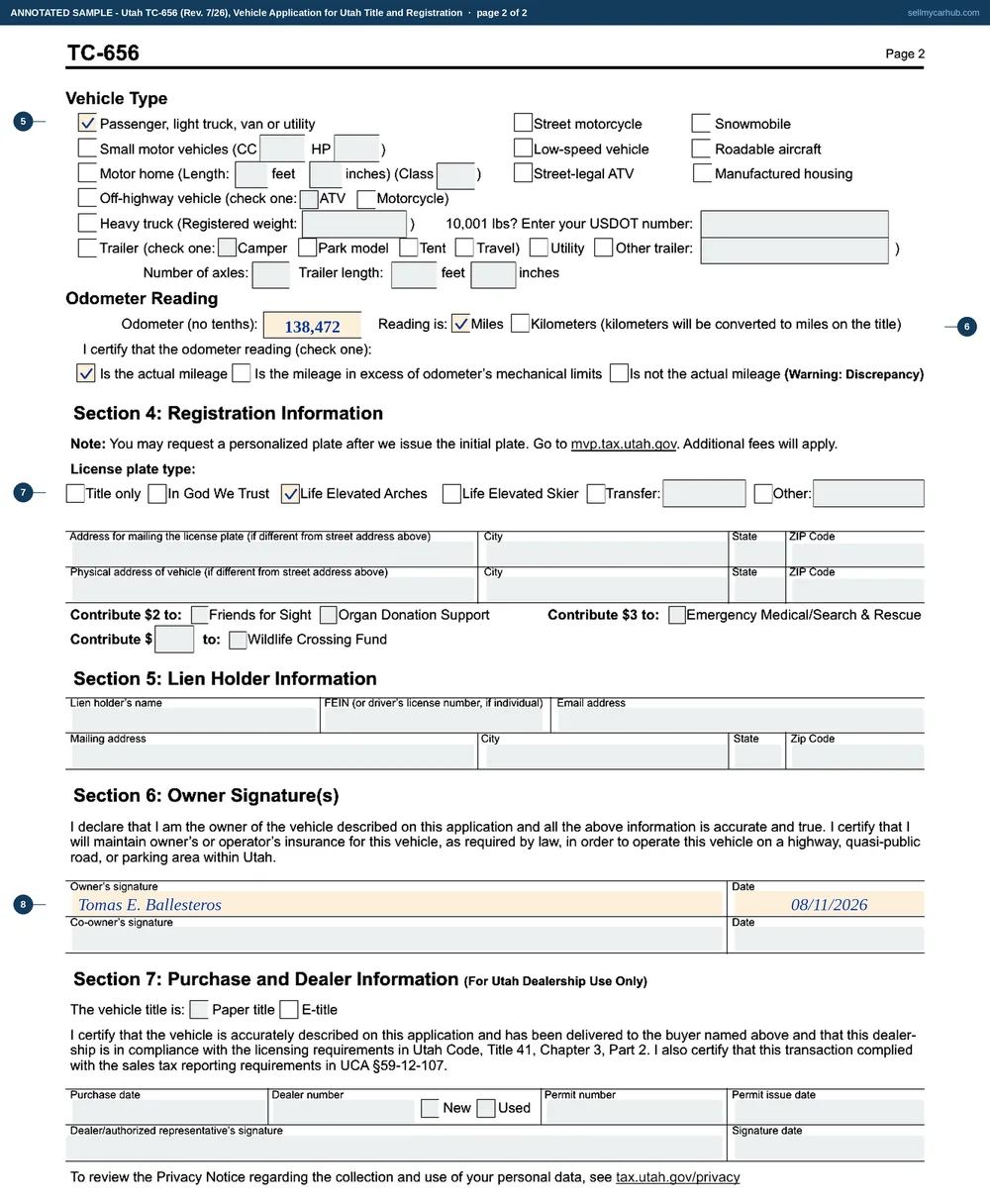
This is all 2 pages of the actual TC-656, rendered from the PDF the Utah State Tax Commission, Motor Vehicle Division publishes and completed end to end: letterhead, every field, and the blocks at the foot.
One tick in the top row.
Watch out: A private purchase is a change of ownership even where the buyer also wants a new plate. Ticking new title instead sends the application down a different route.
Name, email, identification number and its type, the issuing state, and both addresses where they differ.
Watch out: Every owner named here has to produce government-issued identification at the counter. Adding a spouse to be helpful means bringing that spouse, or bringing this form signed by them.
One tick at the top right of Section 1, where two owners are being recorded.
Watch out: This is the conjunction that will be printed between the names on the new certificate, and it decides how many signatures the next sale needs. Couples usually want Or and usually tick And by accident.
Year, make, model, colour, identification number, cylinders, fuel, body style and the purchase price.
Watch out: The purchase price should be the one on the bill of sale. If the two disagree, the Division has two documents about one sale and will ask which is true.
One tick in the block on page two - for most sales, passenger, light truck, van or utility.
Watch out: The boxes below it are for trailers, motor homes, off-highway vehicles and heavy trucks, and each opens a set of extra fields. An ordinary car needs one tick and nothing else from that block.
The reading and one of the three certifications, copied from the ownership document.
Watch out: Copy it from the title or the bill of sale rather than reading the dashboard on the day of filing. A car driven home three hundred miles will not match, and the counter reads the two together.
A plate type, or a plate number in the Transfer field where a plate is being moved onto the vehicle.
Watch out: Transferring plates does not transfer any leftover registration - that is the Division's own warning, and it surprises people who expect to inherit six months of tags.
Owner and co-owner signatures and dates, under the ownership declaration and the insurance certification.
Watch out: The insurance sentence is part of what is being signed. It is a promise about the future, not a statement about the day of the sale.
| On the form | What to put in it |
|---|---|
| Type of application | Eight tick boxes across two rows. A private sale is a change of ownership; a name corrected on a title you are keeping is a corrected title, and the two are priced differently. |
| Section 1: New Owner Information | Primary owner and co-owner, each with a name, email, identification number, the state or country that issued it, and a type: drivers license, passport, state ID, FEIN, military ID or foreign ID. |
| Primary owner's relationship to co-owner: And / Or | Two boxes at the top right of the section, and the most consequential thing on the page. And means both owners have to sign to sell or change the title later; Or means one signature will do. |
| If more than two owners, check here and list on attached sheet | The application holds two names and no more. |
| Street address and Mailing address | Both, for each owner, where they differ. The street address decides the tax rate and the county emissions programme. |
| Section 2: New Lessee Information | A second complete block for a lease, with its own And/Or question. Empty in a sale between two people. |
| Section 3: Vehicle Information | Year, make, model, colour, identification number, cylinders, fuel type, body style, unit and fleet numbers, brand type if the title is branded, commercial-use and farm-use questions, MSRP and purchase price. |
| Vehicle Type | A block of boxes running from passenger, light truck, van or utility through motor home with a length and class, off-highway vehicle, heavy truck with a registered weight and a USDOT number, trailers of five kinds, low-speed vehicle, street-legal ATV, snowmobile, roadable aircraft and manufactured housing. |
| Odometer Reading | The same reading and the same one-of-three certification the ownership document carries, repeated on the application so the two can be read against each other. |
| Section 4: Registration Information | Licence plate type, including a Transfer field for moving a plate across, an address for posting the plate, the physical address of the vehicle, and three contribution boxes. |
| Section 5: Lien Holder Information | The buyer's lender, with a FEIN or a driver licence number if the lender is an individual. |
| Section 6: Owner Signature(s) | A declaration of ownership and accuracy, plus a certification that the owner will maintain owner's or operator's insurance as required by law in order to operate the vehicle on a highway, quasi-public road, or parking area within Utah. |
| Section 7: Purchase and Dealer Information (For Utah Dealership Use Only) | Paper title or e-title, purchase date, dealer number, permit number and issue date, and a dealer certification about sales tax reporting. A private buyer leaves the whole band alone. |
Every line here was read off TC-656 (Rev 7/26) itself — the PDF is here — and off the Utah State Tax Commission, Motor Vehicle Division pages. This is plain-language help with a form, not legal advice, and where our wording and the agency's differ, theirs governs.
Back to all Utah seller paperwork, or what selling a car in Utah involves.