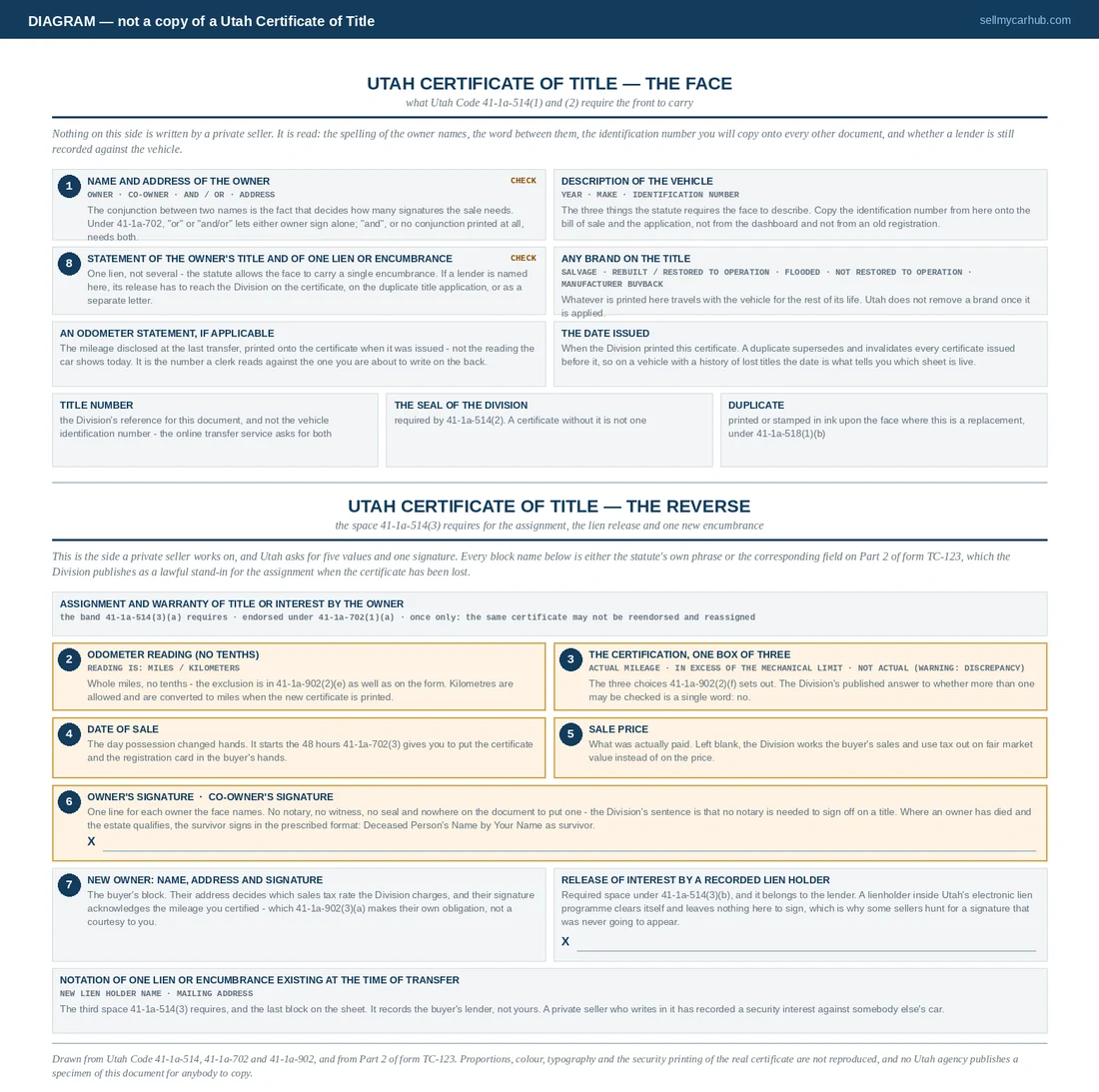
Everything a private Utah seller does to the certificate happens in one band on the back of it, and Utah's statute describes that band rather than picturing it: the certificate of title shall contain adequate space for the assignment and warranty of title or interest by the owner, the release of interest by a recorded lien holder, and the notation of one lien or encumbrance existing at the time of transfer. What follows is that band and the face above it, drawn from the statute and from the Division's own paper substitute for it.
Last updated .
Your 7 boxes
As a private seller you complete these and nothing else:
There is no blank Utah title to download and nothing to rehearse on. The certificate is secure stock printed by the Tax Commission and posted to the owner or to the lienholder, and the Division publishes no image of one anywhere. What is below is a diagram built from the statute that specifies the document, and beside it the Division's own paper substitute filled in for the same sale.
MISSING, ALTERED, OR INCORRECT INFORMATION MAY RESULT IN REJECTED APPLICATION
Every block name below is transcribed from Utah Code 41-1a-514, 41-1a-702 and 41-1a-902, and from Part 2 of form TC-123 - the sheet the Division publishes as a lawful stand-in for the certificate, carrying the same fields in the same order.
Start here
The Utah certificate, drawn - because nobody publishes a picture of one
This is a diagram and it says so on it. No Utah agency publishes a specimen, sample or exhibit of a Utah certificate of title: not on any of the 236 pages of the Division's own site, not in Publication 9, and not in twenty-two years of Motor Vehicle Enforcement Division newsletters. Every block below is named from Utah Code 41-1a-514, which lists what the face must carry and what the certificate must leave room for, and from Part 2 of TC-123, which reproduces the assignment field for field.
Amber — you write it, in pen
Grey — not yours to fill
Numbered — the nine boxes walked through underneath
Click or tap the picture to open it full size.
Drawn from the statute and from the Division's own substitute form. Proportions, typography, colour and the security printing of the real certificate are not reproduced, and no block here carries a value that is not named in a cited source.
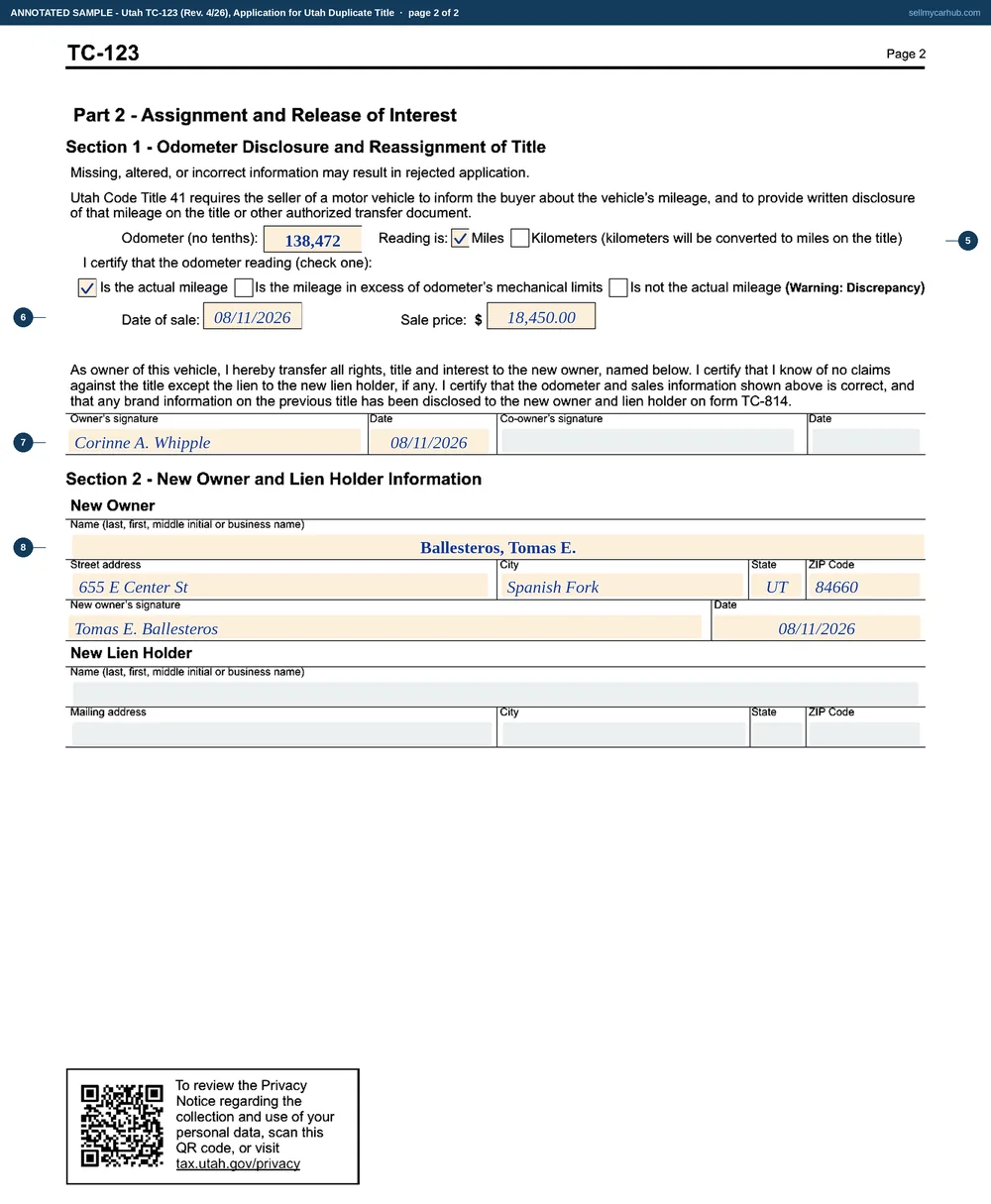
A real one, filled in
TC-123 Part 2 is the assignment, on paper you can actually see
Utah publishes no picture of its title, but it does publish a document that carries the same transfer: Part 2 of the duplicate title application, headed Assignment and Release of Interest. A seller whose certificate has gone missing signs this instead, and the Division treats the result as the ownership document. Filled in here for our sample sale, it is the closest thing to a Utah assignment that anybody can put in front of you.
Click or tap the picture to open it full size.
The same five values a Utah certificate asks for - reading, certification, date, price, signature - in the same order, on the sheet the Division accepts in the certificate's place.
Step by step
Every box, in the order you meet it
1
You fill this in
Before anything: read the face and check the conjunction
The owner names exactly as the certificate prints them, the word between them, and whether a lien holder is still shown.
Watch out: “And” means both of you sign, “or” means one of you can, and nothing printed between the names means both. This is the single fact that decides whether the sale can happen on the day you arranged it.
2
You fill this in
Odometer reading, no tenths
The current mileage in whole miles, in the reading field of the assignment.
Watch out: Utah exempts a vehicle that is twenty years old or older and nothing younger, so a 2009 car still gets a reading even though federal law would let it go. Kilometres are allowed and are converted to miles on the new title.
3
You fill this in
The certification, one box of three
Actual mileage, mileage in excess of the odometer's mechanical limits, or not the actual mileage with an odometer discrepancy warning.
Watch out: The Division's own answer to whether more than one box may be checked is one word: no. The third box is not a way of saying you never looked - it stamps a discrepancy onto every title issued after yours.
4
You fill this in
Date of sale
The day the keys actually changed hands.
Watch out: It starts the 48 hours you have to get the certificate and the registration card into the buyer's hands, and it is the date your report of sale refers to. Back-dating it to help a buyer who has let their insurance lapse is a false statement on a document you have signed.
5
You fill this in
Sale price
What was actually paid for the vehicle.
Watch out: Leave it off and the buyer's tax is worked out on fair market value instead. Write it down low and the Tax Commission's published answer is an audit for the additional tax, penalty and interest, with a fraud penalty at 100% of the tax or $500, whichever is greater.
6
You fill this in
Owner's signature, and the co-owner's
One line each, in the assignment - printed and signed as the face of the certificate spells you.
Watch out: No notary, no witness, no seal. If your identification spells your name differently from the certificate, that mismatch is what a statement of facts is for, and it is easier to send one in than to argue at the counter.
7
The buyer fills this in
The buyer's block
Their printed name, the address they will register at, and a signature acknowledging the mileage you certified.
Watch out: The address decides which sales tax rate the Division charges them, because Utah taxes a private sale at the combined rate for the place the vehicle will be registered. A post-office box is not a place a vehicle is registered.
8
The lienholder fills this in
The lien release block, if the face shows a lender
The recorded lien holder's release of interest, signed and dated by the lender.
Watch out: It can be on the certificate, on the duplicate title application or in a separate letter - the Division accepts all three. A lender inside Utah's e-lien programme removes its interest automatically, so there may be nothing to sign and nothing missing.
9
You fill this in
Then the part that is not on the document
The plate off the car unless you have decided to sell it with the vehicle, the emissions certificate out of the glovebox, and the sale reported to the Division.
Watch out: If the plate comes off you have twenty days to return it for destruction or have it assigned to another vehicle, and a personalised combination has to be dealt with immediately or you lose your priority to it.
Before the pen
Read the front of it for five minutes before the pen comes out
Six things to settle before you uncap a pen. The first one decides whether the sale can happen at all on the day you have arranged, and it is printed on the face of the document you are about to sign.
Read the conjunction between the owner names
“And” needs both signatures, “or” needs one, and nothing printed between the names needs both. Finding that out after your co-owner has flown to Boise is an expensive way to learn it.
Check the lien block on the face before you advertise
If a lender is printed there, the Division needs a release - on the title, on the duplicate title application, or as a separate letter. An electronic lienholder clears itself automatically and leaves nothing to sign, which is why some sellers cannot find the signature they are looking for.
Work out the odometer answer on twenty years, not ten
Utah exempts a vehicle that is 20 years old or older and nothing younger. If the car is under twenty, the reading goes in, no matter which page of the Division's site you happened to read.
Write a bill of sale even though nobody will chase you for one
The Division lists it under Required for All Transactions, and without an acceptable one the tax is worked out on Fair Market Value instead of on what the car actually fetched.
Decide about the plate deliberately
Keeping it is the default and selling it with the car is now allowed. What is not allowed is drifting: a plate left on a car by accident is still registered to you until the buyer applies to have it assigned.
Find the emissions certificate before you list it
In the five programme counties a certificate less than eleven months old transfers with the vehicle. Yours is worth money to your buyer, and it is usually in the glovebox behind the registration.
Advice that survives in Utah because nobody checks it
Four things Utah sellers tell each other that the Tax Commission contradicts in writing. Each answer carries the link.
“Get it notarised or it will not hold up.”
There is nowhere on a Utah certificate to put a seal and no requirement to find one. The Division's own guidance on taking a title from a seller says so in a single line, immediately after the paragraph about who has to sign: no notary is needed to sign off on a title. A stamp added anyway is an alteration on a document the Division reads for alterations.
“The car is a 2009, so the mileage box does not apply.”
It applies. Federal law would exempt a 2010-or-older vehicle ten years after its model year, but Utah legislates its own exemption and it is twice as long: a motor vehicle that is 20 years old or older. Between those two rules sits every model year from 2007 to 2010, exempt federally and not exempt here.
“No title, no sale - they will have to wait for the duplicate.”
Not in Utah. Form TC-123 has a second part headed Assignment and Release of Interest, and the Division's instruction to a seller is to give the completed form to the buyer in place of the Utah title, having signed both Part 1 and Part 2. The buyer registers on that sheet. A duplicate title costs $6.00 and takes ten to fourteen business days, and the sale does not have to wait for it.
“It needs to pass a safety inspection before I can sell it.”
Almost certainly not. Utah Code 53-8-205 reaches commercial vehicles, ground transportation vehicles, buses, taxicabs, multi-axle combinations, first registration of a street-legal all-terrain vehicle or novel vehicle, and the initial registration of a salvage vehicle. An ordinary car is on none of those lists, and Publication 9 puts it plainly: most vehicles do not require a safety inspection for Utah registration.
Fewer signatures than almost anywhere, and not one of them sworn:
Every owner the face of the certificate names
Read the conjunction first. Two names joined by “and” means two signatures; joined by “or” means one will do; printed with nothing between them at all means two, because 41-1a-702 reads a missing conjunction as a conjunctive one.
Nobody as a witness
There is no witness line anywhere on a Utah certificate. The witness people remember is from another state's application form.
No notary, at any point
The Division's sentence is four words longer than it needs to be and worth memorising: no notary is needed to sign off on a title.
The buyer, once
One signature acknowledging the mileage you certified, and an address. Utah Code 41-1a-902 makes the acknowledgement the buyer's own obligation, and requires both of you to keep a legible copy for not less than four years.
The recorded lien holder, if the face still shows one
The release goes on the certificate itself, on the duplicate title application, or in a separate letter - the Division names all three. A lender on an electronic lien clears itself and you will never see a signature at all.
A survivor, in a prescribed format
Where an owner has died and the estate qualifies, the Division prints the exact wording for the seller's line: Deceased Person's Name by Your Name as survivor.
Not an agent on the Tax Commission's power of attorney
The TC-737 is a tax power of attorney. It authorises an agent to receive and inspect confidential tax information, and it has nothing to do with signing a certificate of title.
One number people mix up: the title number is the Division's reference for the document and it is not the vehicle identification number. The online transfer service asks for a combination of VIN and title number, or VIN and owner name, and says the information must match exactly with the motor vehicle information recorded with the State of Utah - so read both off the certificate rather than off an old registration card.
Once it is signed
The assignment is the whole of your job on the document. What is left is physical: the plate off the car or a deliberate decision to sell it with the car, the emissions certificate out of the glovebox, and a report of sale filed the same evening even though nothing sets a date for it.