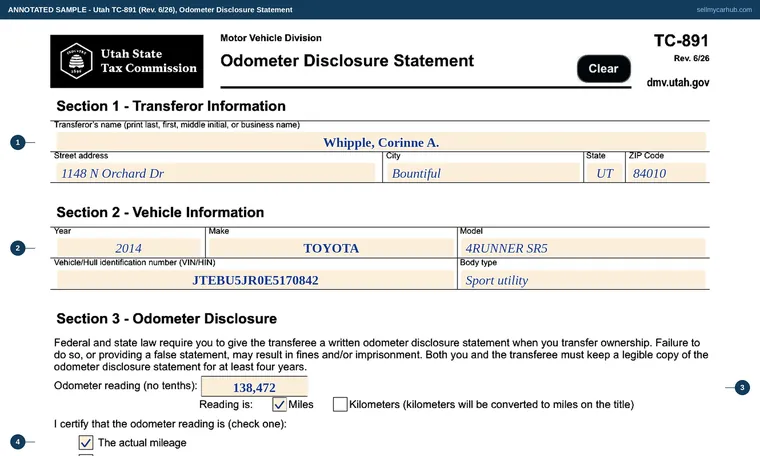
The standalone mileage certification, for the case where the ownership document has nowhere to put one. Utah's statute says that where a vehicle has not been titled, or the certificate of title does not contain a space for the information required, the written disclosure shall be executed as a separate document - and this is that separate document. It calls the two sides transferor and transferee rather than seller and buyer, because the obligation it carries is federal as well as Utah's.
Written against TC-891 (Rev 6/26), issued under Utah Code 41-1a-902. A dealer who has to title and register a vehicle for a customer surrenders the original of this statement to the Division and gives the customer a copy - the reverse of the private-sale rule, where the original is the buyer's. If you are handed a photocopy by somebody who says they kept the original, ask who they are.
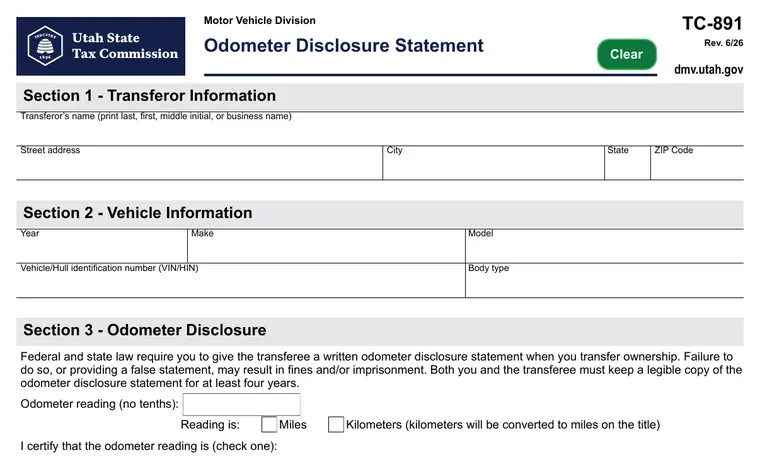
Two documents, and they are not the same thing. Take the blank TC-891 from the files.tax.utah.gov copy so you get the revision that is current today.
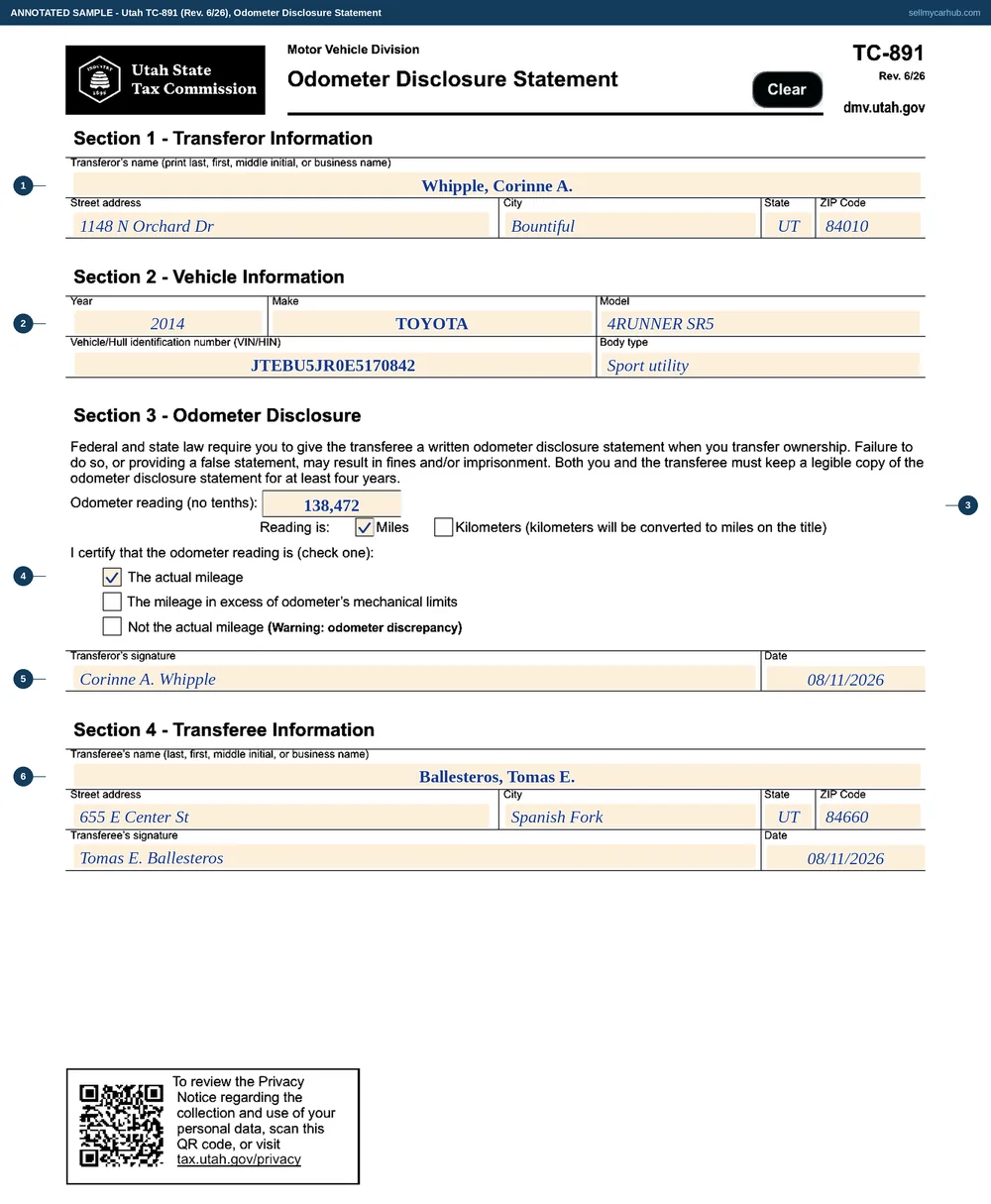
This is the actual TC-891, rendered from the PDF the Utah State Tax Commission, Motor Vehicle Division publishes and completed end to end: letterhead, every field, and the blocks at the foot.
Your printed name and address - the person giving up the vehicle, or the business that owns it.
Watch out: If you are signing as somebody's agent, your name goes here and the authority travels with the packet. The statute puts the duty on the transferor, and an agent signing without authority is a false statement.
Year, make, model, identification number and body type.
Watch out: Body type is the field people leave blank. It is one of the five identifying details the statute requires, and the form asks for it because federal law does.
The mileage in whole numbers, with the miles or kilometers tick beside it.
Watch out: Read it off the dashboard on the day you sign, not off a service record from March. This document is a certification of what the instrument shows now.
One tick: the actual mileage, a reading in excess of the odometer's mechanical limits, or a reading that is not the actual mileage.
Watch out: In excess of mechanical limits means a five-digit instrument that has rolled over, not a car with a lot of miles on it. Choosing it wrongly puts a permanent flag on a vehicle that never earned one.
Your signature and the date of transfer.
Watch out: There is no notary line and no witness line. What makes this document strong is that the transferee signs it in front of you, so do not post it.
The buyer's printed name, address, signature and date.
Watch out: They are acknowledging receipt of your statement, which is a separate legal act from buying the car. If they will not sign it, the disclosure is not complete and neither of you has the copy the four-year rule expects.
| On the form | What to put in it |
|---|---|
| Section 1 - Transferor Information: name (print last, first, middle initial, or business name) | You. The word transferor is used throughout because the duty attaches to whoever is giving up the vehicle, including an executor or an agent. |
| Street address, City, State, ZIP Code | The transferor's address, which the statute lists as part of the required content rather than as a formality. |
| Section 2 - Vehicle Information: Year, Make, Model | Three boxes on one rule. |
| Vehicle/Hull identification number (VIN/HIN), Body type | Body type is on the statutory list of what a disclosure must identify, alongside make, model, year and identification number. |
| Section 3 - Odometer Disclosure: the printed warning | Federal and state law require you to give the transferee a written odometer disclosure statement when you transfer ownership. Failure to do so, or providing a false statement, may result in fines and/or imprisonment. |
| The four-year rule, printed under it | Both you and the transferee must keep a legible copy of the odometer disclosure statement for at least four years. That is longer than most people keep anything about a car they no longer own. |
| Odometer reading (no tenths) | One box. Tenths are excluded by the statute as well as by the form. |
| Reading is: Miles / Kilometers | Two ticks, with a note that kilometers will be converted to miles on the title. |
| I certify that the odometer reading is (check one) | The actual mileage, the mileage in excess of the odometer's mechanical limits, or not the actual mileage with an odometer discrepancy warning. |
| Transferor's signature and Date | One line and one date. No notary block anywhere on the sheet. |
| Section 4 - Transferee Information | The buyer's name and address, then their own signature and date - because acknowledging receipt is their obligation, not a courtesy. |
Every line here was read off TC-891 (Rev 6/26) itself — the PDF is here — and off the Utah State Tax Commission, Motor Vehicle Division pages. This is plain-language help with a form, not legal advice, and where our wording and the agency's differ, theirs governs.
Back to all Utah seller paperwork, or what selling a car in Utah involves.