A verification that the identification number on the paperwork is the identification number on the metal. Utah requires it on every vehicle or vessel being titled here for the first time, which in a private sale means the car you are selling arrived from out of state and has never been through a Utah counter. The form is one page and carries its own trigger in a line above the first section: units registered in Utah for the first time, unless the unit is new and was acquired from an in-state dealer or manufacturer, must be inspected to verify the vehicle or hull identification number.
Written against TC-661 (Rev 12/25), issued under Utah Code 41-1a-511. This form proves what the number is, not who owns the vehicle. It travels with an application and an ownership document; on its own it establishes nothing about title, which is why it also appears in the insufficient-evidence packet alongside a sworn statement of how the vehicle was acquired.
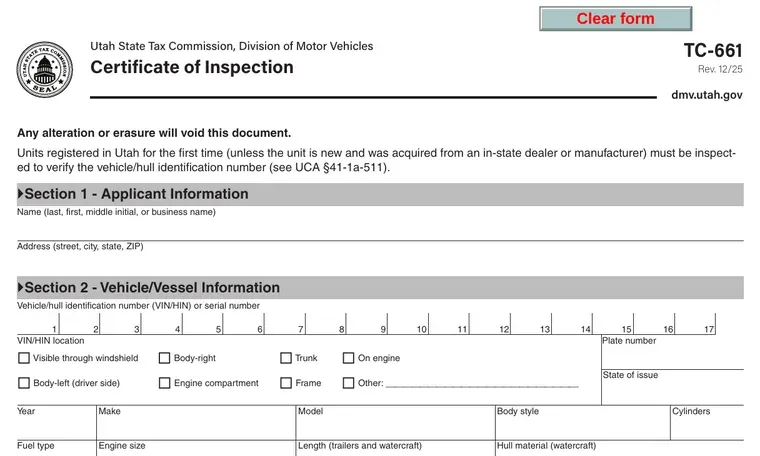
Two documents, and they are not the same thing. Take the blank TC-661 from the files.tax.utah.gov copy so you get the revision that is current today.
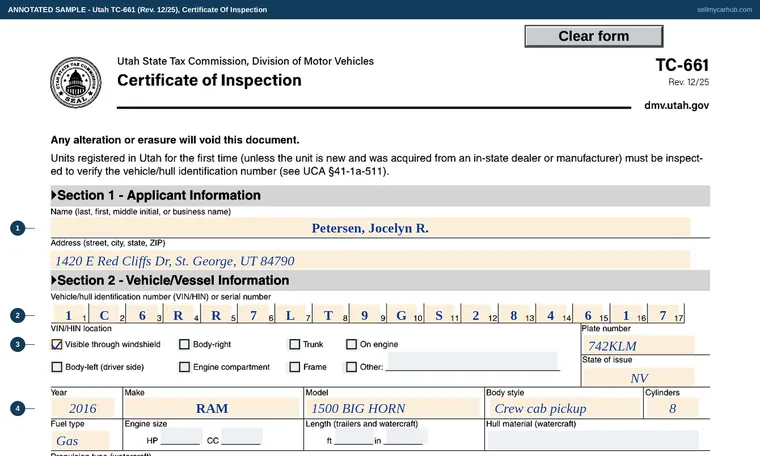
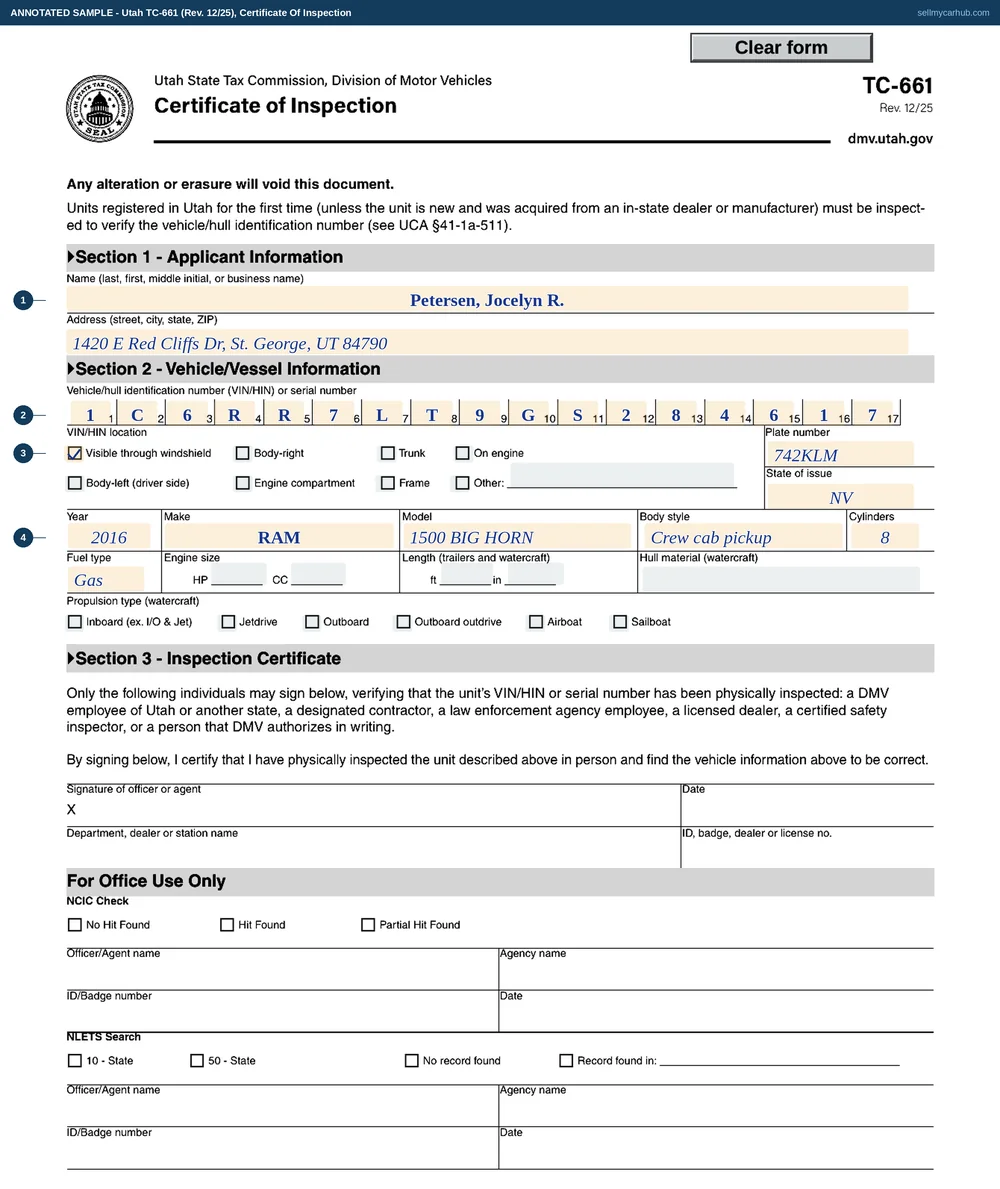
This is the actual TC-661, rendered from the PDF the Utah State Tax Commission, Motor Vehicle Division publishes and completed end to end: letterhead, every field, and the blocks at the foot.
The name and address of the person who will be titling the vehicle.
Watch out: Not the inspector, and not the seller. This is the person whose application the certificate will travel with.
The identification number as read off the vehicle, one character per numbered box.
Watch out: Read off the metal, not off the paperwork - the whole point is to confirm that the two agree. A correction to a character in this comb voids the sheet and needs a fresh one.
One tick recording where the number was read, or the Other line with the place written in.
Watch out: On a modern car it is normally visible through the windshield. On a trailer or a rebuilt vehicle it may only be on the frame, and saying so is part of the record.
Year, make, model, body style, cylinders, fuel type and engine size, as the inspector finds them.
Watch out: If the vehicle in front of the inspector is not the vehicle in the paperwork, this is where it shows up. Do not fill this in beforehand to save them time.
The signature, date, department or station name and the badge, dealer or licence number of whoever inspected it.
Watch out: The list of who may sign is printed above the line. A friend who is good with cars is not on it, and a certificate signed by one is worth nothing at the counter.
| On the form | What to put in it |
|---|---|
| Any alteration or erasure will void this document | Printed at the top, above everything else. It is the only sentence on the sheet in that position and it governs the whole page. |
| Section 1 - Applicant Information | Name and a single address rule. The applicant is the person who will be titling the vehicle, not the inspector. |
| Section 2 - Vehicle/Vessel Information: the identification number comb | Seventeen numbered boxes, one character each, printed 1 to 17. A seventeen-character identification number fills it exactly; an older or imported number does not, and the empty boxes stay empty. |
| VIN/HIN location | Eight tick boxes and a write-in: visible through windshield, body-right, trunk, on engine, body-left (driver side), engine compartment, frame, or Other with a line for it. |
| Plate number and State of issue | Where the vehicle is coming from, on the right-hand side of the same block. |
| Year, Make, Model, Body style, Cylinders, Fuel type, Engine size | The description the inspector is confirming, with horsepower and cubic capacity boxes for a motorcycle. |
| Length and Hull material | For trailers and watercraft. Empty on a car. |
| Propulsion type (watercraft) | Inboard, jetdrive, outboard, outboard outdrive, airboat or sailboat. |
| Section 3 - Inspection Certificate: who may sign | A closed list printed on the form: a DMV employee of Utah or another state, a designated contractor, a law enforcement agency employee, a licensed dealer, a certified safety inspector, or a person that DMV authorizes in writing. |
| Signature of officer or agent, Date | Under a certification that the signer has physically inspected the unit described above in person and finds the vehicle information above to be correct. |
| Department, dealer or station name, and ID, badge, dealer or license no. | The signer's own identifier, which is what makes the certification traceable. |
| For Office Use Only: NCIC Check and NLETS Search | Two bands at the foot for the national crime database check and the multi-state record search. Neither is the applicant's to complete. |
Every line here was read off TC-661 (Rev 12/25) itself — the PDF is here — and off the Utah State Tax Commission, Motor Vehicle Division pages. This is plain-language help with a form, not legal advice, and where our wording and the agency's differ, theirs governs.
Back to all Utah seller paperwork, or what selling a car in Utah involves.