Sell My Car Hub

How to fill out Utah TC-745

A single page that swaps an emissions test for an insurance policy. Utah registers a collectors' vehicle at least thirty years old as a vintage vehicle, and a vintage vehicle of model year 1983 or newer still has to show an emissions certificate in the five testing counties - unless it is covered by an insurance type specific to vehicle collectors. This affidavit is how the owner says so. It matters to a seller because the exemption belongs to the policy, not to the car: it does not travel to a buyer who insures the vehicle on an ordinary motor policy.
Written against TC-745 (Rev 6/26), issued under Utah Code 41-21-1(5) and 41-6a-1642(4). This exemption does not follow the car. A buyer who insures a thirty-year-old pickup on an ordinary policy has to produce an emissions certificate in the five testing counties even though the seller never needed one - so mention it before the handover rather than after.

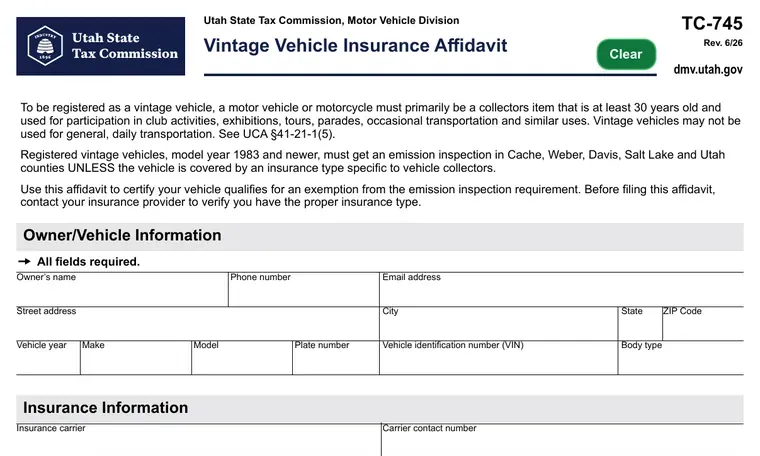
Two documents, and they are not the same thing. Take the blank TC-745 from the files.tax.utah.gov copy so you get the revision that is current today.

Filled in

What a completed one looks like

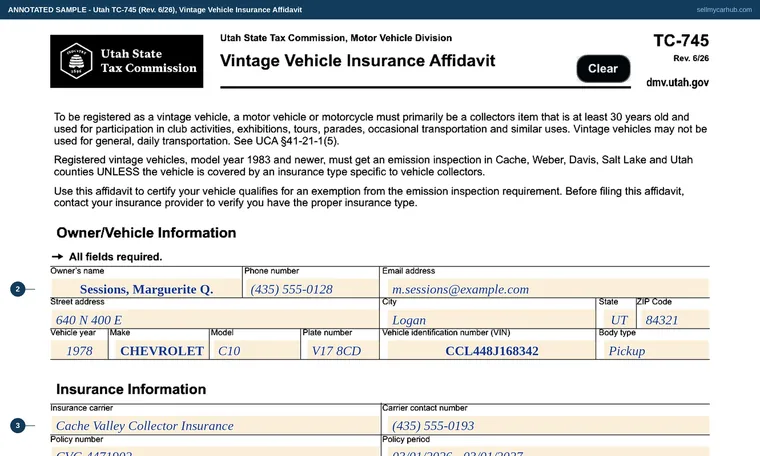
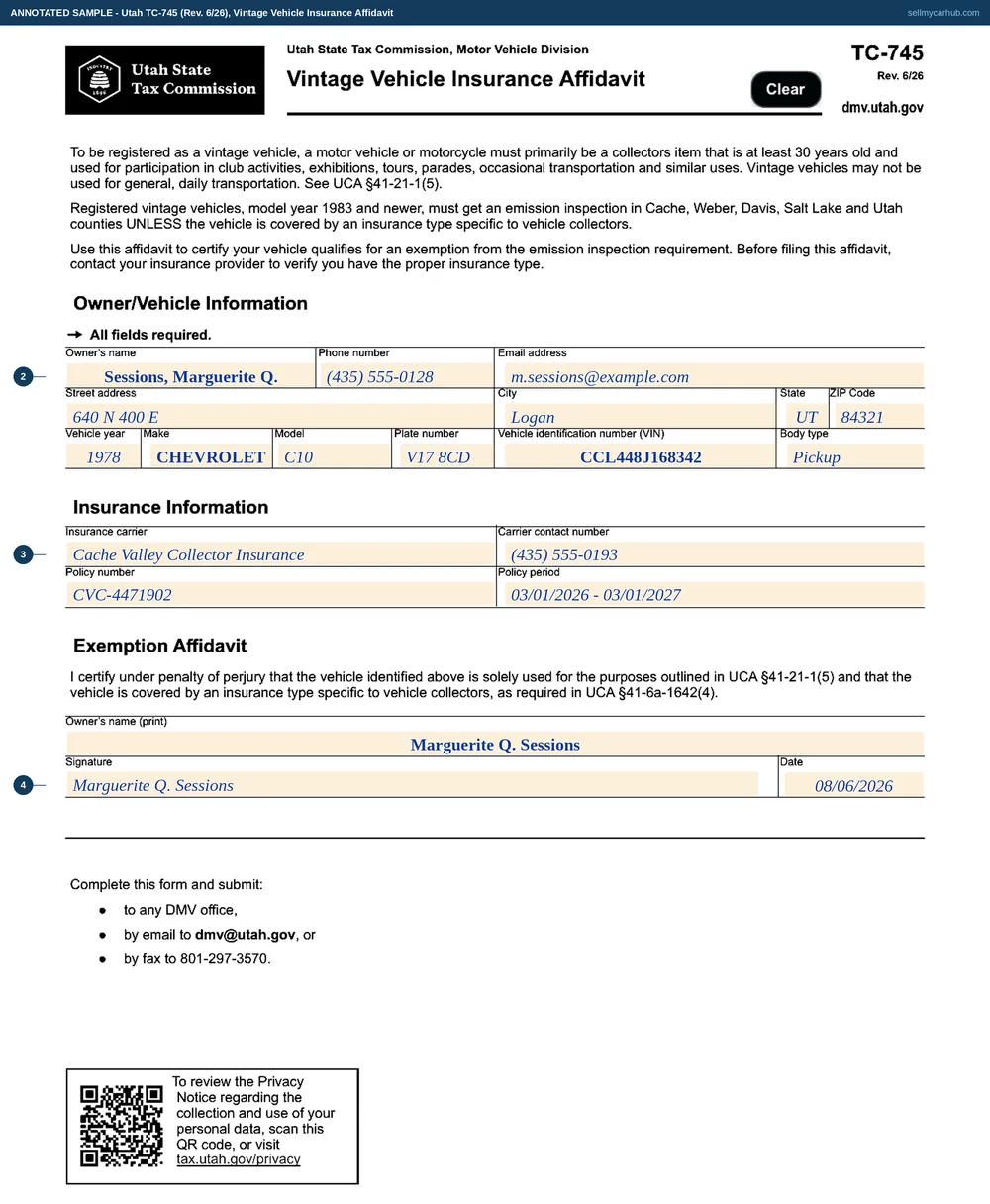
This is the actual TC-745, rendered from the PDF the Utah State Tax Commission, Motor Vehicle Division publishes and completed end to end: letterhead, every field, and the blocks at the foot.

Utah form TC-745 filled in: a 1978 Chevrolet C10 pickup owned by Marguerite Q. Sessions of Logan, plate and identification number recorded, insured on a collector policy with the carrier, policy number and policy period written in, and the exemption affidavit signed and dated.
Every field completed because the form says all fields are required. The policy period is the box that decides how long the certification holds.
Field by field

Every line, in the order you meet it

  1. 1
    You fill this in

    Check the policy before you check the box

    A call to the insurer to confirm that the cover really is a collector-specific type.

    Watch out: The form tells you to do this first, in a sentence of its own. A classic-car discount on a normal policy is not the same thing as a collector policy.

  2. 2
    You fill this in

    Owner and vehicle information

    Name, telephone, email and address, then year, make, model, plate number, identification number and body type.

    Watch out: All fields required is printed as a subheading rather than a suggestion. That includes the telephone number and the email address, which look optional and are not.

  3. 3
    You fill this in

    Insurance Information

    Carrier, carrier contact number, policy number and policy period.

    Watch out: Write the policy period as the insurer states it. It is the field a clerk checks against the registration year the exemption is being claimed for.

  4. 4
    You fill this in

    The exemption affidavit

    A printed name, a signature and a date under the certification made under penalty of perjury.

    Watch out: The certification includes that the vehicle is solely used for club activities, exhibitions, tours, parades and occasional transportation. A vintage plate on a commuter car is a false affidavit, not a loophole.

  5. 5
    You fill this in

    Sending it in

    To any DMV office, by email, or by fax - all three printed at the foot of the sheet.

    Watch out: Keep a copy. The affidavit supports a registration, and the registration is what a buyer will be looking at when they ask why there is no emissions certificate.

At a glance

What goes where

On the formWhat to put in it
The definition, printed above the first boxTo be registered as a vintage vehicle, a motor vehicle or motorcycle must primarily be a collectors item that is at least 30 years old and used for participation in club activities, exhibitions, tours, parades, occasional transportation and similar uses.
The restriction, in the same paragraphVintage vehicles may not be used for general, daily transportation.
The emissions rule it answersRegistered vintage vehicles, model year 1983 and newer, must get an emission inspection in Cache, Weber, Davis, Salt Lake and Utah counties unless the vehicle is covered by an insurance type specific to vehicle collectors.
Owner/Vehicle Information - all fields requiredOwner's name, telephone number and email, then street address, city, state and ZIP. The form says in its own subheading that all fields are required.
Vehicle year, Make, Model, Plate number, Vehicle identification number, Body typeSix boxes across one rule.
Insurance InformationInsurance carrier, carrier contact number, policy number and policy period. The policy period is the field that decides how long the affidavit is worth anything.
Exemption AffidavitA certification under penalty of perjury that the vehicle is solely used for the purposes outlined in Utah Code 41-21-1(5) and that it is covered by an insurance type specific to vehicle collectors.
Owner's name (print), Signature, DatePrinted and signed, with no notary anywhere on the sheet.
Where it goesThree routes printed at the foot: to any DMV office, by email, or by fax.
The instruction before filingBefore filing this affidavit, contact your insurance provider to verify you have the proper insurance type.

What gets this one rejected

Rules that decide whether it is accepted

Every line here was read off TC-745 (Rev 6/26) itself — the PDF is here — and off the Utah State Tax Commission, Motor Vehicle Division pages. This is plain-language help with a form, not legal advice, and where our wording and the agency's differ, theirs governs.

Back to all Utah seller paperwork, or what selling a car in Utah involves.

Want the paperwork handled instead?

Get My Instant Offer → Online · about 2 minutes · free

Or send the details — we'll come to you

Old truck, collector policy, and more paperwork than the truck is worth? We will make you an offer on it as it sits.

or call/text (877) 405-1808