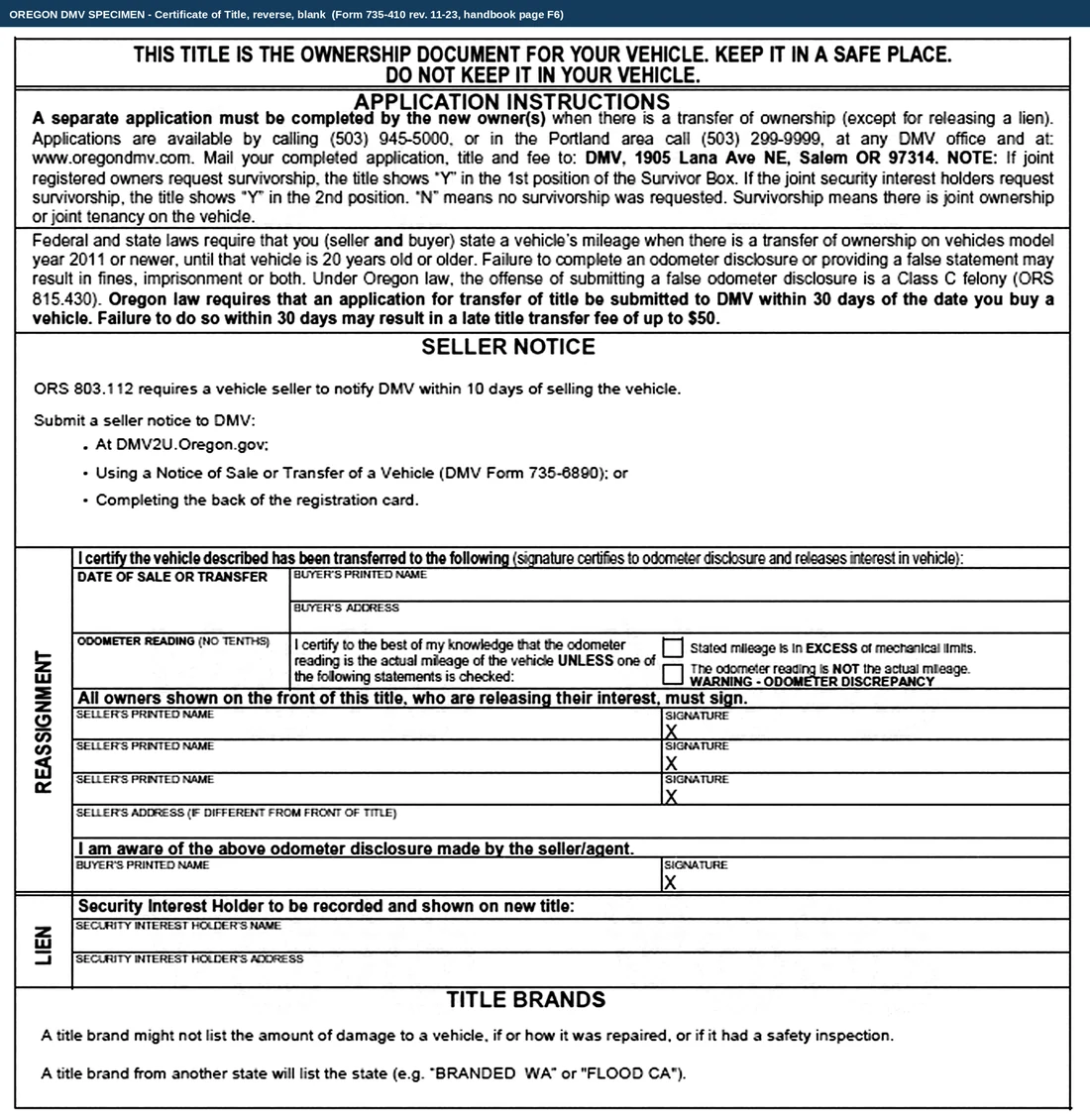
Oregon issues its certificate on one perforated sheet printed both sides, Form 735-410 at revision 11-23. The front was set in Salem the day the title was produced and a private seller writes nothing on it. Everything that moves the car sits in the block on the reverse headed REASSIGNMENT, and every box below is transcribed from Oregon DMV's own specimen of it.
As a private seller you complete these and nothing else:
You cannot download an Oregon title. Yours arrived by post from Salem on security paper, and the only lawful blank one in existence is the specimen DMV prints in its own handbook — which is what is reproduced here. The 735-226 your buyer files is a normal download, and it has its own page.
Both margins carry the same four words set vertically: VOID IF ALTERED OR ERASED.
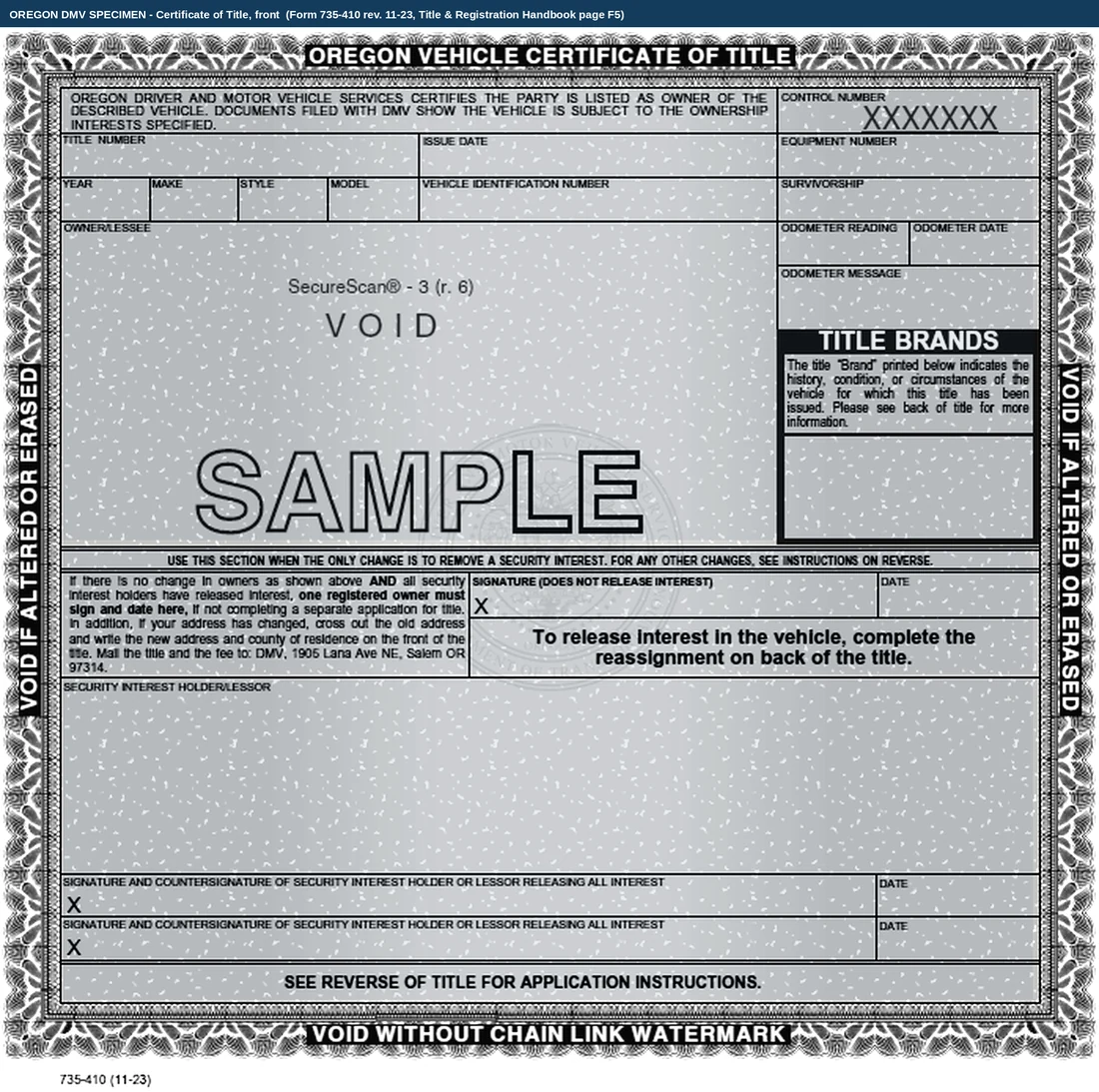
The handbook describes the current certificate exactly: Form 735-410 dated 11-23, “size is 8 ½” X 8 ½”; color is blue and light red with a blue border”, issued on standard 8½ x 11 paper perforated so the top portion comes away.
Not a drawing and not a photograph of somebody's document — this is Oregon DMV's own specimen of Form 735-410, reproduced on page F5 of the Title & Registration Handbook with VOID across the middle, SAMPLE across the lower half and the control number printed as a row of Xs. Every panel on it is greyed here because a private seller writes on none of them.
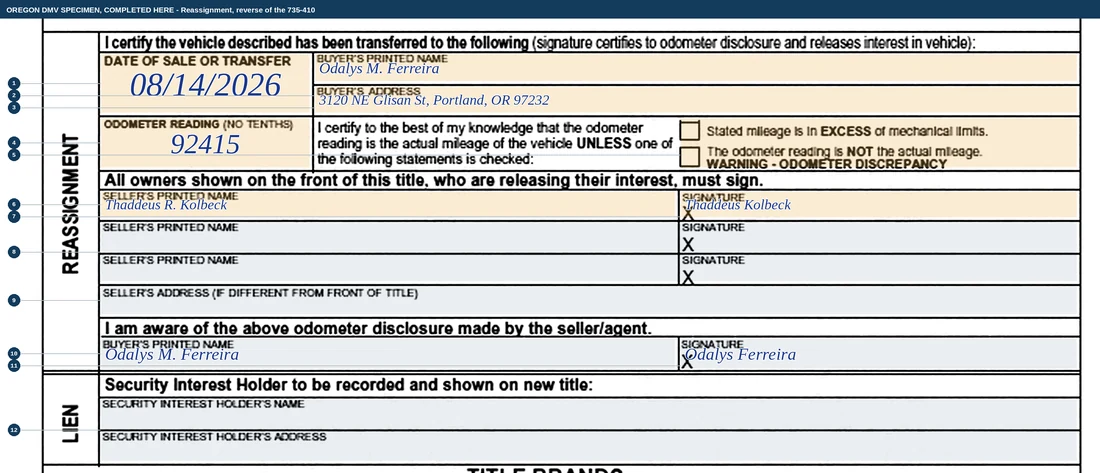
The same specimen, cropped to the block that matters and filled in for a 2017 Subaru Outback sold in Roseburg to a buyer in Portland. Amber is what gets written in pen; grey is a row this particular sale leaves alone — one owner, no second seller, no lender to record. Tap any number to jump to what that box means.
Before you watch. Oregon DMV publishes no video about the seller notice, which is the filing that actually protects you. That is a checked claim rather than an assumption: the channel is youtube.com/@OregonDOT, its videos tab returned 30 titles and eight searches of the channel returned 75 distinct videos between them, including all six of the DMV2U series — logging in, renewing registration, renewing a licence, changing an address, a trip permit, and this one. None covers reporting a vehicle sold.
Published by Oregon DOT on its own channel. It is the buyer's side of your sale — the guided DMV2U application that replaces the paper 735-226 — and it is worth five minutes of a seller's time because it shows exactly what the person buying your car is going to be asked for. Nothing loads from YouTube until you press play.
Top left of the reassignment block, in the tall column beside the buyer's name. The day the car changed hands.
Watch out: This date starts both clocks at once — your ten days to file the seller notice, and the buyer's thirty before a late title transfer fee attaches to their application. Post-dating it to be helpful moves both.
The first line of the buyer's half of the block. Their legal name, printed, not their signature.
Watch out: Copy it off the licence they are showing you, not off the message thread. DMV links every record to a customer number that is keyed to the name it holds, and a shortened first name here is a query letter later.
The line directly underneath. Street, city, state and ZIP of the person taking the car.
Watch out: You need this twice — here, and again on the seller notice, which asks for the buyer's name and address specifically. Get it once, in writing, while they are still standing in front of you.
The shorter left-hand cell under the date. Whole miles as the dash shows them.
Watch out: No tenths is printed in the label and DMV means it. If the display is blank note that the odometer is not readable; if it is stuck, give the reading and note that the mileage is not actual; if it has rolled past its digits, write what it shows and note that it has rolled over. A brand of not readable or not actual can never be taken off the title again.
Two tick boxes: stated mileage is in EXCESS of mechanical limits, and the odometer reading is NOT the actual mileage — WARNING, ODOMETER DISCREPANCY.
Watch out: Both stay empty on an ordinary sale, which is what the sample shows. The certification above them only holds if neither is ticked, and ticking one when it is not true is the Class C felony the reverse of the title warns about.
The first of three identical rows under the heading “All owners shown on the front of this title, who are releasing their interest, must sign.”
Watch out: Print it as the front of the title has it. If the front shows two names and only one is here, the other owner owes DMV a separate release or bill of sale before the transfer can be processed.
The right-hand half of the same row, marked with an X. This is the signature that certifies the odometer disclosure and releases your interest in one stroke, as the block's own heading says.
Watch out: Original wet ink. Hand-printing is fine — the handbook says the signature does not have to be in cursive and an X counts as an owner's mark — but a photocopy is not accepted on any Oregon release except a secure disclosure or a secure power of attorney.
Two more printed-name-and-signature pairs, for a title issued in more than one name.
Watch out: Empty on a one-owner sale and that is correct. Do not let a buyer sign here to save time — these rows are for people releasing interest, and a buyer signing one is exactly the alteration the margin warns voids the certificate.
A full-width line under the three owner rows, completed only where you have moved since the title was issued.
Watch out: If it matches the front, leave it. If you have moved, this is the line DMV reads, and it is separate from the address change you would make on the front of the title when you are keeping the car.
Below a line reading “I am aware of the above odometer disclosure made by the seller/agent.” The buyer's name, printed again.
Watch out: The handbook requires at least one buyer to print and sign here, and it is the half of the disclosure sellers forget to ask for. A reading with nobody acknowledging it is not a completed disclosure.
Beside their printed name, on the X. That is the last mark made on the certificate in a private sale.
Watch out: Get it before they drive off. Chasing a stranger for one signature on a document you have already handed over is the single most common way an Oregon private sale stalls.
The LIEN block at the foot of the reverse: the name and address of whoever is lending the buyer the money.
Watch out: This is the buyer's lender, not yours. Your lender releases on the front of the sheet. If the buyer fills this in, the new title is posted to their lender and the buyer gets only a registration card, which is worth telling them before they start ringing DMV about a missing envelope.
The front carries the title number, the issue date, the vehicle, the owner, an odometer reading from the last transfer, a SURVIVORSHIP box and a red-outlined TITLE BRANDS box.
Watch out: Two things to check rather than write. If the TITLE BRANDS box says anything other than NONE, say so in the advert, because it travels with the car forever. And if the front still shows a security interest holder, the sale cannot go ahead until they have released it on that same face.
Not on the certificate at all. Ten days, at DMV2U.Oregon.gov, on Form 735-6890, or on the back of your registration card.
Watch out: The reverse of your own title prints the deadline under SELLER NOTICE, which is the last place anyone looks. Do it the evening of the sale while the buyer's address is still in front of you.
Six habits worth having before the pen touches the security paper, and the first one is the reason the other five matter.
| Blue or black ink | The bill of sale prints it as a note above the boxes, and every other Oregon form assumes it. Pencil is not a document. |
|---|---|
| Never white out, never strike through | The same note bars both, and the certificate's margins say VOID IF ALTERED OR ERASED on their own account. A wrong name is fixed with Form 735-502, not with a pen. |
| Original signatures, not photocopies | Chapter E requires the original release to accompany a transaction, and allows a carbon copy of exactly two documents — a Secure Odometer Disclosure and a Secure Power of Attorney. |
| Whole miles, no tenths | Printed inside the label on the certificate, on the 735-226 and on the salvage application. A reading with a decimal in it is a discrepancy waiting to be recorded. |
| Your name as DMV holds it | Every Oregon record hangs off a customer number tied to a name. The handbook's instruction is to always use your customer number and the same name with DMV. |
| Read the line above the signature | Most of these forms carry it: knowingly making a false statement on an application for title or registration is a Class A misdemeanour under ORS 803.070 and 803.075. |
The ink rule is Oregon DMV's own: “Use only blue or black ink. Do not white out or strike through any name(s). Must be original sellers’ signature (no photocopies).” — Oregon DMV Title & Registration Handbook, Chapter F: Ownership Documents (revised 07/01/26).
Four things said confidently about selling a car in Oregon that cost sellers money or a second trip. Each correction links the Oregon source it comes from.
“The plates belong to the buyer — leave them on.”
They are yours to leave or to take, and Oregon DMV says so in one line: “You may remove your license plates before selling your vehicle.” Its own Notice of Sale form goes further and recommends removing them, because a plate left on the car is the plate a toll camera or a parking officer photographs. What it costs is the buyer's problem — full registration fees for new plates — so settle it in the price rather than at the kerb.
“An Oregon title transfer costs about thirty dollars.”
It has not for years, and there is no single figure. Oregon sets the title fee by the vehicle's combined MPG rating: $101 at 0 to 19 MPG, $106 at 20 to 39, $116 at 40 or higher, and $192 for an all-electric vehicle. The same chart applies to a duplicate and a replacement, because Oregon has no separate duplicate-title charge at all.
“Filing the sale with DMV takes the car out of my name.”
It does not, and both the department and the statute say so plainly. DMV: “DMV will note on your record that you sold the vehicle, but you will stay listed as the owner until the buyer transfers the title.” ORS 803.112(5): notification “is for informational purposes only and does not constitute an assignment or release of any interest in the vehicle.” File it anyway, inside ten days — it is the dated record of who took the car.
“Oregon has no sales tax, so there is a catch somewhere.”
Not on this. Oregon runs two vehicle taxes and neither reaches a private sale: the privilege tax is charged on dealers for the privilege of selling vehicles in Oregon, and the use tax applies to vehicles bought from dealers outside Oregon. To be taxable at all a vehicle must have been bought from a dealer, have 7,500 miles or less on it, and never have been titled in Oregon.
Oregon Department of Revenue, vehicle privilege and use taxes
Oregon spreads the signatures across both faces of one sheet, so it is worth knowing whose name belongs where:
| Every owner releasing interest | Three printed rows inside the reassignment block, each a printed name and a signature. The handbook's rule is that all owners shown on the front who are giving up their interest must sign — though not all of them have to do it here, because a separate release or bill of sale is accepted from the ones who cannot. |
|---|---|
| The buyer, once | Under the line “I am aware of the above odometer disclosure made by the seller/agent.” The handbook requires at least one buyer to print and sign it, and that signature is what makes the mileage figure a disclosure rather than a note. |
| The security interest holder | On the FRONT, in the block at the foot marked SIGNATURE AND COUNTERSIGNATURE OF SECURITY INTEREST HOLDER OR LESSOR RELEASING ALL INTEREST. There are two of those lines, for two lenders. |
| Nobody in front of a notary | Chapter E requires an original wet signature on a release of interest and says nothing about notarisation. The only Oregon form in this whole set that needs one is the Inheritance Affidavit. |
| A representative signing for an owner | Writes the owner's name, then the word by, then their own — the power of attorney's own worked example is “Sharon Smith by Jane Doe”. |
| A business | Signs in the business name with an authorised representative's signature beside it. The handbook's own illustration: if the vehicle is owned by John Doe DBA Ajax Autos, then John Doe is the owner and the release comes from John Doe. |
Signing is the middle of the job, not the end of it. The clock that belongs to you is the ten-day seller notice; the thirty days you keep hearing about is the buyer's, and it is a different thirty days entirely.
The two things that follow a signed title — what happens to the plates and telling Oregon DMV the car is gone — are set out in full on the Oregon paperwork page rather than repeated here.
The forms that go with it: the seller notice, which is the ten-day one, the application your buyer files and a replacement title, if yours has gone missing.
Every field description here is taken from the Oregon DMV Title & Registration Handbook, Chapter F: Ownership Documents (revised 07/01/26) and the Oregon Department of Transportation, Driver and Motor Vehicle Services Division title pages, current as of 2026-08-23. Plain-language help with a form, not legal advice, and where our wording and the agency's differ, theirs governs.
Back to all Oregon paperwork, or what selling a car in Oregon involves.