Sell My Car Hub

How to fill out Oregon 735-515

Eighteen numbered lines and a set of instructions on the back that are more useful than the form. It replaces a certificate that has been lost, destroyed or mutilated — and there is a large, badly known exception to needing it at all. Oregon has no separate duplicate-title fee, so the replacement costs exactly what a transfer costs, off the same MPG-banded chart.
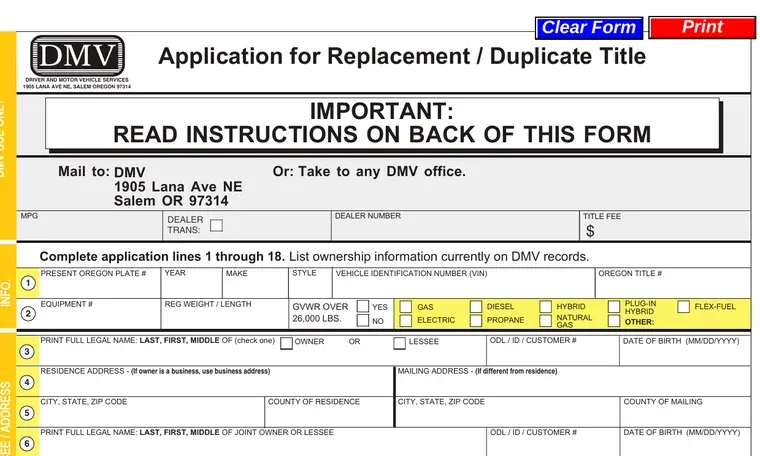
Written against 735-515 (9-23), issued under ORS 803.065 and ORS 803.070. Revised September 2023, which makes it one of the older forms in this set — check the code in the footer against the copy you download. DMV was quoting about a week for Oregon replacement titles when this page was written.

Two documents, and they are not the same thing. Take the blank 735-515 from the oregon.gov copy so you get the revision that is current today.

Filled in

What a completed one looks like

This is all 2 pages of the actual 735-515, rendered from the PDF the Oregon Department of Transportation, Driver and Motor Vehicle Services Division publishes and completed end to end: letterhead, every field, and the blocks at the foot.

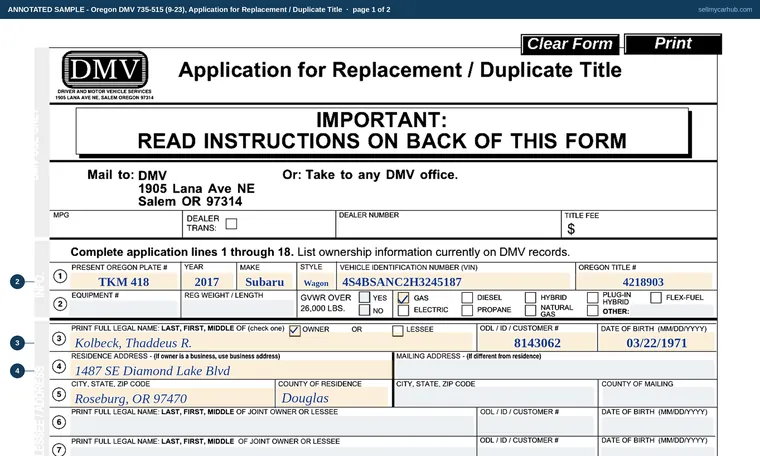
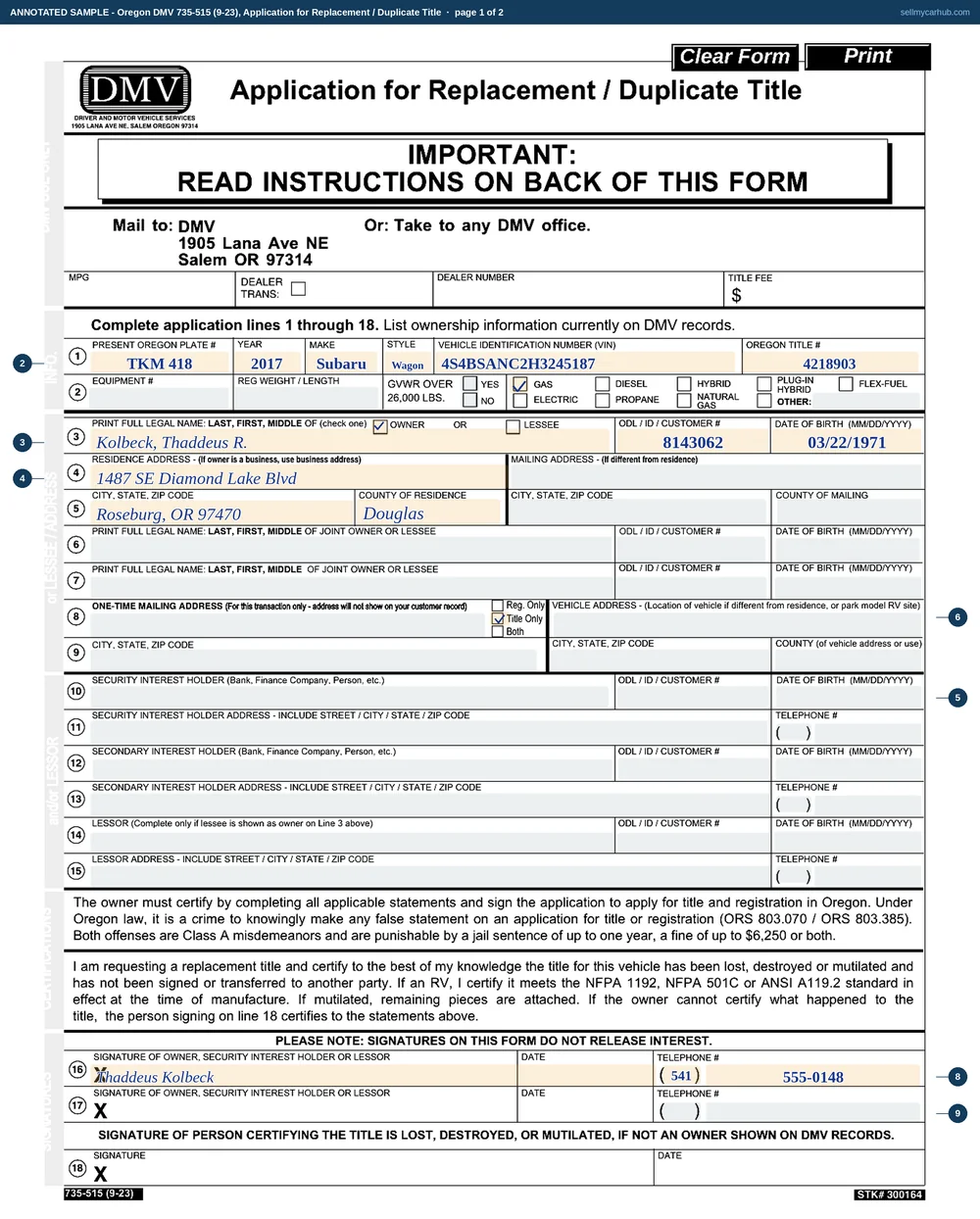
An Oregon Application for Replacement / Duplicate Title filled in: VIN 4S4BSANC2H3245187, title number 4218903, a 2017 Subaru Outback, plate TKM 418, owner Thaddeus R. Kolbeck of Roseburg in Douglas County, Title Only ticked, and the owner's signature on line 16 under the note that signatures on this form do not release interest.
Page 1 of 2. The application itself, completed by the registered owner before the sale. The security interest and lessor lines are greyed because nothing is financed, and the ownership block is filled in to match the last title DMV issued rather than the sale being planned.
An Oregon Application for Replacement / Duplicate Title filled in: VIN 4S4BSANC2H3245187, title number 4218903, a 2017 Subaru Outback, plate TKM 418, owner Thaddeus R. Kolbeck of Roseburg in Douglas County, Title Only ticked, and the owner's signature on line 16 under the note that signatures on this form do not release interest.
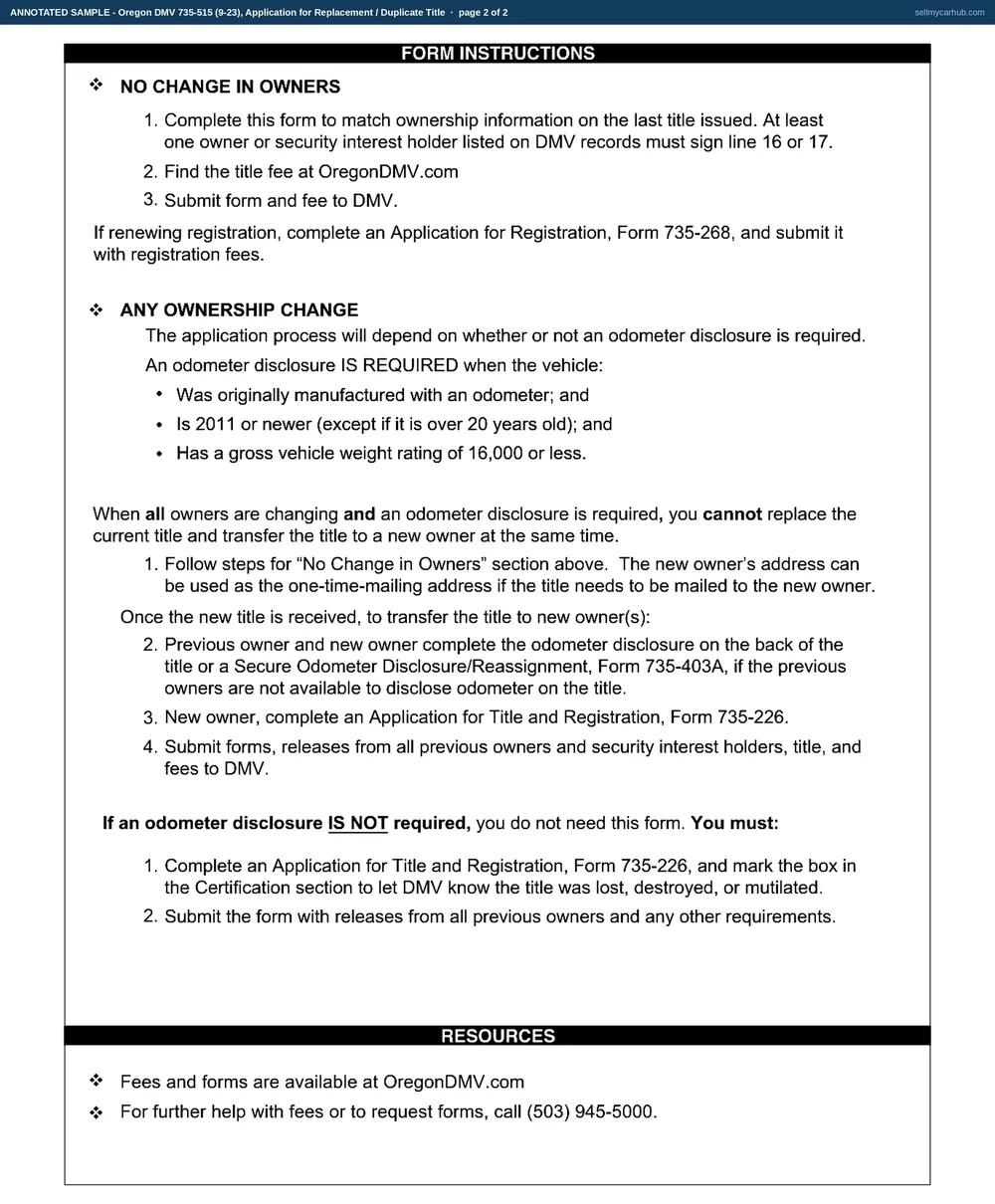
Page 2 of 2. The instructions, and the most useful half of the document: the test for whether an odometer disclosure is required, what to do when it is not, and the order the transfer runs in afterwards.
Field by field

Every line, in the order you meet it

  1. 1
    You fill this in

    Line 1 — VIN and Oregon Title #

    The vehicle identification number and, if you have it, the number of the title you have lost.

    Watch out: The title number is on the registration card as well as on the certificate, which is useful when the certificate is the thing that has gone missing.

  2. 2
    You fill this in

    Line 2 — plate, year, make, style

    The vehicle as DMV holds it.

    Watch out: Copy from the registration card. Guessing at a style that does not match the record is a query letter, and a query letter is another week.

  3. 3
    You fill this in

    Line 3 — owner or lessee, name, customer number, date of birth

    The printed instruction is to list ownership information currently on DMV records.

    Watch out: Not the ownership you are about to create. If you have married, moved or added a partner since the title was issued, this form still shows what DMV shows — the change comes later, on a different application.

  4. 4
    You fill this in

    Lines 4 to 7 — addresses and counties

    Residence, mailing if different, and a county for each.

    Watch out: This is where the replacement title will be posted, unless there is a security interest holder — in which case it goes to them and you get nothing in the post at all.

  5. 5
    You fill this in

    Lines 11 to 14 — security interest holder and lessor

    Any lender or lessor currently recorded.

    Watch out: If a lender holds the original, the replacement goes to them too. That is worth a phone call before you spend the fee.

  6. 6
    You fill this in

    Line 15 — Title Only, Reg. Only or Both

    Three small boxes.

    Watch out: Title Only on a replacement before a sale. Picking Both starts a registration transaction you did not want and adds fees to it.

  7. 7
    You fill this in

    The certification

    That the title has been lost, destroyed or mutilated, and has not been signed or transferred to another party.

    Watch out: That last clause is the one to read twice. A title you have already signed over and then mislaid is not a lost title — it is somebody else's problem now, and certifying otherwise is a Class A misdemeanour.

  8. 8
    You fill this in

    Lines 16 and 17 — signature of owner, security interest holder or lessor

    At least one owner or security interest holder listed on DMV records has to sign one of these two lines.

    Watch out: Above them, in capitals: SIGNATURES ON THIS FORM DO NOT RELEASE INTEREST. Signing here is not signing the car over to anybody.

  9. 9
    Somebody else fills this in

    Line 18 — signature of a person who is not an owner on DMV records

    For somebody certifying what happened to the title when the owner cannot.

    Watch out: The instructions add that if the owner cannot certify what happened to the title, the person signing on line 18 certifies to the statements above. It is the estate and power-of-attorney case.

At a glance

What goes where

On the formWhat to put in it
Lines 1 and 2Vehicle identification number and Oregon title number; then present Oregon plate number, year, make, style, equipment number and a registration weight or length, with a GVWR over 26,000 pounds pair.
Line 3 onwards, ownershipOwner or lessee, printed full legal name last, first, middle, customer number and date of birth — completed to match the ownership information currently on DMV records rather than what you intend it to become.
Lines 4 to 8Residence address, mailing address if different, two city rows each with a county, and two joint owner rows.
Lines 9 and 10A one-time mailing address used for this transaction only, and a vehicle address for a vehicle that lives away from the residence.
Lines 11 to 14Security interest holder, secondary interest holder and lessor, each with a customer number, date of birth, telephone and full address.
Line 15, Title Only, Reg. Only or BothThe three-way tick that says what is being applied for.
The certificationI am requesting a replacement title and certify to the best of my knowledge the title for this vehicle has been lost, destroyed or mutilated and has not been signed or transferred to another party — with an added line that if mutilated, the remaining pieces are attached.
Lines 16 and 17, signaturesSignature of owner, security interest holder or lessor. At least one owner or security interest holder listed on DMV records must sign one of them.
Line 18A signature line for a person certifying the title is lost, destroyed or mutilated who is not an owner shown on DMV records.
The note above the signaturesPrinted in capitals: PLEASE NOTE — SIGNATURES ON THIS FORM DO NOT RELEASE INTEREST.

What gets this one rejected

Rules that decide whether it is accepted

Every line here was read off 735-515 (9-23) itself — the PDF is here — and off the Oregon Department of Transportation, Driver and Motor Vehicle Services Division pages. This is plain-language help with a form, not legal advice, and where our wording and the agency's differ, theirs governs.

Back to all Oregon seller paperwork, or what selling a car in Oregon involves.

Want the paperwork handled instead?

Get My Instant Offer → Online · about 2 minutes · free

Or send the details — we'll come to you

Lost the title and the car has not moved in a year? That is the ordinary case for us, not the difficult one.

or call/text (877) 405-1808