Sell My Car Hub

How to fill out Oregon 735-512

The form for a title that was issued and never arrived, as opposed to one that arrived and got lost. Oregon treats those as different problems with different forms and different fees, and this one has a window either side of it: at least 30 days must have passed since the title was issued, so it is certainly not still in the post, and no more than six months, after which the department wants a replacement application and the replacement fee instead. On a salvage title the front end of the window is 20 days rather than 30.
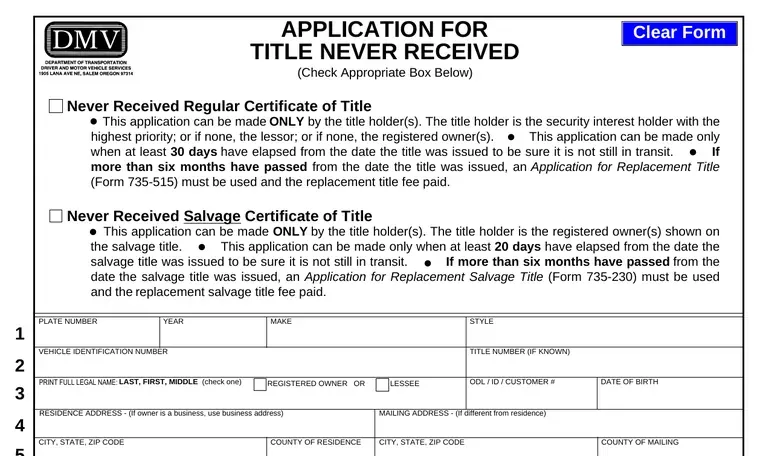
Written against 735-512 (1-25), issued under ORS 803.065. Revised January 2025. Check which of the two windows you are in before filling anything in — the whole form is built around them, and the wrong one means starting again with a different application and a fee.

Two documents, and they are not the same thing. Take the blank 735-512 from the oregon.gov copy so you get the revision that is current today.

Filled in

What a completed one looks like

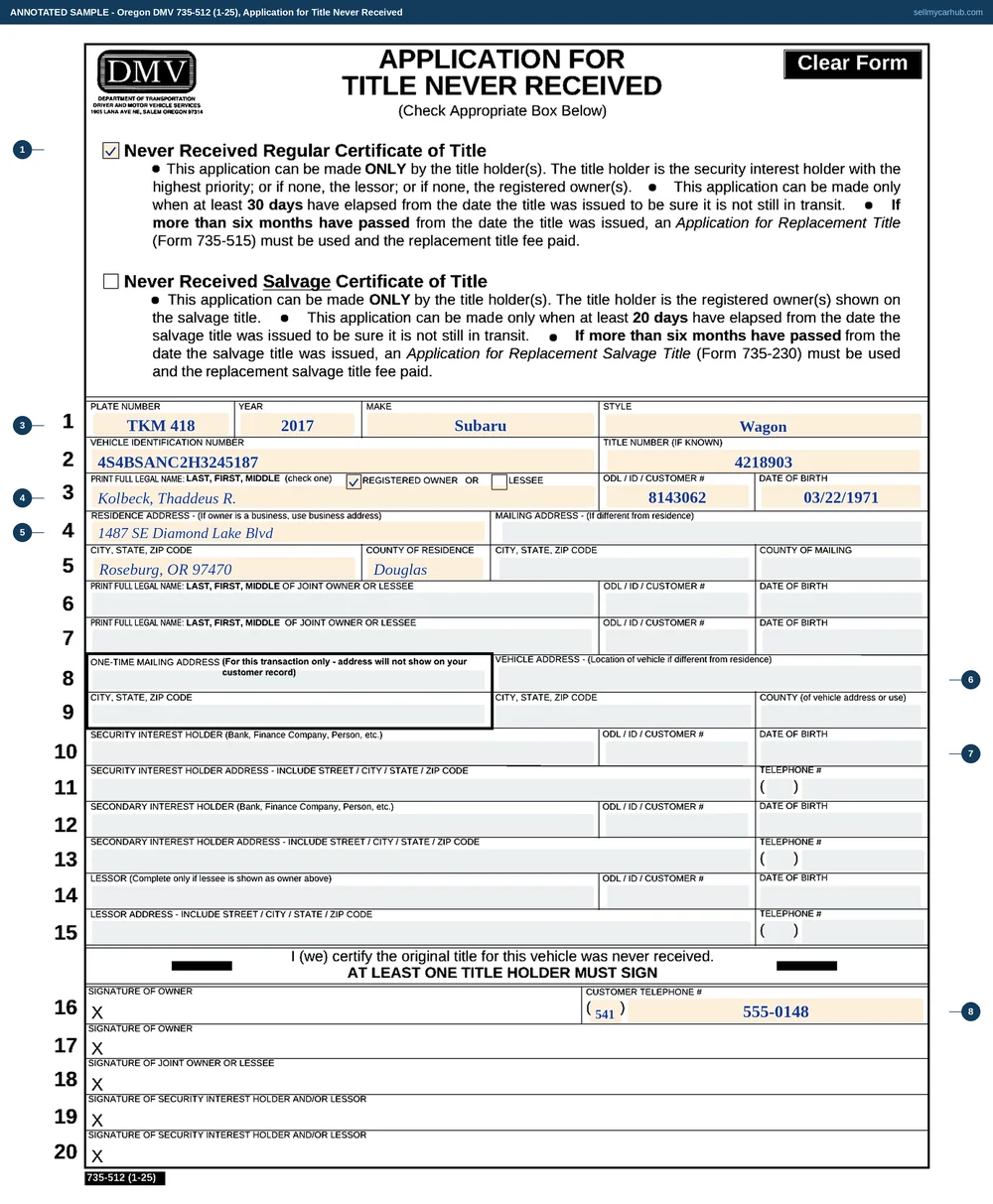
This is the actual 735-512, rendered from the PDF the Oregon Department of Transportation, Driver and Motor Vehicle Services Division publishes and completed end to end: letterhead, every field, and the blocks at the foot.

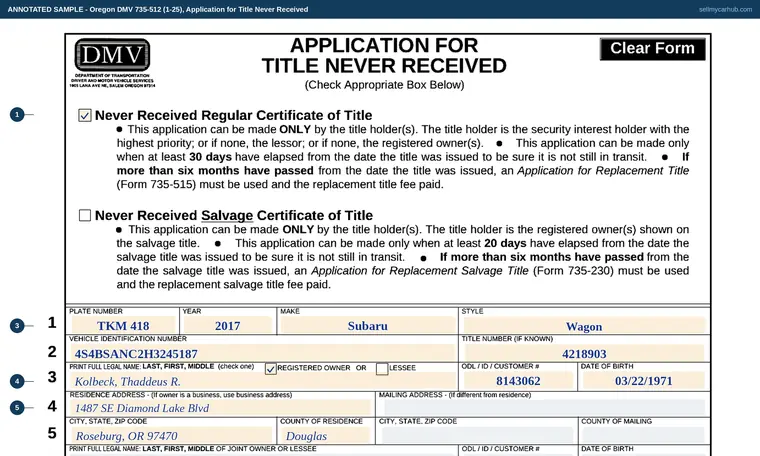
An Oregon Application for Title Never Received filled in: the regular certificate box ticked, plate TKM 418, a 2017 Subaru wagon, VIN 4S4BSANC2H3245187, title number 4218903, registered owner Thaddeus R. Kolbeck of Roseburg in Douglas County with a customer number and date of birth, and the owner's signature under the certification that the original title was never received.
The 735-512 at revision 1-25, filed by the registered owner about seven weeks after DMV issued a title that never arrived — inside the thirty-day floor and well short of the six-month ceiling that would send it to the replacement form instead.
Field by field

Every line, in the order you meet it

  1. 1
    You fill this in

    Never Received Regular Certificate of Title

    The first of two boxes at the head of the form.

    Watch out: Tick one, and read the paragraph beside it. The two boxes carry different waiting periods — thirty days for a regular title, twenty for a salvage one.

  2. 2
    You fill this in

    Never Received Salvage Certificate of Title

    The second box, for a salvage title that was issued and never turned up.

    Watch out: The escape route past six months differs too: a regular title goes to Form 735-515 and a salvage one to Form 735-230.

  3. 3
    You fill this in

    Plate number, year, make, style, VIN, title number

    The vehicle block across the top of the sheet, with the title number marked if known.

    Watch out: If known is doing real work here. A title you never received is a title whose number you may never have seen, and DMV can find it from the VIN.

  4. 4
    You fill this in

    Lines 1 to 3 — registered owner or lessee

    Printed full legal name last, first, middle, with the customer number and date of birth.

    Watch out: Match DMV's record exactly. The department is being asked to reissue a document it has already issued once, and it will check the name it issued it to.

  5. 5
    You fill this in

    Lines 4 to 8 — addresses and counties

    Residence address, city, state, ZIP, county of residence, mailing address and county of mailing.

    Watch out: If the title never arrived because the address on the record was wrong, this is the moment to fix it — otherwise the replacement goes to the same place.

  6. 6
    You fill this in

    Lines 13 to 15 — vehicle address and one-time mailing address

    Where the vehicle lives if that is not the residence, and a mailing address used for this transaction only.

    Watch out: The one-time address does not change your customer record. It is the right box for a title you want sent somewhere unusual just this once.

  7. 7
    You fill this in

    Lines 16 to 19 — security interest holder and lessor

    Any lender or lessor on the record, with customer numbers, dates of birth, addresses and telephones.

    Watch out: If one of these is filled in, they are the title holder and the application is theirs. You can complete the form; they have to sign it.

  8. 8
    You fill this in

    Line 20 — the certification and signature block

    I (we) certify the original title for this vehicle was never received, with four signature lines under it.

    Watch out: At least one title holder must sign — the instruction is printed in capitals directly above the lines. A form arriving with every box filled in and no signature is the most common way this one comes back.

At a glance

What goes where

On the formWhat to put in it
The two boxes at the topNever Received Regular Certificate of Title, or Never Received Salvage Certificate of Title.
Vehicle blockPlate number, year, make, style, vehicle identification number and title number if known.
Lines 1 to 8, the registered ownerPrinted full legal name last, first, middle, customer number, date of birth, residence address — business address if the owner is a business — city, state, ZIP, county of residence, mailing address, county of mailing and a customer telephone number.
Lines 9 to 12Two joint owner or lessee rows with customer numbers and dates of birth.
Lines 13 to 15A vehicle address with its own county, and a one-time mailing address used for this transaction only.
Lines 16 to 19Security interest holder, secondary interest holder and lessor, each with a customer number, date of birth, address and telephone.
Line 20, the certificationI (we) certify the original title for this vehicle was never received — with the printed instruction that at least one title holder must sign.
The signature blockSignature of owner, signature of joint owner or lessee, and signature of security interest holder and/or lessor, each on its own X.
The eligibility notesPrinted at the top: the application can only be made by the title holder, who is the security interest holder at highest priority, or the lessor, or the registered owners.

What gets this one rejected

Rules that decide whether it is accepted

Every line here was read off 735-512 (1-25) itself — the PDF is here — and off the Oregon Department of Transportation, Driver and Motor Vehicle Services Division pages. This is plain-language help with a form, not legal advice, and where our wording and the agency's differ, theirs governs.

Back to all Oregon seller paperwork, or what selling a car in Oregon involves.

Want the paperwork handled instead?

Get My Instant Offer → Online · about 2 minutes · free

Or send the details — we'll come to you

Waiting on a title that never came, on a car you have already stopped driving? Tell us about it.

or call/text (877) 405-1808