Sell My Car Hub

How to fill out Oregon 735-11

Two pages, a hundred-odd boxes, and an inspector's signature that a seller cannot supply for themselves. Oregon charges $9 for it and it becomes the buyer's problem in four situations, three of which a seller can see coming: the ownership document is from another state or another country, the vehicle is being titled as totalled or as assembled, reconstructed or replica, or DMV has reason to believe it was never certified as meeting federal vehicle standards. If you are selling a car you brought to Oregon and never retitled, this is the form standing between your buyer and a plate.
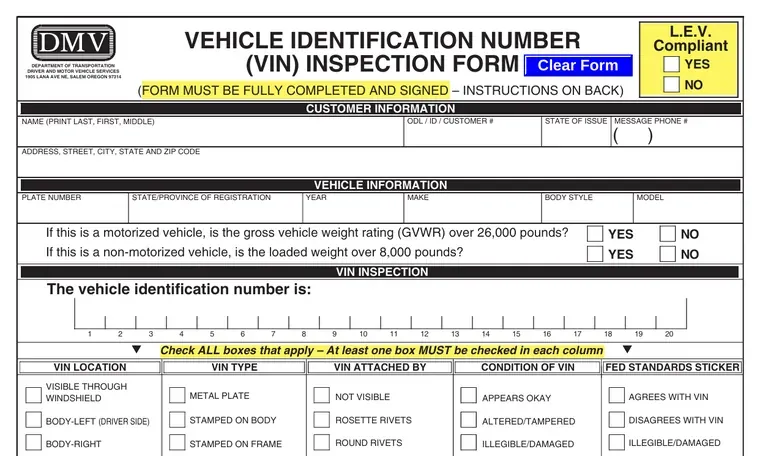
Written against 735-11 (1-26), issued under ORS 803.045 and OAR 735-020. Revised January 2026. The inspection costs $9 and can be done during a title appointment at DMV, which is usually the cheapest way to fit it into a sale rather than making it a separate errand.

Two documents, and they are not the same thing. Take the blank 735-11 from the oregon.gov copy so you get the revision that is current today.

Filled in

What a completed one looks like

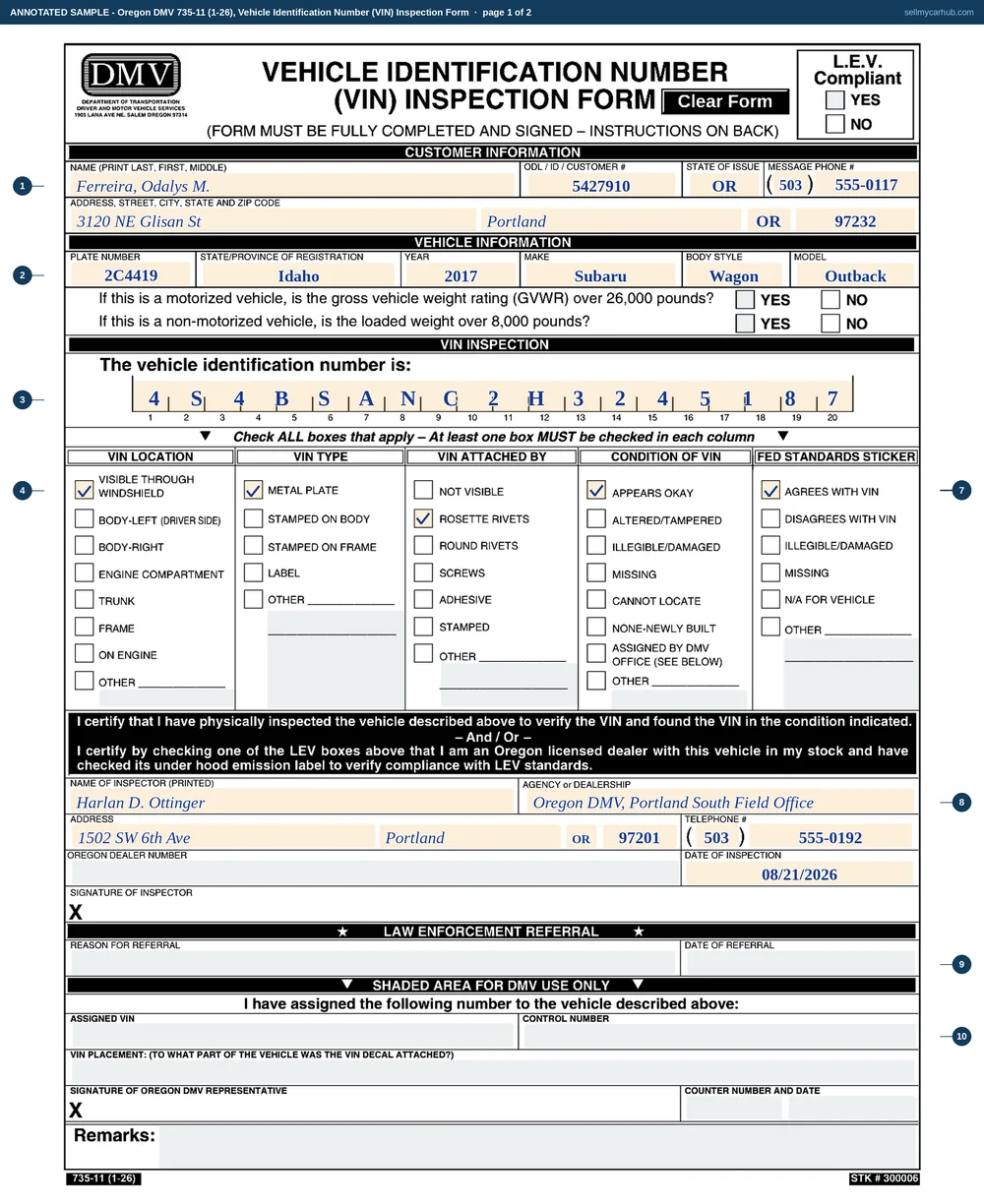
This is all 2 pages of the actual 735-11, rendered from the PDF the Oregon Department of Transportation, Driver and Motor Vehicle Services Division publishes and completed end to end: letterhead, every field, and the blocks at the foot.

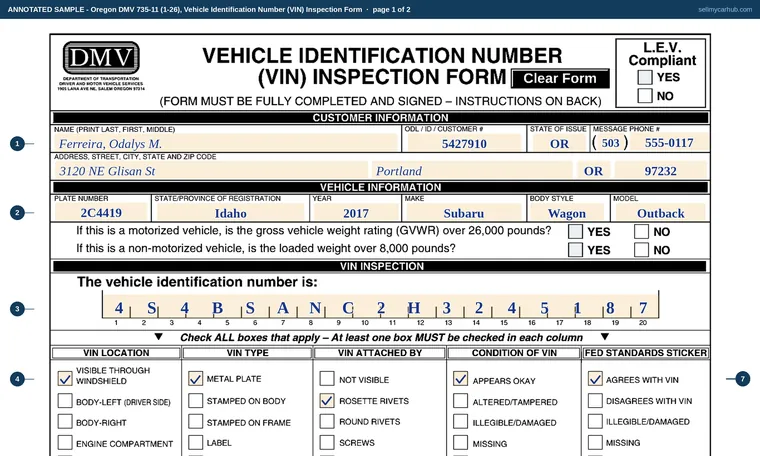
An Oregon VIN Inspection Form filled in: customer Odalys M. Ferreira of Portland, a 2017 Subaru Outback previously plated in Idaho, the VIN 4S4BSANC2H3245187 written one character per cell across the twenty-box comb, visible through windshield ticked under VIN LOCATION, metal plate under VIN TYPE, rosette rivets under VIN ATTACHED BY, appears okay under CONDITION OF VIN, and an inspector's name, agency and date at the foot.
Page 1 of 2. Customer, vehicle, the twenty-cell VIN comb and the four condition columns. Everything below the inspector's signature line is greyed — the law enforcement referral block and the DMV-use block belong to other people entirely.
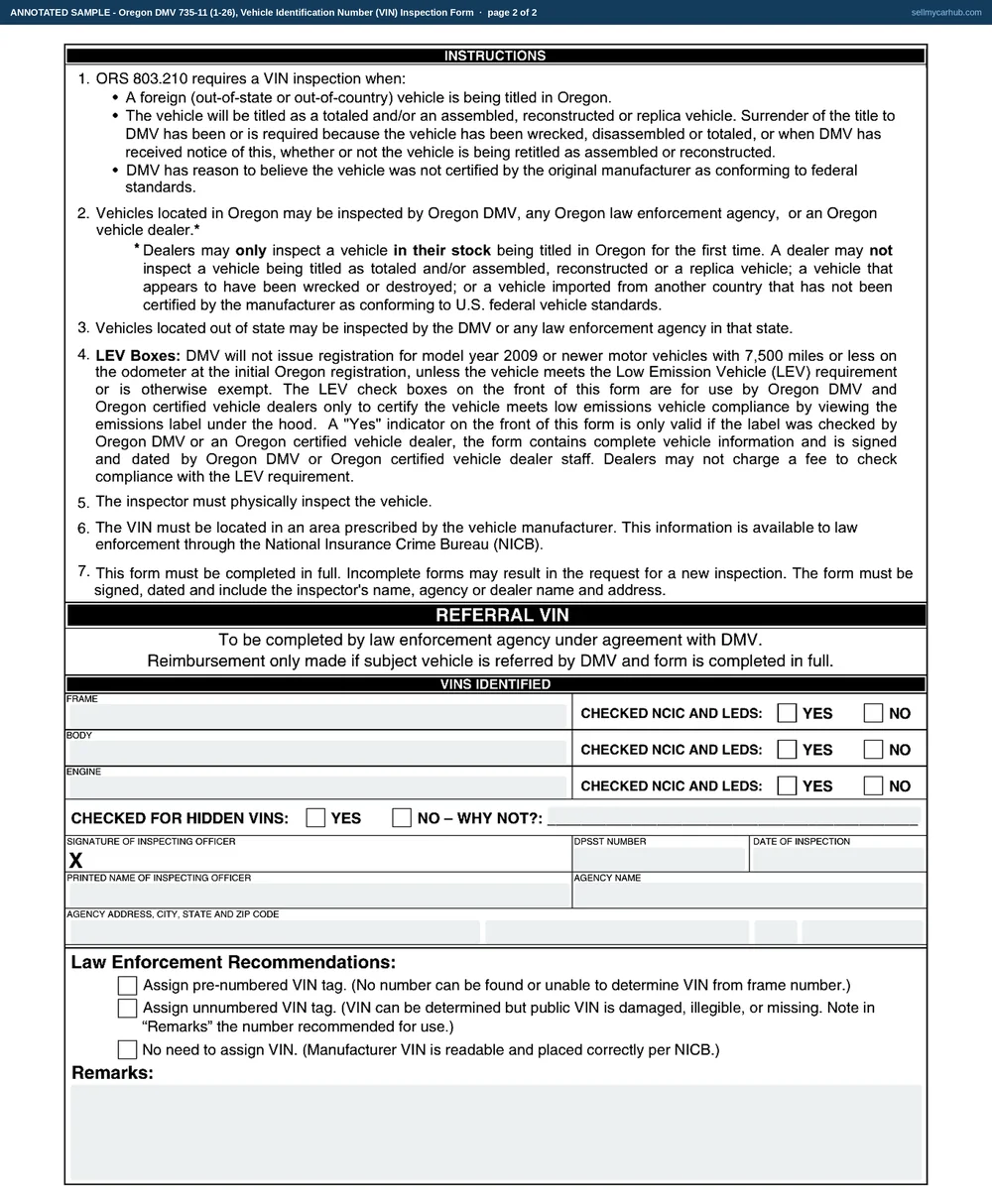
An Oregon VIN Inspection Form filled in: customer Odalys M. Ferreira of Portland, a 2017 Subaru Outback previously plated in Idaho, the VIN 4S4BSANC2H3245187 written one character per cell across the twenty-box comb, visible through windshield ticked under VIN LOCATION, metal plate under VIN TYPE, rosette rivets under VIN ATTACHED BY, appears okay under CONDITION OF VIN, and an inspector's name, agency and date at the foot.
Page 2 of 2. The instructions side, which is where the four triggers for an inspection are set out and where the limits on who may inspect what are spelled out.
Field by field

Every line, in the order you meet it

  1. 1
    The buyer fills this in

    CUSTOMER INFORMATION

    Printed name last, first, middle, the customer number with its state of issue, a message phone and a full address.

    Watch out: State of issue matters here in a way it does not elsewhere on Oregon paperwork — the whole reason this form exists is usually that the vehicle and its owner have just arrived from somewhere else.

  2. 2
    The buyer fills this in

    VEHICLE INFORMATION

    Plate number, state or province of registration, year, make, body style and model.

    Watch out: Province is on the form because Oregon sees Canadian ownership documents. If the vehicle came from outside the United States it needs proof of federal standards compliance as well as this inspection.

  3. 3
    The vehicle verifier fills this in

    The vehicle identification number is

    A comb of twenty numbered cells. One character per box, read off the vehicle rather than off the paperwork.

    Watch out: The point of the exercise is to find out whether the metal agrees with the document. An inspector who copies the number off the title has not done the inspection.

  4. 4
    The vehicle verifier fills this in

    VIN LOCATION

    Visible through windshield, body-left, body-right, engine compartment, frame, trunk, or other.

    Watch out: At least one box in this column, and in each of the three beside it. The instruction is printed above them in capitals.

  5. 5
    The vehicle verifier fills this in

    VIN TYPE and VIN ATTACHED BY

    Metal plate, stamped on body, stamped on frame, adhesive label; then rosette rivets, round rivets, screws, stamped, or not visible.

    Watch out: Rosette rivets are the factory fitting on most modern cars. Screws holding a VIN plate on is the observation that starts a law enforcement referral.

  6. 6
    The vehicle verifier fills this in

    CONDITION OF VIN

    Altered or tampered, appears okay, assigned by DMV, cannot locate, illegible or damaged, missing, or none — newly built.

    Watch out: None — newly built is the box for an assembled vehicle that has never had a number. That is where a DMV-assigned VIN comes from, and why the OR prefix box appears on so many other Oregon forms.

  7. 7
    The vehicle verifier fills this in

    FED STANDARDS STICKER

    Whether the federal certification label agrees with the VIN, disagrees with it, is illegible, missing, or not applicable.

    Watch out: A sticker that disagrees with the VIN is the single most serious thing this form can record, and it is why the referral block exists underneath.

  8. 8
    The vehicle verifier fills this in

    The inspector block

    Printed name, agency or dealership, address, telephone, Oregon dealer number where there is one, date of inspection and signature.

    Watch out: The form must be signed, dated and include the inspector's name, agency or dealer name and address. Any of those missing and the inspection has to be done again.

  9. 9
    Somebody else fills this in

    LAW ENFORCEMENT REFERRAL

    A whole block for an officer: reason for referral, the VINs found on frame, body and engine, whether NCIC and LEDS were checked, and a recommendation on assigning a number.

    Watch out: Completed by a law enforcement agency under agreement with DMV. Reimbursement is only made if the subject vehicle is referred by DMV and the form is completed in full.

  10. 10
    Somebody else fills this in

    SHADED AREA FOR DMV USE ONLY

    The assigned VIN, where the decal was attached, a control number, and a DMV representative's signature.

    Watch out: Nobody outside DMV writes here. If a vehicle leaves with a DMV-assigned number, this is the block that records it and the number will start with OR.

At a glance

What goes where

On the formWhat to put in it
Customer informationName printed last, first, middle, the ODL, ID or customer number with its state of issue, a message phone, and a full address.
Vehicle informationPlate number, state or province of registration, year, make, body style and model, plus two gross-weight questions — over 26,000 pounds for a motorised vehicle, over 8,000 pounds loaded for a non-motorised one.
The vehicle identification number isA twenty-cell comb, numbered 1 to 20, for the VIN as it is physically found on the vehicle.
VIN LOCATIONWhere the number was found: visible through windshield, body-left, body-right, engine compartment, frame, trunk, or other.
VIN TYPEMetal plate, stamped on body, stamped on frame, adhesive label, or other.
VIN ATTACHED BYRosette rivets, round rivets, screws, stamped, not visible, or other.
CONDITION OF VINAltered or tampered, appears okay, assigned by DMV, cannot locate, illegible or damaged, missing, none — newly built, or other.
FED STANDARDS STICKERAgrees with VIN, disagrees with VIN, illegible or damaged, missing, or not applicable for this vehicle.
L.E.V. CompliantA yes-or-no pair at the top right, for an Oregon licensed dealer certifying low emission vehicle compliance from the label under the hood.
Inspector blockPrinted name, agency or dealership, address, telephone, Oregon dealer number, date of inspection and signature.
Law enforcement referralA separate block for an officer working under agreement with DMV: reason for referral, VINs identified on frame, body and engine, whether NCIC and LEDS were checked, whether hidden VINs were checked, and a recommendation on assigning a number.
Shaded area for DMV use onlyThe assigned VIN, where the decal was attached, a control number, and the signature of an Oregon DMV representative.

What gets this one rejected

Rules that decide whether it is accepted

Every line here was read off 735-11 (1-26) itself — the PDF is here — and off the Oregon Department of Transportation, Driver and Motor Vehicle Services Division pages. This is plain-language help with a form, not legal advice, and where our wording and the agency's differ, theirs governs.

Back to all Oregon seller paperwork, or what selling a car in Oregon involves.

Want the paperwork handled instead?

Get My Instant Offer → Online · about 2 minutes · free

Or send the details — we'll come to you

An out-of-state title, a VIN nobody can read, or a car that has not been registered here in years — none of it stops us buying.

or call/text (877) 405-1808