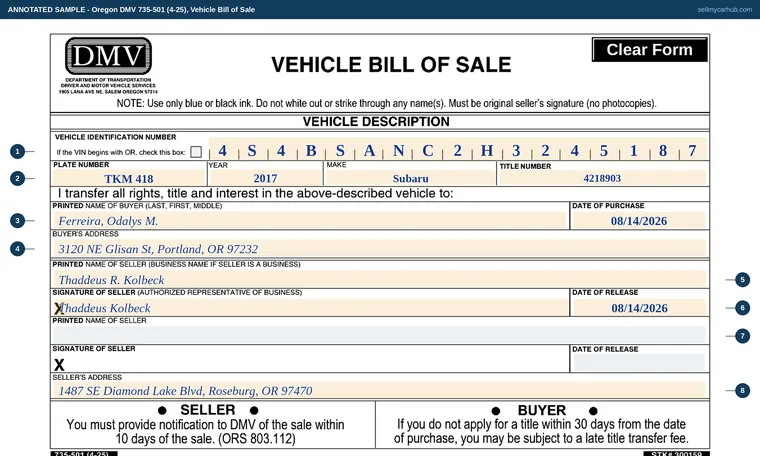
One page, fifteen boxes, and the only Oregon document in this whole set that a seller can complete on their own doorstep without the certificate in front of them. It is a release of interest, not a receipt: DMV accepts it in place of a signature on the title where the person releasing cannot sign the title itself, and it is what a buyer is told to ask for when the name on the certificate is not the name of the person selling the car. It is also the form that prints the ten-day rule where a seller will actually see it.
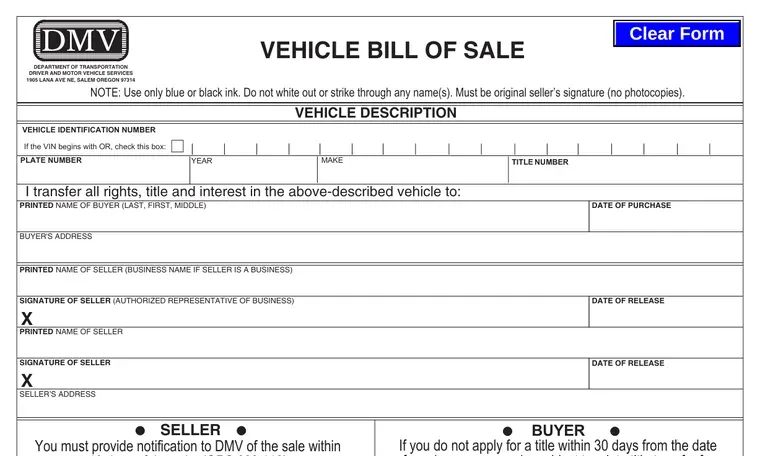
Written against 735-501 (4-25), issued under ORS 803.112 and the release-of-interest requirements in DMV Title & Registration Handbook Chapter E. Revised April 2025. The ten-day and thirty-day notes printed down the right-hand side are part of the form, not commentary added here — check they are still on the copy you download.
Two documents, and they are not the same thing. Take the blank 735-501 from the oregon.gov copy so you get the revision that is current today.
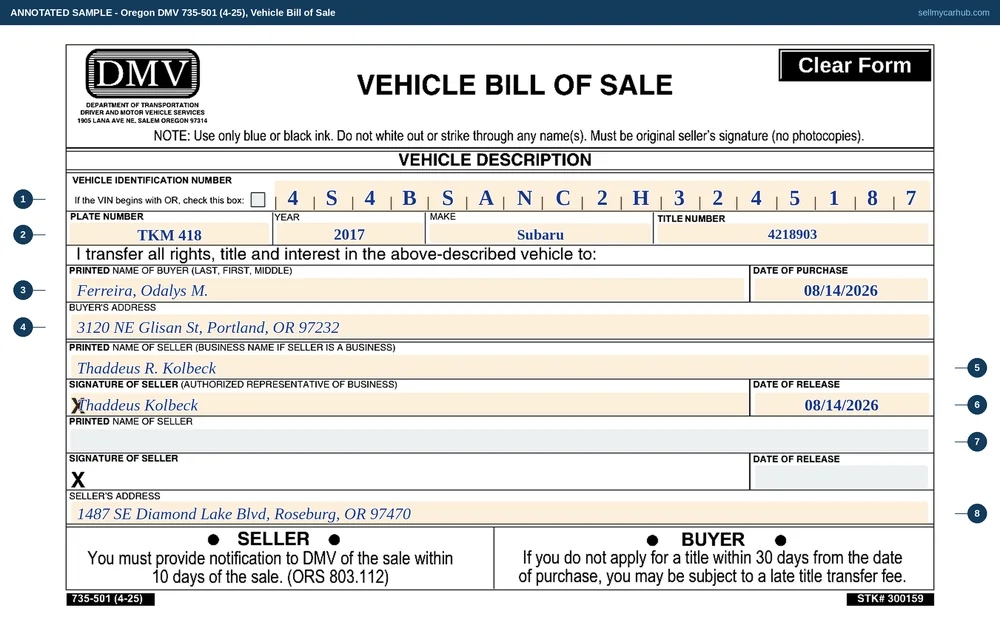
This is the actual 735-501, rendered from the PDF the Oregon Department of Transportation, Driver and Motor Vehicle Services Division publishes and completed end to end: letterhead, every field, and the blocks at the foot.
The full-width box across the top of the form, with a tick box beside it for a VIN that begins with the letters OR.
Watch out: The OR box is for a DMV-assigned identification number — the kind issued to an assembled or reconstructed vehicle after an inspection. If your VIN came from a factory, leave it alone.
Four boxes on the second row, describing the vehicle as the certificate describes it.
Watch out: Any one of plate, VIN or title number is enough for DMV to identify the vehicle, but a bill of sale carrying all four is a bill of sale nobody has to ring you about.
The buyer's printed name, last, first, middle, and the date of purchase beside it.
Watch out: That opening sentence is the part that makes this a release rather than a receipt. Cross it out or reword it and DMV is holding a document it cannot use.
A full-width line under the buyer's name.
Watch out: Take it off the licence they are showing you. You need the same address again within ten days, on the seller notice, and reconstructing it from memory is where sellers guess.
The first seller row. A printed name — or a business name, where the seller is a business — and the date interest is released.
Watch out: Print it as the title has it. A release from a business needs the business name and an authorised representative's signature both, which is why the row's label names them separately.
The signature line inside the first seller row.
Watch out: Original ink, blue or black, and no photocopies — the note at the top of the form says exactly that. Hand-printing is acceptable; the handbook does not require cursive.
A second printed name, date of release and signature, for a certificate issued in two names.
Watch out: Left blank on a one-owner sale. If the front of the title shows two owners and only one signs anywhere, the transfer stops until the other releases — here or on their own document.
The last line on the form.
Watch out: Give the address DMV has for you if you can. The department matches people by customer number and name, and an address it has never seen is one more thing for a clerk to reconcile.
| On the form | What to put in it |
|---|---|
| Vehicle description | Vehicle identification number across the top, with a tick box beside it for a VIN that begins with the letters OR, then plate number, year, make and title number on the row below. |
| I transfer all rights, title and interest in the above described vehicle to | The printed name of the buyer, last, first, middle, and the date of purchase. |
| Buyer's address | A single full-width line under the buyer's name. |
| Printed name of seller | Two seller rows, each taking a printed name and a date of release. The first row's label adds: business name if seller is a business. |
| Signature of seller | A signature line inside each seller row, the first of them labelled authorized representative of business. |
| Seller's address | The last line on the sheet, below both signature rows. |
| The note above the boxes | Printed instructions rather than a field: use only blue or black ink, do not white out or strike through any name, and it must be an original seller's signature with no photocopies. |
| The two side notes | One says you must provide notification to DMV of the sale within 10 days of the sale, citing ORS 803.112. The other says that if the buyer does not apply for a title within 30 days from the date of purchase, they may be subject to a late title transfer fee. |
Every line here was read off 735-501 (4-25) itself — the PDF is here — and off the Oregon Department of Transportation, Driver and Motor Vehicle Services Division pages. This is plain-language help with a form, not legal advice, and where our wording and the agency's differ, theirs governs.
Back to all Oregon seller paperwork, or what selling a car in Oregon involves.