The one form on this whole site that exists purely for the person selling the car. It tells DMV the vehicle has gone, names who took it, and puts a dated line on your record saying so. Oregon gives you ten days from the transfer to file it, and the form spends its first four bullet points explaining what it is not: it is not a bill of sale, it does not change ownership on DMV records, and the owner shown on the record will not change until the buyer is issued a title.
Written against 735-6890 (5-26), issued under ORS 803.112. Revised May 2026. If you file on DMV2U instead you are filing the same notice — the online service is the department's preferred route and it timestamps itself, which the posted form does not.
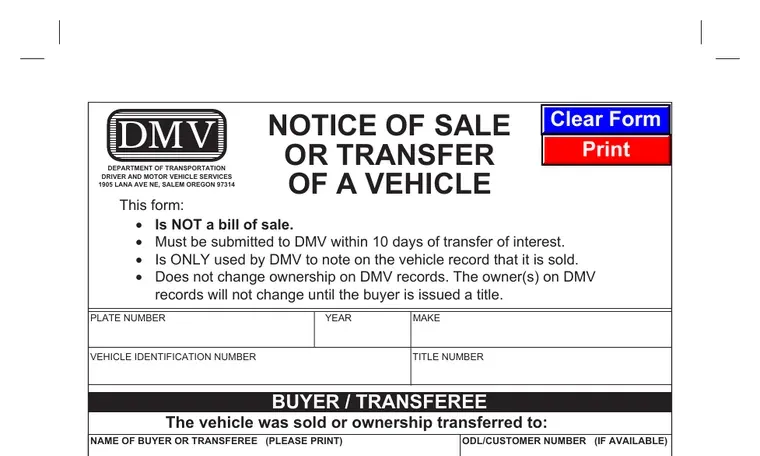
Two documents, and they are not the same thing. Take the blank 735-6890 from the oregon.gov copy so you get the revision that is current today.
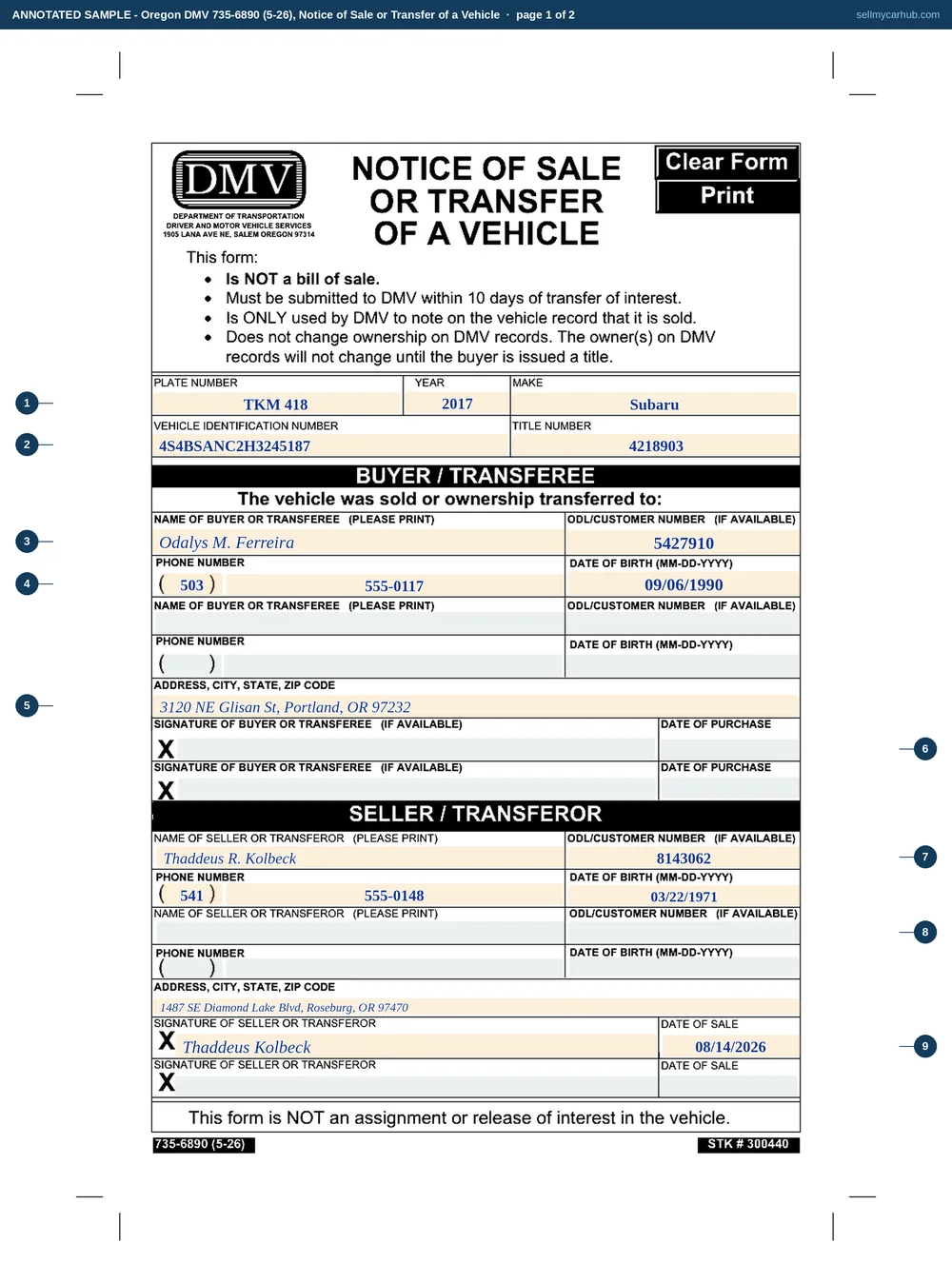
This is all 2 pages of the actual 735-6890, rendered from the PDF the Oregon Department of Transportation, Driver and Motor Vehicle Services Division publishes and completed end to end: letterhead, every field, and the blocks at the foot.
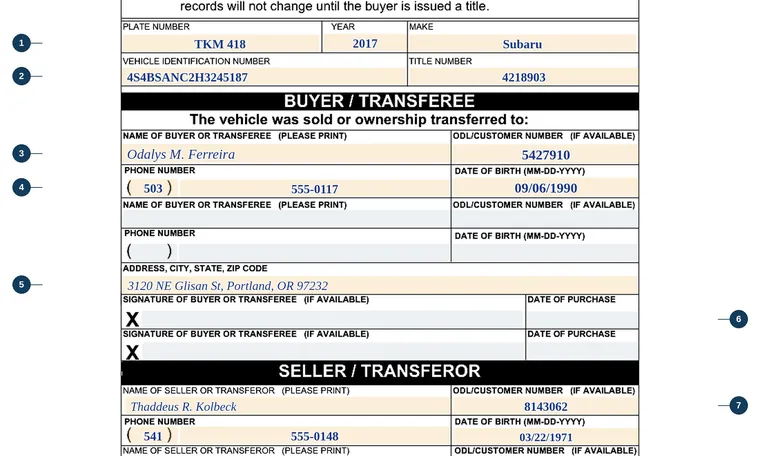
The first row of the vehicle block.
Watch out: Give the plate number even if you took the plates off. It is how DMV finds the registration record attached to the vehicle you are reporting.
The second row. Both are on the face of the certificate you have just signed over.
Watch out: Photograph the front of the title before you hand it across. Everything this form asks for is on that one face, and once the certificate is gone it is gone.
The buyer's printed name, with an ODL or customer number beside it marked if available.
Watch out: Print it as their licence prints it. The customer number is optional but it is the thing that lets DMV attach the notice to a real person rather than to a name.
An area code box and a number, then a date of birth in the department's own order.
Watch out: Leave a box empty rather than filling it with something plausible. A wrong date of birth here is not a harmless blank — knowingly submitting false information about a transfer is a Class C misdemeanour.
One line for where the buyer lives.
Watch out: DMV's instruction on its selling page is to include the name and address of the buyer, and this is the line it means. It is also the line that turns the notice from a shrug into a record.
Two signature lines in the buyer's half, each with a date of purchase, both marked if available.
Watch out: Genuinely optional — the department expects most of these to be filed by the seller alone after the buyer has driven away. If the buyer is still standing there, a signature costs nothing and makes the notice harder to argue with.
Your printed name, customer number, area code, phone and date of birth, with a second row for a co-owner.
Watch out: Use the name DMV holds for you. The handbook's rule for the whole system is to always use your customer number and the same name with DMV, because every record hangs off that number.
An identical identity block for a second registered owner.
Watch out: A jointly owned car is jointly sold. Both owners have released interest on the certificate, and both belong on the notice that says so.
The last block on the form, and the only signature it actually requires.
Watch out: The date of sale here has to be the same date you wrote in the reassignment block on the title. Two documents in the same envelope disagreeing about the day the car changed hands is the kind of discrepancy that generates a letter.
| On the form | What to put in it |
|---|---|
| Vehicle block | Plate number, year and make on the first row; vehicle identification number and title number on the second. |
| Buyer / transferee | Under the line “The vehicle was sold or ownership transferred to:” — printed name, ODL or customer number if available, phone number with a separate area code box, and date of birth as MM-DD-YYYY. The whole set repeats for a second buyer. |
| Buyer's address | One full-width line taking address, city, state and ZIP code. |
| Buyer's signature | Two signature lines, each with a date of purchase beside it, both marked if available. |
| Seller / transferor | The same identity block again for the seller: printed name, ODL or customer number, area code and phone, date of birth, repeated for a second seller. |
| Seller's address | A full-width line for address, city, state and ZIP. |
| Signature of seller or transferor | Two signature lines with a date of sale beside each. These are the only signatures on the form that are not marked optional. |
| The four bullets at the top | Printed conditions rather than fields: the form is not a bill of sale, must be submitted to DMV within 10 days of transfer of interest, is only used by DMV to note on the vehicle record that it is sold, and does not change ownership on DMV records. |
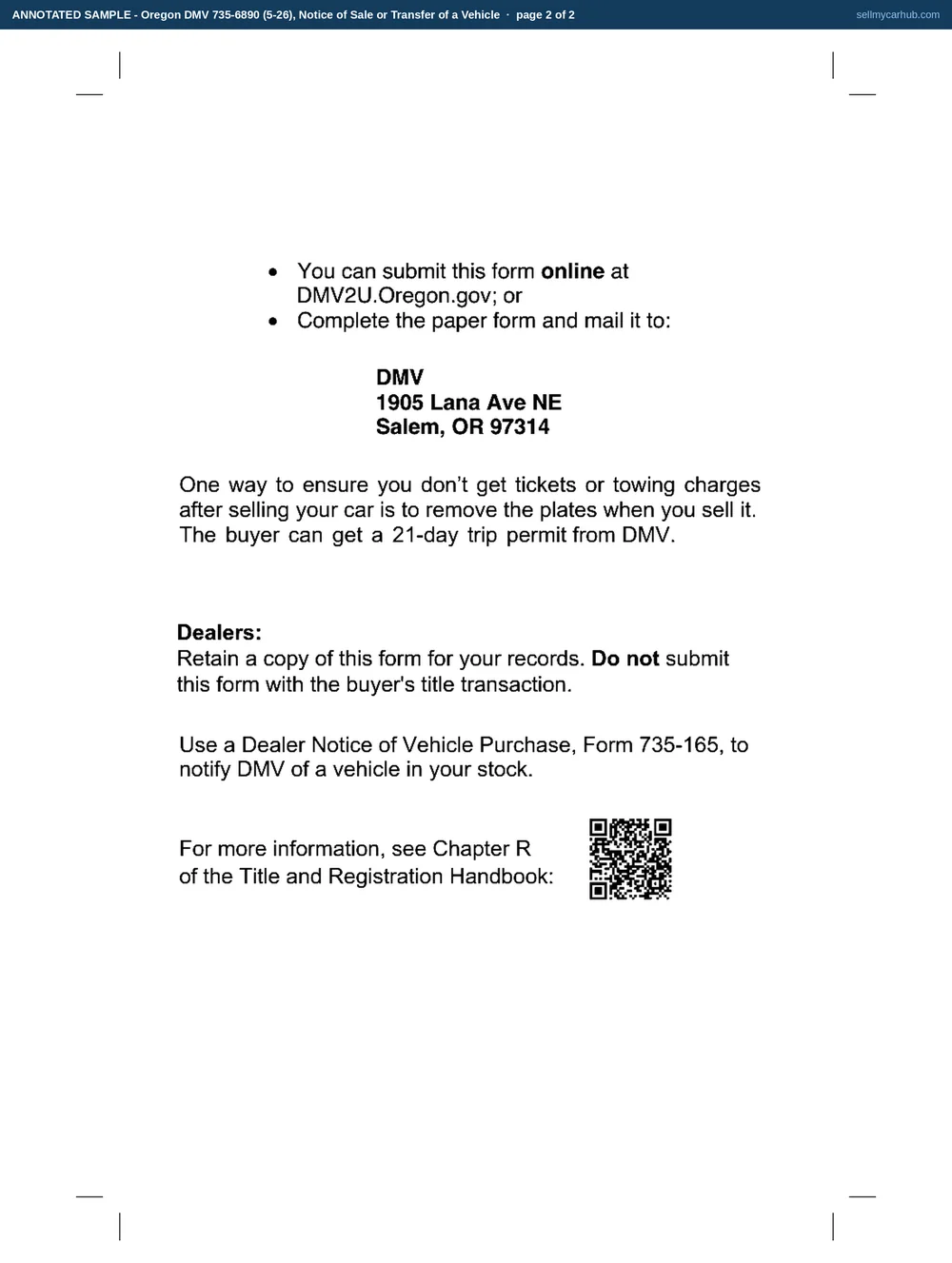
| The dealer note on page two | Dealers retain a copy and do not submit this form with the buyer's title transaction; a vehicle taken into dealer stock is notified on a Dealer Notice of Vehicle Purchase, Form 735-165, instead. |
Every line here was read off 735-6890 (5-26) itself — the PDF is here — and off the Oregon Department of Transportation, Driver and Motor Vehicle Services Division pages. This is plain-language help with a form, not legal advice, and where our wording and the agency's differ, theirs governs.
Back to all Oregon seller paperwork, or what selling a car in Oregon involves.