The document that actually moves the car onto somebody else's record. Two sides, twenty-one numbered lines, and a private seller signs it nowhere at all — it belongs to the person buying the car, who posts it to Salem or takes it to a DMV office with your assigned certificate behind it. It is worth a seller's time anyway, because everything the buyer will ring you about in the fortnight after the sale is on this sheet: the VIN they cannot read, the county they have to name, the survivorship box, and the odometer certification they need from you and do not have.
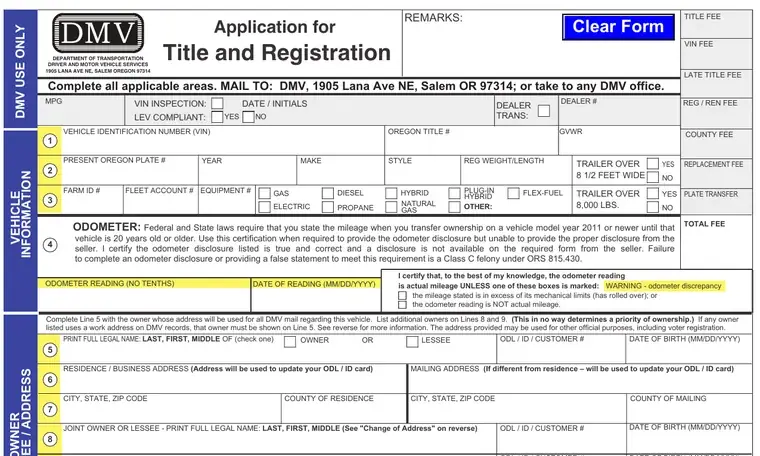
Written against 735-226 (4-26), issued under ORS 803.045 and ORS 803.070. Revised April 2026 and revised often. Take a fresh copy from the DMV forms page rather than a saved one, and check the code in the bottom left corner against the revision this page was written against.
Two documents, and they are not the same thing. Take the blank 735-226 from the oregon.gov copy so you get the revision that is current today.
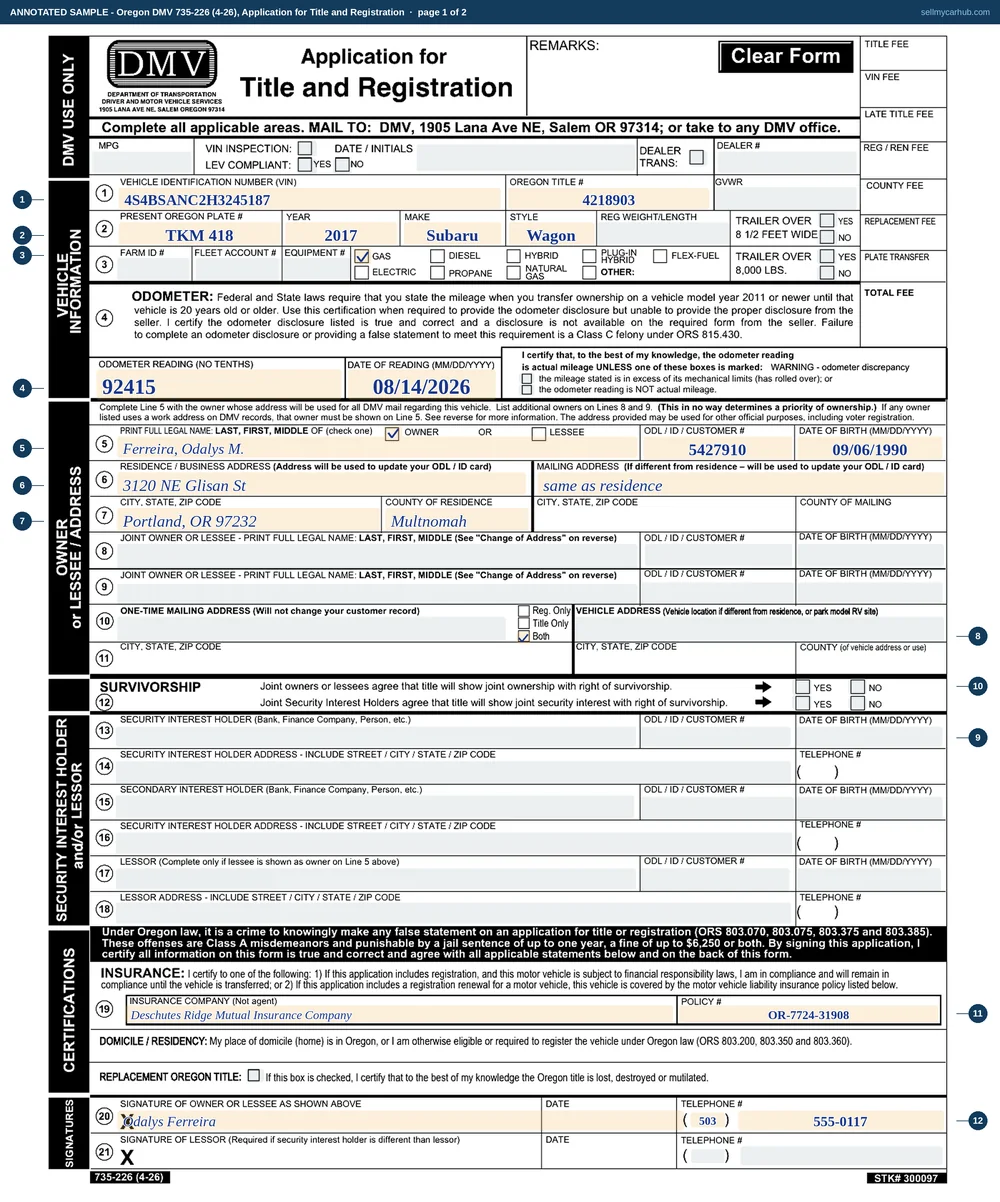
This is all 2 pages of the actual 735-226, rendered from the PDF the Oregon Department of Transportation, Driver and Motor Vehicle Services Division publishes and completed end to end: letterhead, every field, and the blocks at the foot.
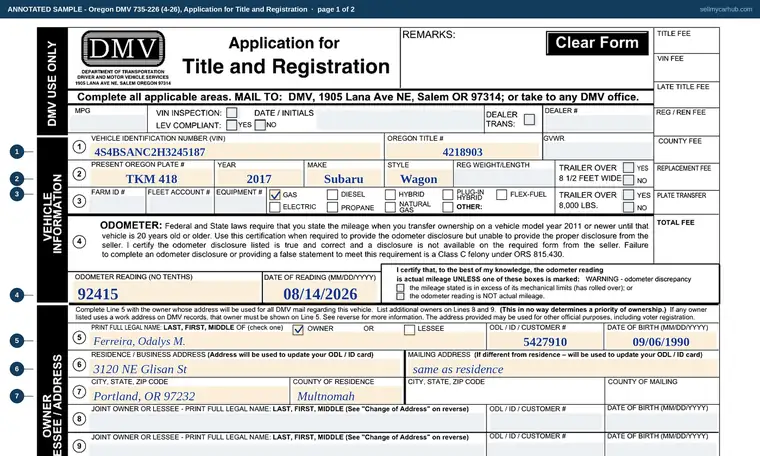
The top row of the form. Seventeen characters and the title number printed on the face of the certificate.
Watch out: Copy the VIN from the title, not the dashboard, and remember a VIN never contains I, O or Q. If DMV cannot match it, the next thing that happens is a $9 VIN inspection.
The plate currently on the vehicle and the three descriptors, all taken from the certificate rather than the advert.
Watch out: If the seller took the plates off, this line still wants the plate number that was on it — that is how DMV finds the registration record it is about to close.
One of nine boxes. Hybrid means electricity plus another source; plug-in hybrid means it can be charged from a socket and also burns petrol.
Watch out: This is not cosmetic in Oregon. Motor power feeds the fee tables, and an all-electric vehicle is charged a title fee of its own rather than the petrol chart's — the figures are on the Oregon fees page and on our hub page.
Whole miles, no tenths, and the date the figure was taken, with two exception boxes beside them.
Watch out: The certification underneath is worded for the case where the buyer cannot get a proper disclosure from the seller, and the form spells out the stakes: failing to complete an odometer disclosure, or providing a false statement to meet the requirement, is a Class C felony under ORS 815.430.
Tick owner or lessee, then print the full legal name last, first, middle, with the Oregon driver licence, ID or customer number and a date of birth.
Watch out: Line 5 decides where every piece of DMV post about this vehicle goes. The form says so in its own instruction: complete line 5 with the owner whose address will be used for all DMV mail regarding this vehicle.
The residence address, which will also update the buyer's licence or ID card, and a mailing address only where it differs.
Watch out: The form warns that the address provided may be used for other official purposes, including voter registration. A mail drop entered here as a convenience has a longer reach than the reader expects.
Two city rows side by side, each with its own county box: county of residence and county of mailing.
Watch out: Oregon asks for the county separately everywhere, and a Portland address can sit in Multnomah, Washington or Clackamas. Fill it from the licence rather than guessing — it is also what decides the county registration fee.
Three small boxes in the middle of the sheet.
Watch out: Title Only is for a vehicle that will not be driven. A buyer who wants to drive it home wants Both, and if the seller kept the plates that means full registration fees and a new set.
Name, customer number, date of birth, telephone and full address for anyone financing the purchase.
Watch out: Whoever is named here receives the new title. The buyer gets the registration card only, which is the single most misunderstood thing about an Oregon title transfer.
A yes-or-no pair for joint owners, and a second pair for joint security interest holders.
Watch out: This is the box the family reads years later. Oregon records it as a two-letter code in the SURVIVORSHIP field on the front of the title, and whether it says Y or N decides whether an estate needs an inheritance affidavit or nothing at all.
Two boxes under the insurance certification, completed where the application includes registration.
Watch out: It has to be the insurer's name. Writing the local agency there is the most common reason a registration part of an otherwise clean application is held.
One signature, dated, with a telephone number beside it. A second line takes the lessor's signature where that is a different party.
Watch out: Above it sits the sentence that makes this a sworn document: knowingly making a false statement on an application for title or registration is a Class A misdemeanour under ORS 803.070, 803.075, 803.375 and 803.385, punishable by up to a year in jail, a fine, or both.
| On the form | What to put in it |
|---|---|
| Line 1, vehicle identification | The complete VIN and the Oregon title number, copied from the face of the certificate rather than from the windscreen plate. |
| Line 2, the vehicle | Present Oregon plate number, year, make, style, and a registration weight or length where the vehicle has one. Two tick pairs sit to the right for a trailer over 8½ feet wide and one over 8,000 pounds. |
| Line 3, motor power | Nine boxes — gas, diesel, hybrid, plug-in hybrid, flex-fuel, electric, propane, natural gas, or other with a line to write it on — beside farm ID, fleet account and equipment numbers. |
| Line 4, odometer | The reading in whole miles with no tenths and the date it was read, then a certification that it is actual mileage unless one of two boxes is marked: in excess of mechanical limits, or not actual mileage under the words WARNING - odometer discrepancy. |
| Lines 5 to 9, who is applying | Owner or lessee, full legal name last-first-middle, customer number and date of birth; then residence and mailing address with a county named for each; then two more rows for joint owners, a one-time mailing address and a vehicle address. |
| Line 10, what is being applied for | Title only, registration only, or both — three small boxes stacked in the middle of the page. |
| Lines 11 to 13, lenders and lessors | Security interest holder, secondary interest holder and lessor, each with a customer number, date of birth, telephone number and a full address. |
| Line 12, survivorship | Two yes-or-no pairs: joint owners or lessees agree the title will show joint ownership with right of survivorship, and joint security interest holders agree the same for the interest. |
| Line 19, insurance | Insurance company — not the agent — and a policy number, sitting under a certification that the vehicle is in compliance with the financial responsibility laws and will remain so until it is transferred. |
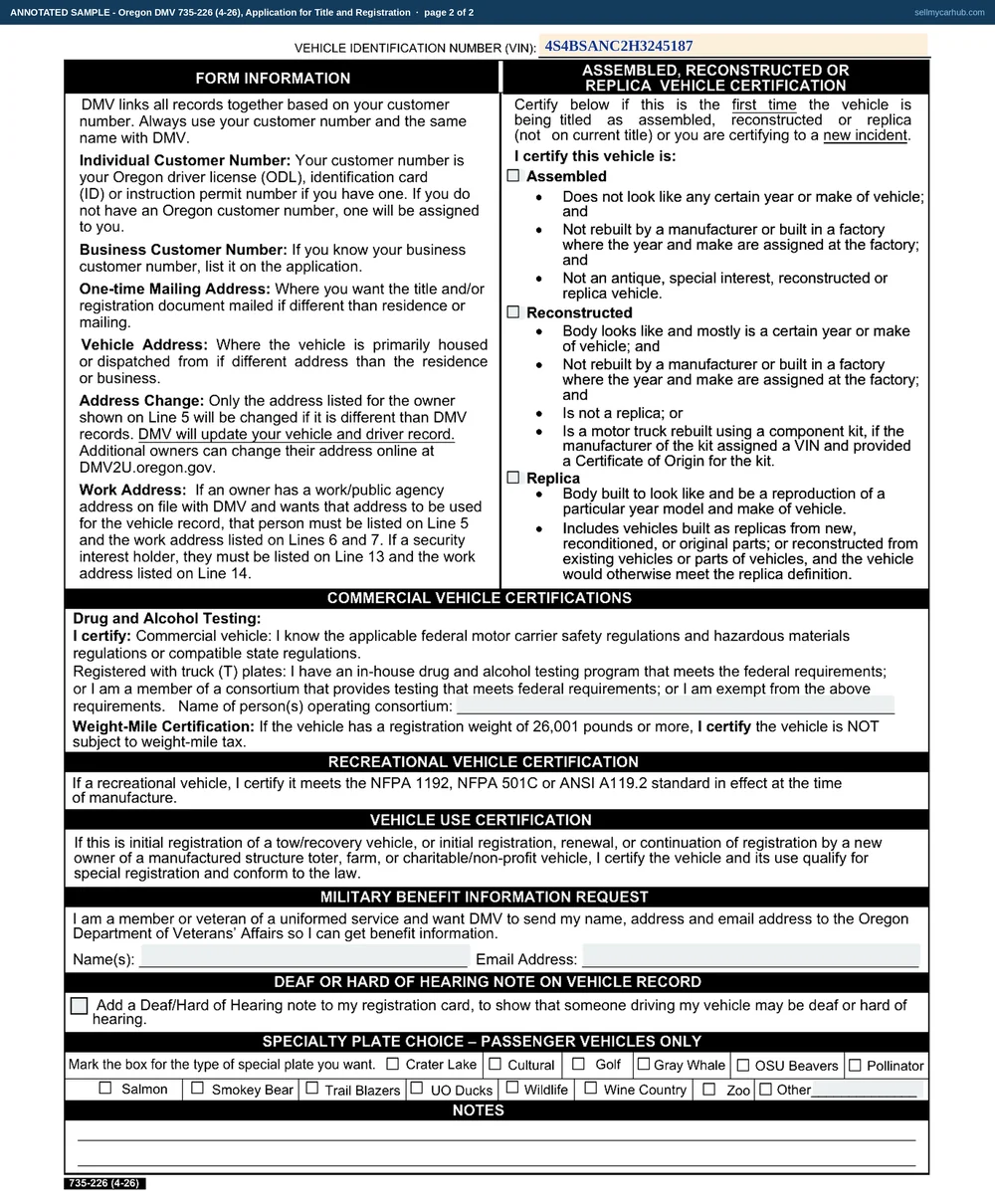
| The certifications block | Domicile, replacement Oregon title, recreational vehicle standards, vehicle use, commercial vehicle and drug-and-alcohol testing, a military benefit information request and a deaf or hard-of-hearing notation. |
| Lines 20 and 21, signatures | Signature of owner or lessee as shown above with a date and telephone number, and a separate signature of lessor required where the security interest holder is a different party. |
| Page two, specialty plates | Sixteen named passenger plate designs with a box each — Crater Lake, Cultural, Golf, Gray Whale, Pollinator, Salmon, Smokey Bear, Trail Blazers, Wildlife, Wine Country, Zoo, OSU Beavers, UO Ducks — and an Other line. |
Every line here was read off 735-226 (4-26) itself — the PDF is here — and off the Oregon Department of Transportation, Driver and Motor Vehicle Services Division pages. This is plain-language help with a form, not legal advice, and where our wording and the agency's differ, theirs governs.
Back to all Oregon seller paperwork, or what selling a car in Oregon involves.