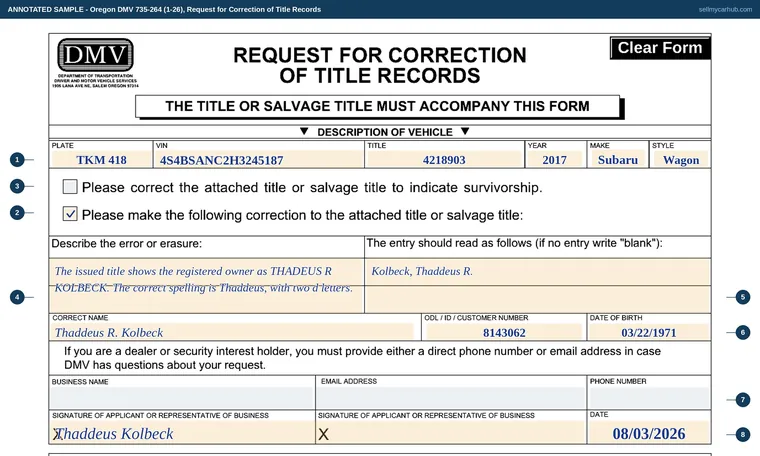
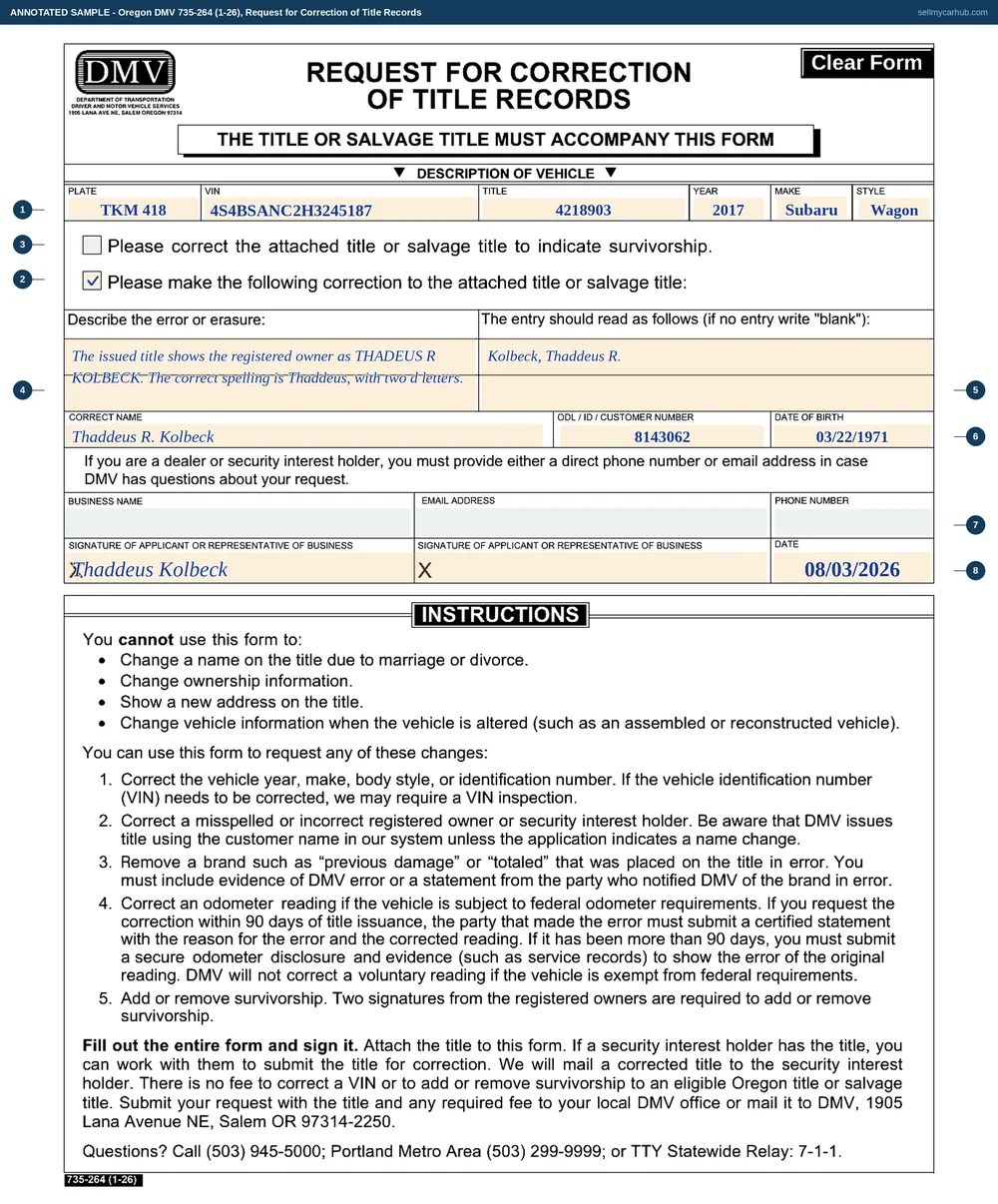
The form for a certificate that has already been issued with something wrong on it. Its instructions are unusually generous with the word cannot, and that is the useful part: it lists four things it will not do and five it will, and knowing which side of the line your problem falls on saves a fortnight. There is no fee at all to correct a VIN or to add or remove survivorship, and the title has to travel with the form — it says so in capitals across the top.
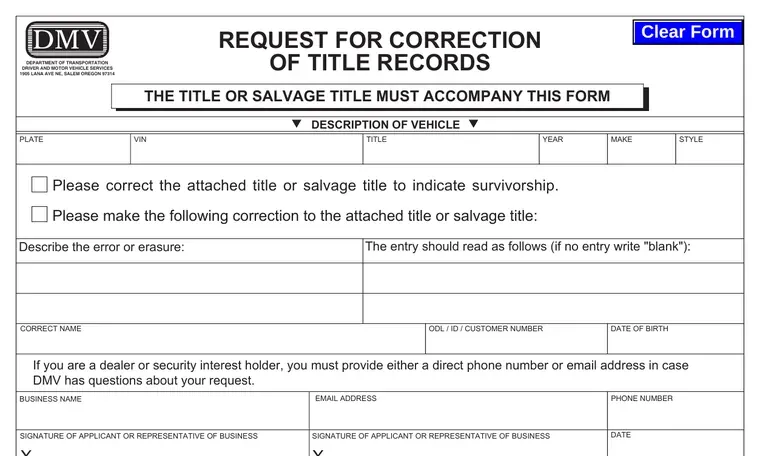
Written against 735-264 (1-26), issued under ORS 803.075 and ORS 803.140. Revised January 2026. The single most important line on it is the one in capitals at the top — the certificate goes in the envelope with the form, which means the car cannot be sold while it is in the post.
Two documents, and they are not the same thing. Take the blank 735-264 from the oregon.gov copy so you get the revision that is current today.
This is the actual 735-264, rendered from the PDF the Oregon Department of Transportation, Driver and Motor Vehicle Services Division publishes and completed end to end: letterhead, every field, and the blocks at the foot.
Plate, VIN, title number, year, make and style across the top band.
Watch out: Copy from the certificate you are about to post, and photograph the whole thing first. It will be out of your hands for as long as the correction takes.
The first of two request lines, for the five corrections this form can make.
Watch out: Read the list before ticking. Four things it cannot do are printed underneath, and marriage, divorce, a new address and a change of ownership are all on that side.
The second request line, its own transaction and free of charge.
Watch out: Two signatures from the registered owners are required to add or remove survivorship, which is why the form carries two signature lines.
A free-text block for what is wrong on the issued certificate.
Watch out: Say what the title says and what it should say. A description that only says the name is wrong leaves the clerk to guess which part of it.
The corrected wording. If there should be no entry at all, write “blank”.
Watch out: The department reissues the title from this box. Whatever you write here is what gets printed, spelling and all.
Three boxes for the person whose name is being put right.
Watch out: The customer number is how DMV knows this is a correction rather than a different person. Without it a misspelled name looks like a new owner.
For a dealer or security interest holder making the request.
Watch out: The form requires one or the other: if you are a dealer or security interest holder, you must provide either a direct phone number or an email address in case DMV has questions about your request.
Two signature lines at the foot.
Watch out: One signature is enough for most corrections. Survivorship is the exception, and a survivorship request with one signature comes straight back.
| On the form | What to put in it |
|---|---|
| Description of vehicle | Plate, VIN, title, year, make and style across one band. |
| The two request lines | Please make the following correction to the attached title or salvage title, and a second option: please correct the attached title or salvage title to indicate survivorship. |
| Describe the error or erasure | A free-text block, mirroring the wording on the 735-502. |
| The entry should read as follows | A second free-text block, with the same “blank” instruction if there should be no entry. |
| Correct name, ODL / ID / customer number, date of birth | Three boxes for the person whose name is being corrected. |
| Business name and phone number | For a dealer or security interest holder making the request, plus an email address — the form says either a direct phone number or an email address is required in case DMV has questions. |
| Signature of applicant or representative of business | Two signature lines with dates, because adding or removing survivorship needs two signatures from the registered owners. |
| The five things it can do | Correct the vehicle year, make, body style or identification number; correct a misspelled or incorrect registered owner or security interest holder; remove a brand such as previous damage or totaled placed in error; correct an odometer reading; and add or remove survivorship. |
| The four things it cannot do | Change a name on the title due to marriage or divorce; change ownership information; show a new address on the title; or change vehicle information when the vehicle is altered, such as an assembled or reconstructed vehicle. |
Every line here was read off 735-264 (1-26) itself — the PDF is here — and off the Oregon Department of Transportation, Driver and Motor Vehicle Services Division pages. This is plain-language help with a form, not legal advice, and where our wording and the agency's differ, theirs governs.
Back to all Oregon seller paperwork, or what selling a car in Oregon involves.