One page that lets somebody else sign a Virginia title on your behalf when registering or transferring a vehicle. It is a single-vehicle document - the certificate's own VIN and title number are printed into the middle of it - and unlike the equivalent form in several other states, it needs no notary at all. What it does need is care about who you name, because the wording gives them everything.
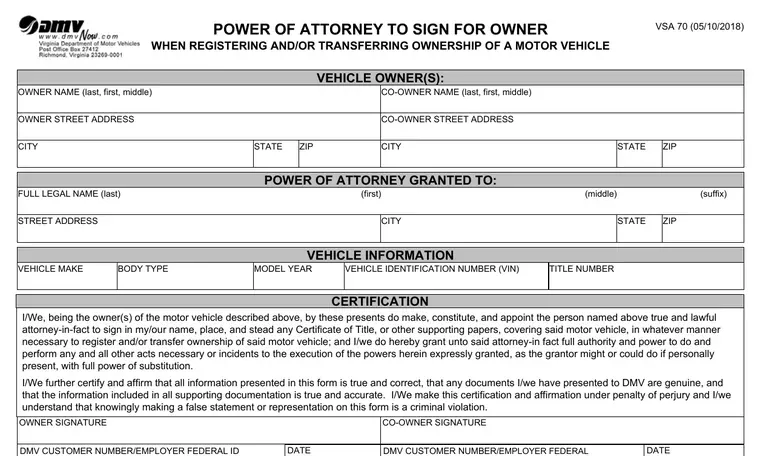
Written against VSA 70 (05/10/2018), issued under Va. Code 46.2-629. The two signature lines on this form have no boxes behind them - they are printed rules, and the only fillable boxes on that row are the customer number and the date. That is a rendering detail rather than a legal one, but it means an owner completing this on screen and printing it will find their name typed everywhere except the one place that has to be handwritten.
Two documents, and they are not the same thing. Take the blank VSA 70 from the dmv.virginia.gov copy so you get the revision that is current today.
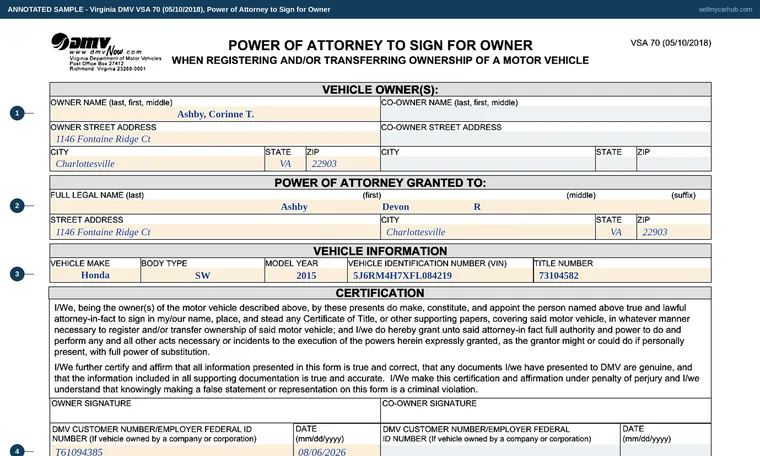
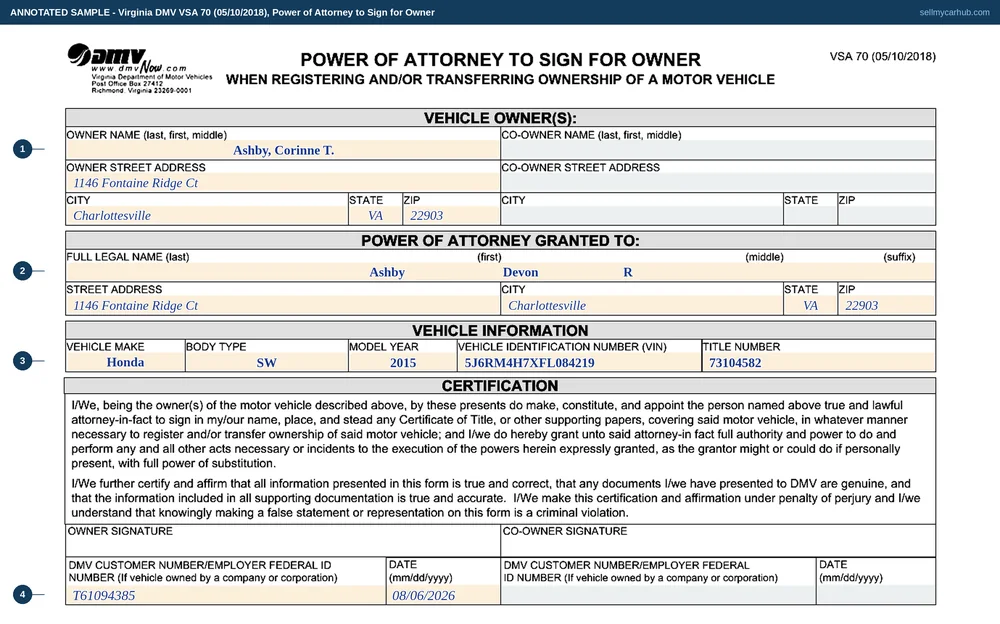
This is the actual VSA 70, rendered from the PDF the Virginia Department of Motor Vehicles publishes and completed end to end: letterhead, every field, and the blocks at the foot.
Your name and address as they appear on the certificate, with the co-owner block used only if there is one.
Watch out: Match the certificate, not the driving licence, if the two differ. This form is about signing that document.
The full legal name and address of the person who will sign for you.
Watch out: Full legal name. A nickname on a power of attorney is an argument waiting at a DMV counter.
Make, body type, model year, VIN and title number - the five boxes that limit the authority to one car.
Watch out: Copy the title number as well as the VIN. Together they are what stops this page being used on a different vehicle.
Your DMV customer number or employer federal ID, and the date you signed.
Watch out: Sign on the printed rule above these boxes in ink. It is the one thing on this form that cannot be typed.
| On the form | What to put in it |
|---|---|
| Vehicle owner or owners | Owner name in last, first, middle order and street address, city, state and ZIP; then the same block again for a co-owner. |
| Power of attorney granted to | The attorney-in-fact's full legal name split across last, first, middle and suffix on one long line, then their street address, city, state and ZIP. |
| Vehicle information | Vehicle make, body type, model year, the vehicle identification number and the title number - five boxes that tie the authority to one car. |
| Certification | The operative wording: the owners make, constitute and appoint the person named above true and lawful attorney-in-fact to sign in their name, place and stead any Certificate of Title or other supporting papers covering the vehicle, in whatever manner necessary to register and/or transfer ownership, with full authority and power to do and perform any and all other acts necessary or incident to the execution of the powers granted, as the grantor might or could do if personally present, with full power of substitution. |
| Signatures | Owner signature and co-owner signature above, then a DMV customer number or employer federal ID number and a date beneath each - the identification lines are boxes, the signature lines are printed rules with nothing behind them. |
Every line here was read off VSA 70 (05/10/2018) itself — the PDF is here — and off the Virginia Department of Motor Vehicles pages. This is plain-language help with a form, not legal advice, and where our wording and the agency's differ, theirs governs.
Back to all Virginia seller paperwork, or what selling a car in Virginia involves.