The form a Utah seller finds when they search for a power of attorney, and the wrong one for what they usually want. It is the Tax Commission's tax power of attorney: it authorises an agent to receive and inspect your confidential tax information and to perform any acts that you can, within the tax matters you list, and it must be notarised to be valid. It does not sign a certificate of title. The Motor Vehicle Division publishes no title power of attorney at all - the answer to an owner who cannot get to the counter is a signed TC-656 travelling with the packet instead.
Written against TC-737 (Rev 5/26), issued under Utah Code 59-1-403. There is no Motor Vehicle Division power of attorney for signing a certificate of title in Utah, and saying so plainly is more useful than pointing at a form that will be refused. If you cannot be at the counter, the route is a signed title application in the packet; if you cannot sign at all, that is a question for a lawyer rather than for a form.
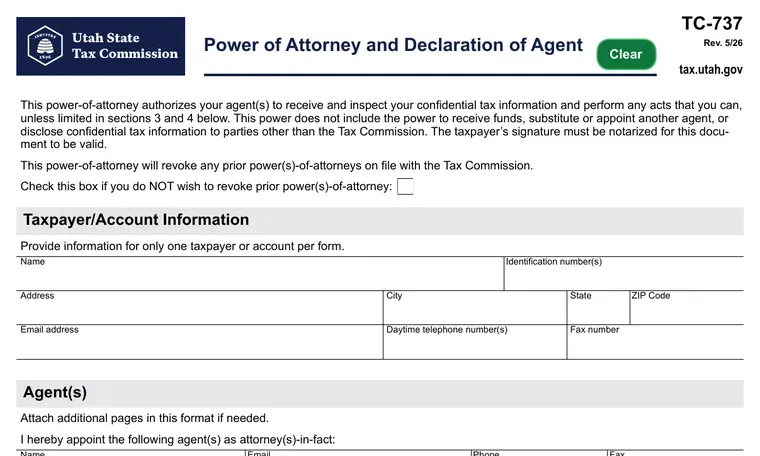
Two documents, and they are not the same thing. Take the blank TC-737 from the files.tax.utah.gov copy so you get the revision that is current today.
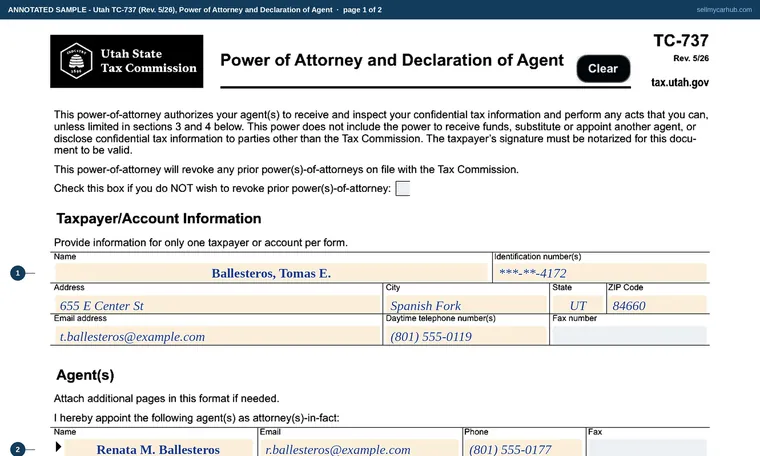
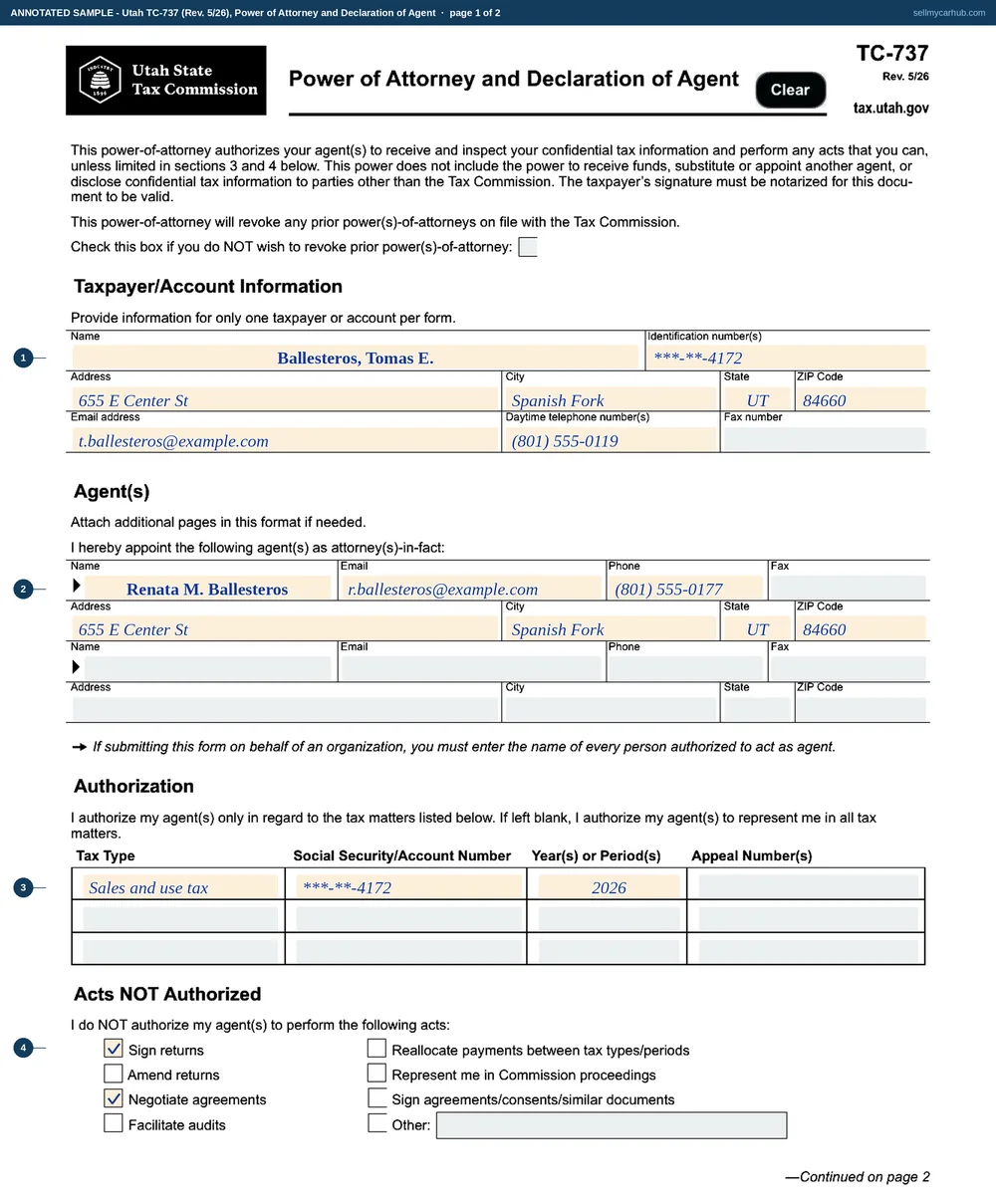
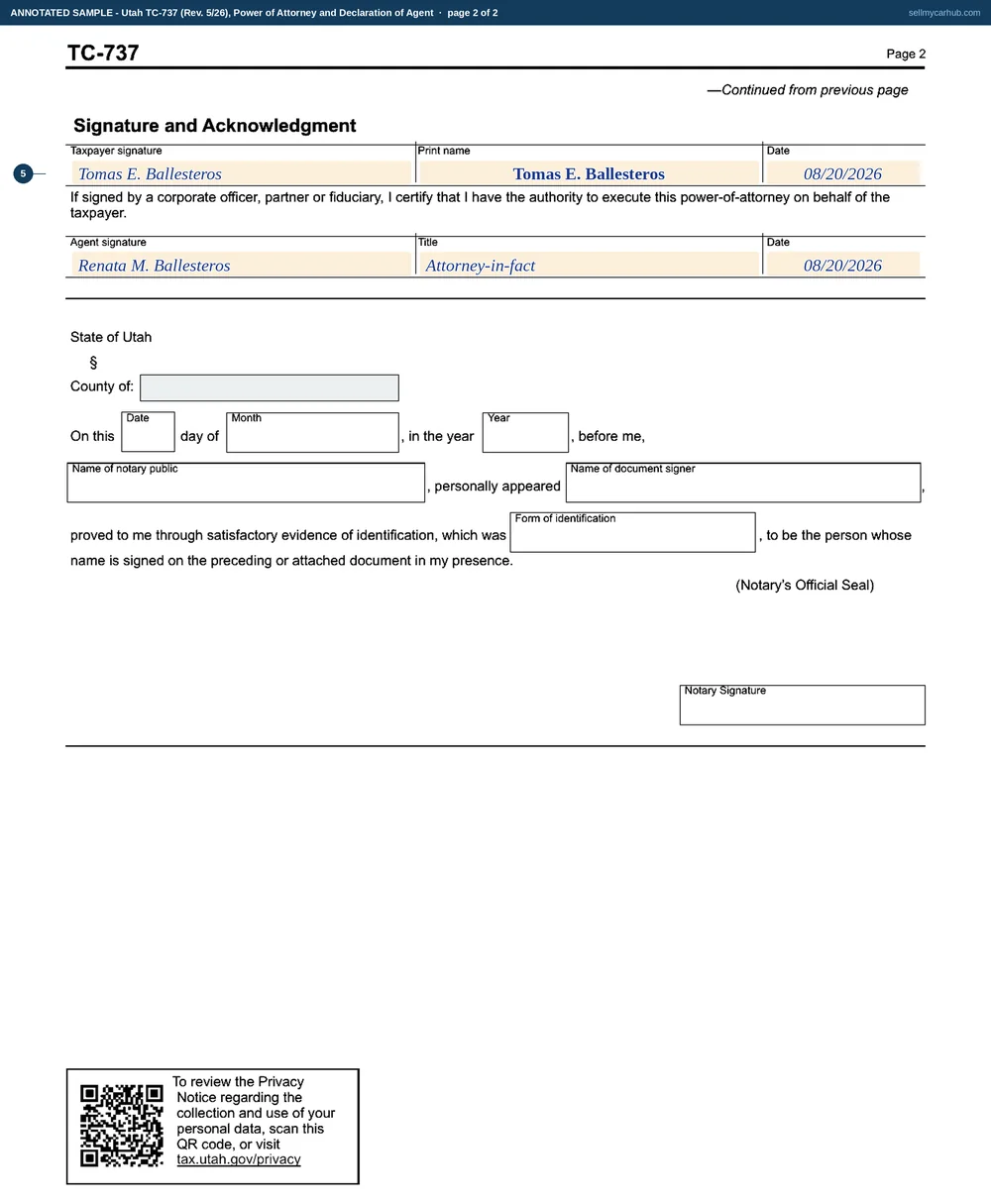
This is all 2 pages of the actual TC-737, rendered from the PDF the Utah State Tax Commission, Motor Vehicle Division publishes and completed end to end: letterhead, every field, and the blocks at the foot.
One taxpayer, with the identification number, address, email and telephone.
Watch out: One account per sheet. A person and their business are two taxpayers and need two forms even where the same agent is being appointed.
Up to two names with contact details, appointed as attorneys-in-fact.
Watch out: If the taxpayer is an organisation, every person who will act has to be named. An unnamed colleague cannot ring up on the strength of somebody else's appointment.
The tax types, account numbers, periods and appeal numbers the appointment covers.
Watch out: Leaving it blank is not neutral. The line above the table says a blank authorises representation in all tax matters.
Ticks against anything the agent should not be able to do - signing or amending returns, negotiating agreements, facilitating audits and the rest.
Watch out: This is the only place on the form where the appointment gets narrower. Most people who later regret a power of attorney left this block empty.
The taxpayer signs, and a notary completes the acknowledgement.
Watch out: Do not sign it in advance. A notary is acknowledging a signature made in front of them, and one made the week before is not.
| On the form | What to put in it |
|---|---|
| The opening paragraph | This power-of-attorney authorizes your agent(s) to receive and inspect your confidential tax information and perform any acts that you can, unless limited in sections 3 and 4 below. |
| What it does not include | In the same paragraph: this power does not include the power to receive funds, substitute or appoint another agent, or disclose confidential tax information to parties other than the Tax Commission. |
| The notary requirement | One sentence, and it is the only one of its kind in the Utah seller's paperwork: the taxpayer's signature must be notarized for this document to be valid. |
| The revocation default | This power-of-attorney will revoke any prior power(s)-of-attorney on file with the Tax Commission, with a tick box for anyone who does not want that. |
| Taxpayer/Account Information | Name, identification numbers, address, email, daytime telephone and fax - and a warning to provide information for only one taxpayer or account per form. |
| Agent(s) | Two blocks, each with a name, email, telephone, fax and address, under the words I hereby appoint the following agent(s) as attorney(s)-in-fact. |
| The organisation rule | If submitting this form on behalf of an organization, you must enter the name of every person authorized to act as agent. |
| Authorization | A four-column table - tax type, account number, years or periods, appeal numbers - with a default printed above it: if left blank, I authorize my agent(s) to represent me in all tax matters. |
| Acts NOT Authorized | Eight tick boxes and an Other line, covering signing returns, amending returns, negotiating agreements, facilitating audits, reallocating payments, representing the taxpayer in Commission proceedings and signing agreements, consents or similar documents. |
| Signature and notarial block | The taxpayer signs and a notary completes the acknowledgement, which is what the opening paragraph makes a condition of validity. |
Every line here was read off TC-737 (Rev 5/26) itself — the PDF is here — and off the Utah State Tax Commission, Motor Vehicle Division pages. This is plain-language help with a form, not legal advice, and where our wording and the agency's differ, theirs governs.
Back to all Utah seller paperwork, or what selling a car in Utah involves.