For a certificate that exists but is wrong. Nine printed reasons run down the middle of the form — a misspelled name, a change of name, an identification number, a body style, a year model in error, the wrong lienholder, a change of motor or body, a title incorrectly assigned, and adding survivorship — and each of them produces a fresh certificate rather than an annotation on the old one.
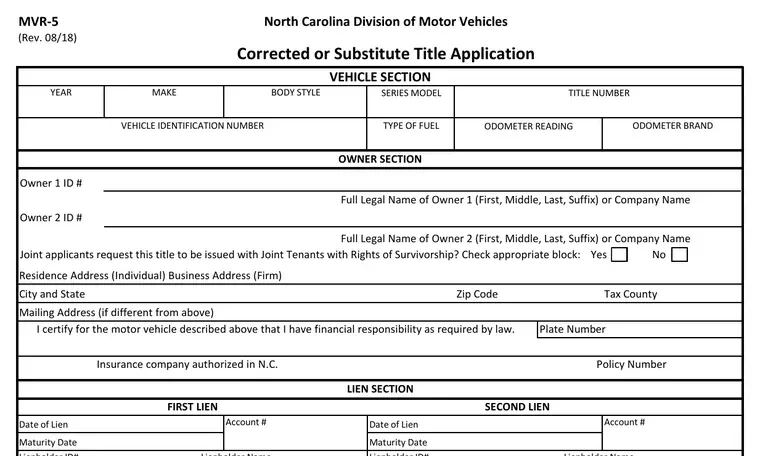
Written against MVR-5 (Rev 08/18), issued under N.C. General Statute 20-68. This form is one of the oldest in the North Carolina set and its revision is much older than the rest of them, so check the footer against the copy on ncdot.gov before filling one in.
Two documents, and they are not the same thing. Take the blank MVR-5 from the ncdot.gov copy so you get the revision that is current today, then print our MVR-5 guide and keep it beside you while you fill theirs in.
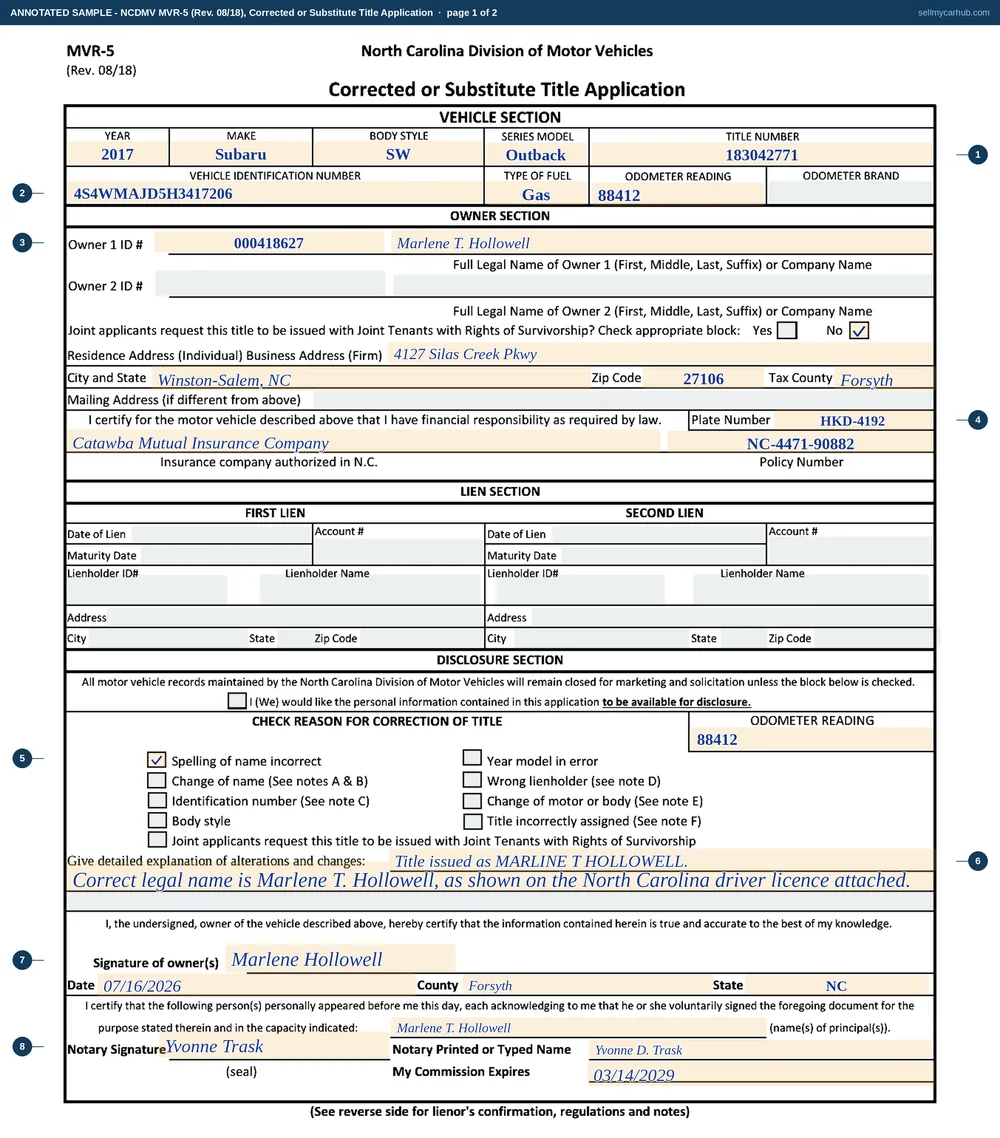
This is all 2 pages of the actual MVR-5, rendered from the PDF the North Carolina Division of Motor Vehicles publishes and completed end to end: letterhead, every field, and the blocks at the foot.
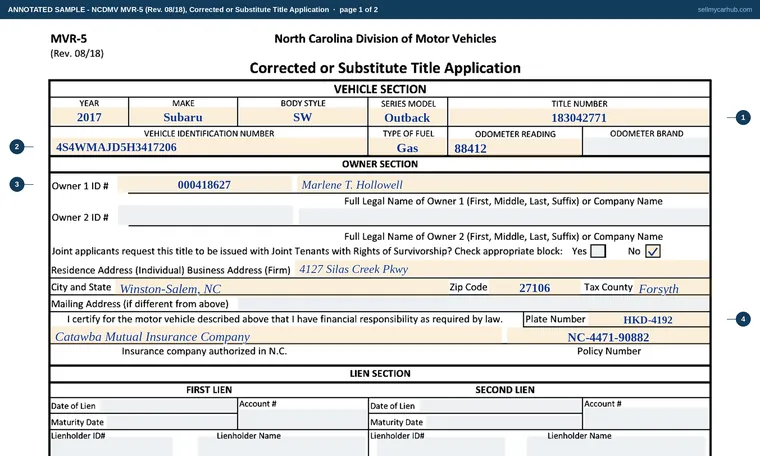
Top row of the vehicle section, beside the series model.
Watch out: The correction is applied to a specific certificate, so this is the number of the wrong one you are holding.
Second row, with the fuel type, odometer reading and odometer brand beside it.
Watch out: If the VIN itself is what is wrong, tick identification number as the reason and read note C — that correction needs more than this form.
The name you want on the corrected certificate, with your driver licence number.
Watch out: Write the correct version here. The wrong version goes in the explanation lines further down, not in this box.
The plate currently on the vehicle, the insurer authorised in N.C. and the policy number.
Watch out: The certification above it is the same financial responsibility statement the MVR-1 carries. A correction application still asserts that the car is insured.
One of nine tick boxes down the middle of the form.
Watch out: Five of the nine carry a lettered note. Read the note before you tick the box — several of them ask for a document that has to travel with the application.
Three lines to say what is wrong and what it should be.
Watch out: Say both halves. Title issued as X, correct legal name is Y, evidence attached — an explanation that only names the correct version leaves the agent guessing at the error.
Under the certification that the information contained is true and accurate to the best of your knowledge.
Watch out: One signature line for a single owner; joint owners both sign and are both acknowledged.
Names of the principals, notary signature, printed or typed name, seal and commission expiry.
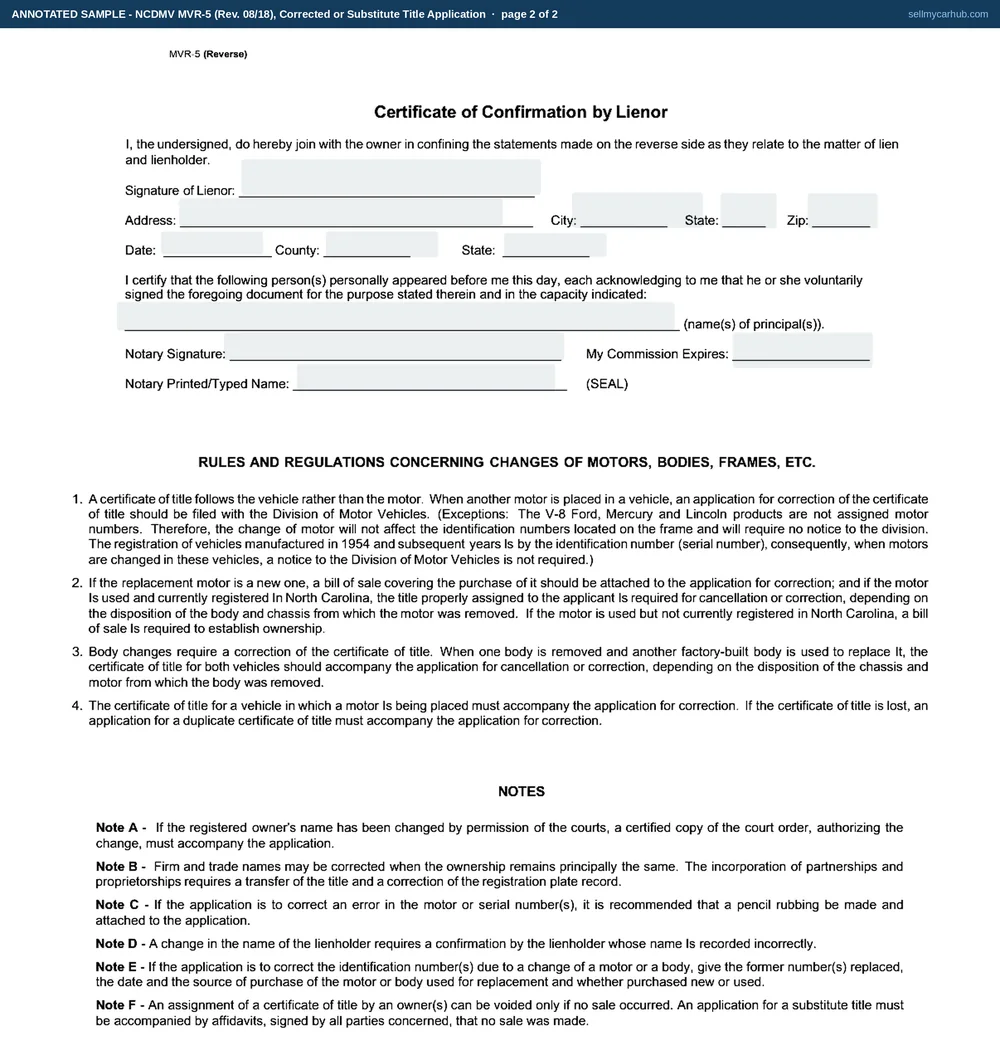
Watch out: Then check the reverse. If a lien is recorded against the vehicle, the lienor's confirmation on the back needs its own signature and its own acknowledgment.
| On the form | What to put in it |
|---|---|
| Vehicle section | Year, make, body style, series model and title number on the first row; VIN, type of fuel, odometer reading and odometer brand on the second. |
| Owner section | Owner 1 and owner 2 ID numbers and full legal names, the survivorship yes/no question, and then address, city and state, ZIP, tax county and a mailing address if different. |
| Financial responsibility | Plate number, insurance company authorised in N.C. and policy number, under the certification that the owner has financial responsibility as required by law. |
| Lien section | First and second lien: date of lien, account number, maturity date, lienholder ID number, lienholder name and a full address for each. |
| Check reason for correction of title | The nine tick boxes, several of which carry a note reference — change of name sends you to notes A and B, identification number to note C, wrong lienholder to note D, change of motor or body to note E, and title incorrectly assigned to note F. |
| Detailed explanation | Three lines under the instruction to give a detailed explanation of alterations and changes. This is the part of the form that decides whether the correction is accepted. |
| Signature and acknowledgment | Owner's signature under the certification that the information is true and accurate, then date, county and state, and the notary certificate. |
| The reverse | Certificate of confirmation by lienor with its own notary block, and then the department's rules and regulations concerning changes of motors, bodies and frames. |
Every line here was read off MVR-5 (Rev 08/18) itself — the PDF is here — and off the North Carolina Division of Motor Vehicles pages. This is plain-language help with a form, not legal advice, and where our wording and the agency's differ, theirs governs.
Back to all North Carolina seller paperwork, or what selling a car in North Carolina involves.