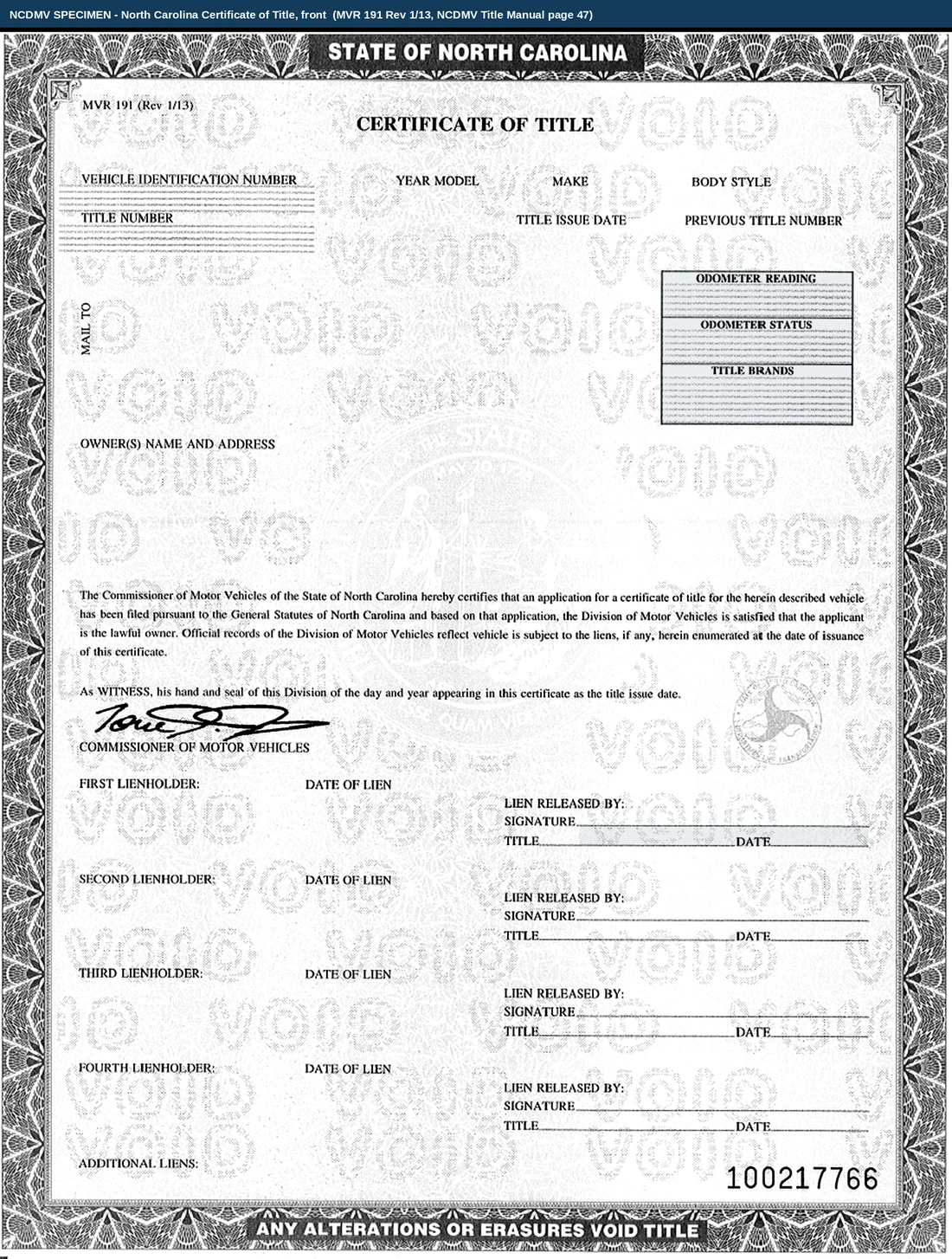
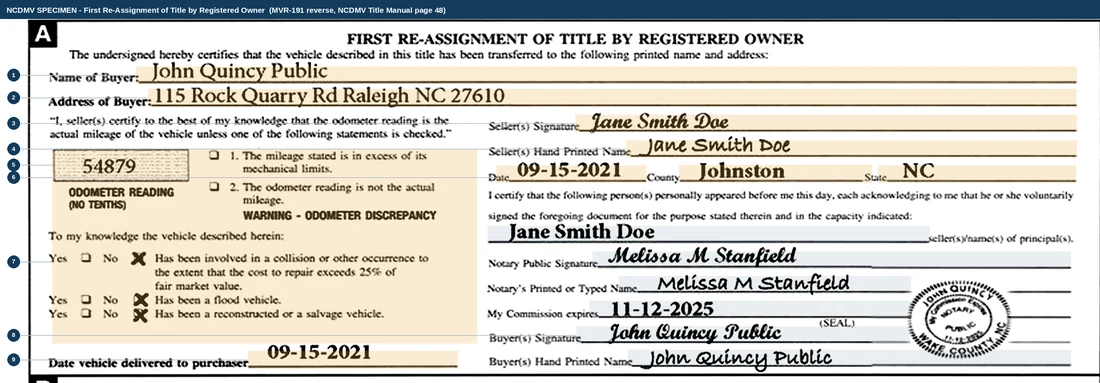
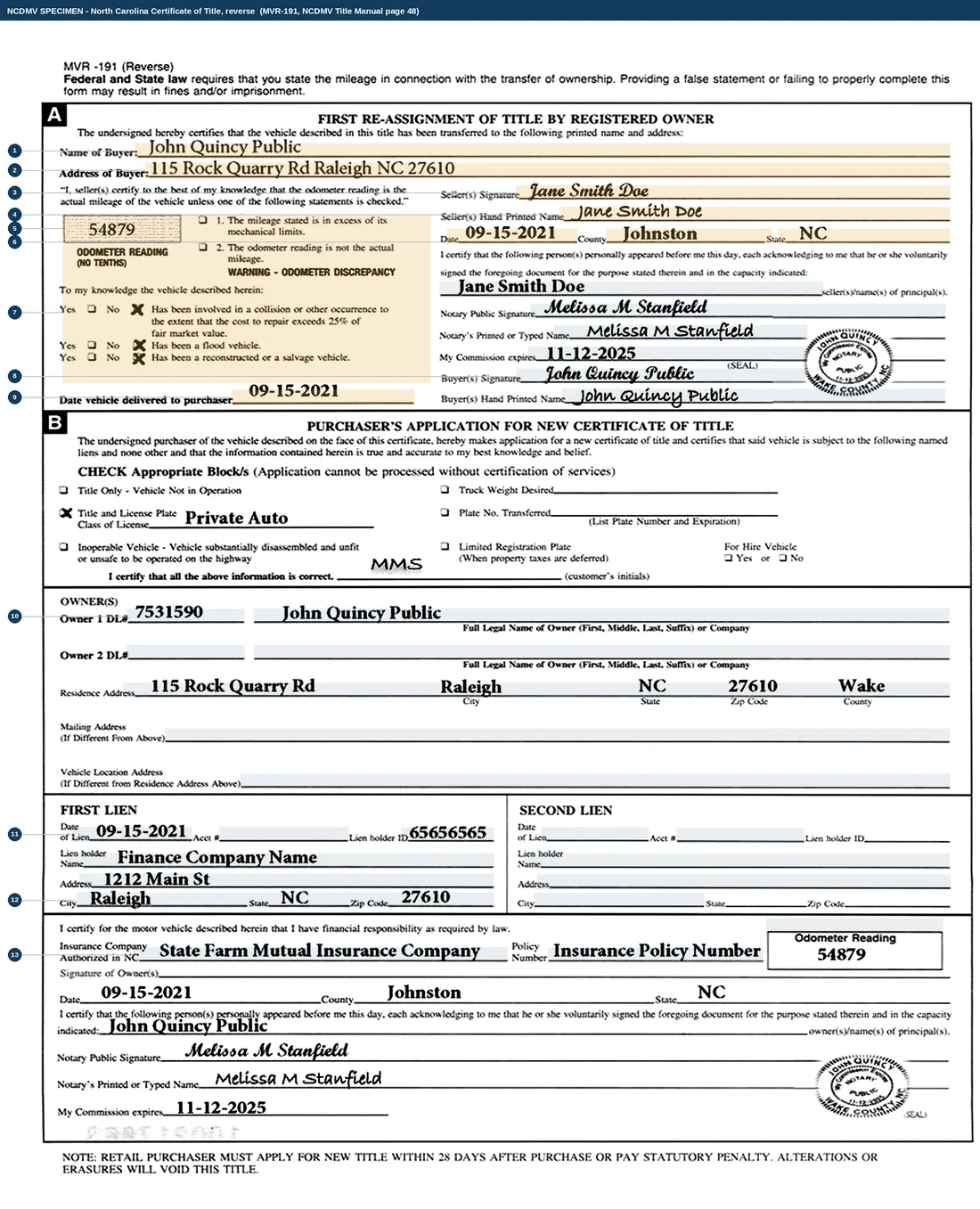
North Carolina does the whole transfer on one sheet. Section A on the reverse of the certificate is the assignment and it is yours; section B underneath is the buyer's application for a new title. Every box below is numbered against NCDMV's own specimen of the MVR-191, reproduced in the Division's Vehicle Registration Section Title Manual — and the numbering on the pictures matches the numbering in the list.
As a private seller you complete these and nothing else:
There is no blank North Carolina title to download and there never will be: yours arrived in the post from Raleigh on security paper. What NCDMV does publish is a picture of one, inside a 561-page manual written for licence plate agency staff. This walkthrough is that picture, with the boxes a private seller fills in marked out on it.
Everything here happens in front of a notary, and nothing here can be corrected with a pen.
The Title Manual reduces the whole thing to a checklist of six: purchaser's name and address, date of sale or date of delivery, seller's signature, odometer reading, notarization, damage disclosure statement. Those six are what constitutes a proper assignment of a title document, and a transfer missing any one of them is not a transfer.
This is not a drawing and not somebody's document. It is the MVR 191 (Rev 1/13) as NCDMV reproduces it on page 47 of its Title Manual: watermarked VOID across every panel, every field empty, specimen number 100217766 along the bottom. A private seller writes nothing at all on this side — the two blocks marked out are the ones that most look like somewhere to sign.
The same manual prints the reverse on the next page, and prints it completed — in the Division's own hand, with a cast the Division invented: John Quincy Public buying from Jane Smith Doe, the lender written in as “Finance Company Name”. Nothing has been added to this picture. The amber marks which boxes belong to a seller and the numbers match the list below.
Before you watch. NCDMV does not publish a video showing the MVR-191 being filled in. Several channels do and none of them is the agency — they are dealerships, notary services and how-to accounts, which is why none is embedded here.
Published by NCDOT on its own channel in August 2024, and the closest thing NCDMV has to a seller's video. Title fraud is the seller's problem more than the buyer's here, because the document a North Carolina seller hands over is a notarised assignment — and an assignment left blank is the raw material for it. Nothing loads from YouTube until you press play.
The first line of section A. The buyer's printed name, written by you, before anybody signs anything.
Watch out: Leaving it blank so the buyer can fill it in later is a Class 2 misdemeanor under G.S. 20-72(b) — for both of you. The statute names delivering and accepting a title assigned in blank in the same breath.
The line underneath. Street, city, state and ZIP as the buyer's licence has them.
Watch out: This is the address NCDMV writes to. Get it from the licence rather than from a phone screen — a buyer who never receives the title comes back to you first.
Right-hand column, top line. Sign it in the presence of the notary and not before.
Watch out: The acknowledgment printed underneath says the person signing personally appeared. Signing at home and walking the paper to a notary afterwards is the single commonest reason a North Carolina assignment is rejected.
The line below the signature, in block capitals or plain print, matching the name on the face of the title.
Watch out: Match the face of the certificate, not your usual signature. If the title says MARLINE and you are Marlene, that is a correction on an MVR-5 before the sale, not a scribble in the margin during it.
A printed box on the left of section A, marked ODOMETER READING (NO TENTHS). Whole miles only.
Watch out: This box is on the certificate itself, which is why an MVR-180 with a different number on it is worse than useless — two documents disagreeing about the mileage is a discrepancy, and the Division treats it as one.
The three short blanks under your printed name. The date is the date you signed in front of the notary, and the county is the notary's county.
Watch out: The date of the acknowledgment and the date the vehicle was delivered are two different dates and two different boxes. Filling one and leaving the other empty is an incomplete assignment.
Two tick boxes for a reading that exceeds the mechanical limits or is not the actual mileage, then three Yes/No lines: a collision costing more than 25% of fair market value, a flood vehicle, a reconstructed or salvage vehicle.
Watch out: Leaving all five empty is not neutral — the printed sentence above them already certifies the reading as actual unless one is ticked, and the damage lines have to be answered either way. Failing to disclose is a Class 2 misdemeanor under G.S. 20-71.4 and carries civil liability on top.
The last two lines of section A. The buyer signs to acknowledge the odometer reading and prints the same name underneath.
Watch out: Both parties are acknowledged by the same notary at the same sitting where possible. If the buyer signs later in front of a different notary, that is still acceptable — but the assignment is not complete until they have.
Bottom left of section A, on its own. The day the keys changed hands.
Watch out: This is the date the buyer's 28 days run from, and the date that decides who owned the car when a ticket was issued. Write it even if it is the same day as everything else.
The purchaser's application starts here: driver licence number, full legal name, residence address, city, state, ZIP and county.
Watch out: The county on this line sets the vehicle property tax, which NCDMV collects for the counties at registration. It is the buyer's county, not yours and not where the paperwork is filed.
First and second lien: date, account number, lienholder ID, name and address. Completed where the buyer is borrowing to buy the car.
Watch out: If the buyer is financing, their lender ends up holding the new title. That is normal here and it does not delay anything on your side — but it does mean the title will not arrive at the buyer's address.
The buyer certifies financial responsibility and names a company authorised in North Carolina, with the policy number.
Watch out: It has to be a North Carolina-licensed insurer. A buyer arriving with an out-of-state policy on a car they are registering here is turned away at the counter.
The buyer signs, and a notary takes the acknowledgment a second time, on the same sheet of paper.
Watch out: This is why both parties often go to the licence plate agency together. Two acknowledgments taken at one counter costs the published fee once each and saves the buyer a separate errand.
Six habits, and the first of them is the one that separates North Carolina from almost everywhere else: do not sign until the notary is watching.
| Do not sign until you are there | The notary is certifying that you appeared in front of them. A pre-signed title is not a shortcut, it is a defective assignment. |
|---|---|
| Never a blank buyer line | Handing over a signed title with the purchaser's name empty is named as a Class 2 misdemeanor in G.S. 20-72(b), and so is accepting one. |
| No alterations, no erasures | It is printed along the bottom border of the certificate. A mistake is fixed with an MVR-28 and a new assignment, never with a line through it. |
| Whole miles, no tenths | The odometer window on the certificate says so in the box label, and the MVR-180 repeats it. |
| Answer all three damage questions | Two of the five only bite on a car five model years old or newer, but the salvage, flood and reconstructed lines apply to every model year. |
| Take the plate before you leave | G.S. 20-72(a) says shall remove. Then surrender it or move it — and surrender it before you cancel the insurance. |
The ink rule is NCDMV's own: “6 Items Constitute a Proper Assignment of a Title Document: 1. Purchaser's name and address 2. Date of sale or date of delivery 3. Seller's signature 4. Odometer reading 5. Notarization 6. Damage Disclosure Statement.” — NCDMV Vehicle Registration Section Title Manual, revised 2026.
Three things repeated confidently about selling a car in North Carolina, each of which costs a seller either money or a second trip to a licence plate agency. Every correction below links the North Carolina source it comes from.
"Put a lower figure on the bill of sale and the buyer's tax bill drops with it."
Not on a private sale in North Carolina. NCDMV's Title Manual is explicit: vehicles not purchased from a licensed dealer are subject to 3% highway use tax on the value schedule provided by the Division. G.S. 105-187.3(b) says the same in statute — where the seller is not a retailer the taxable amount is the market value, and market value is presumed to be the figure in the Commissioner's own schedule. Under-writing the price changes nothing except how the paperwork reads.
"The mileage box is optional once the car is ten years old."
That was the rule and it is still printed on NCDMV's own forms table, which says the odometer statement is required if the vehicle is less than 10 years old. The MVR-180 itself carries the current rule on its face: models 2010 or older are exempt at ten years of age, later models at twenty. A 2016 sold in 2026 is not exempt and will not be until 2036.
"Cancel the insurance as soon as the car is sold."
Not before the plate goes back. NCDMV's Title Manual puts it in one line under the surrender procedure: a license plate must be surrendered before liability insurance is cancelled on the vehicle. Do it the other way round and the insurer's termination notice lands against a live plate, which is how a sold car turns into a lapse letter, a civil penalty and a block on renewing anything else you own.
Two notarial acts on one sheet of paper, and six people who might have to sign it:
| The registered owner | Signs section A in the presence of the notary, then hand-prints the same name on the line below. Both lines, every time. |
|---|---|
| Every owner named on the face | Where two names are joined by “and”, both have to sign and both signatures have to be acknowledged. NCDMV asks for a black-and-white copy of the other owner's licence or ID with the paperwork. |
| The buyer | Signs and hand-prints in section A to acknowledge the odometer reading, and signs again at the foot of section B as the applicant — in front of a notary a second time. |
| A notary public | Twice on this one sheet: once for the assignment, once for the purchaser's application. A licence plate agency will take both, and NCDMV publishes the fee. |
| An attorney-in-fact | Only on an MVR-63, and only where NCDMV does not hold the title. A title in a lienholder's hands — paper or electronic — needs the secure MVR-63A, which is not a form the public can download. |
| The lienholder | Releases on the front of the certificate, in the block for the lien being cleared, or separately on an MVR-46D that is itself notarised. |
Signing is the middle of the job. What follows is the plate, which the statute says comes off with you, and the MVR-46F, which nobody makes you file and which is the only thing that clears the car off your record.
The two things that follow a signed title — what happens to the plates and telling NCDMV the car is gone — are set out in full on the North Carolina paperwork page rather than repeated here.
The forms that go with it: the odometer statement, which is signed alongside it, the damage disclosure the buyer has to sign for and the affidavit that clears the car off your record.
Every field description here is taken from the NCDMV Vehicle Registration Section Title Manual, revised 2026 and the North Carolina Division of Motor Vehicles title pages, current as of 2026-08-23. Plain-language help with a form, not legal advice, and where our wording and the agency's differ, theirs governs.
Back to all North Carolina paperwork, or what selling a car in North Carolina involves.