Sell My Car Hub

How to fill out North Carolina MVR-181

Five yes/no questions about the history of the car, signed by you and acknowledged by the buyer. Two of them are limited to vehicles five model years old and newer; the other three apply to every model year, however old the car is. Getting one of them wrong is not a paperwork problem — G.S. 20-71.4 makes a failure to disclose a Class 2 misdemeanor and adds civil liability on top.
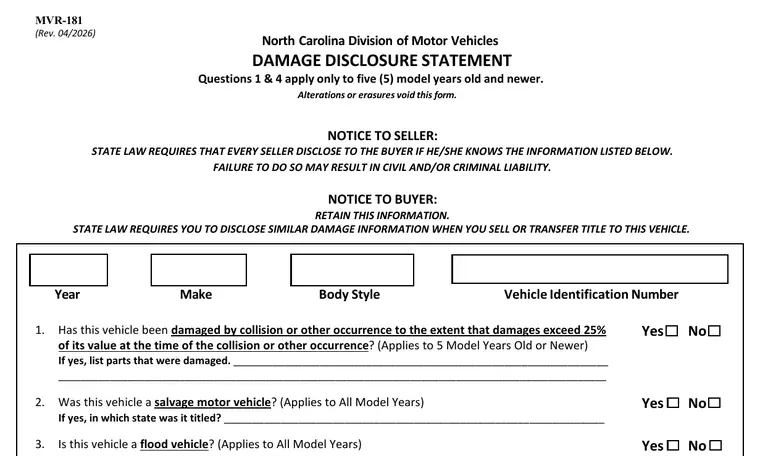
Written against MVR-181 (Rev 04/2026), issued under N.C. General Statute 20-71.4. The three questions that apply to all model years — salvage, flood and reconstructed — do not expire. A car that was flooded twenty years ago still gets a Yes on question 3, and the fact that no title brand ever appeared does not change the answer.

Two documents, and they are not the same thing. Take the blank MVR-181 from the ncdot.gov copy so you get the revision that is current today, then print our MVR-181 guide and keep it beside you while you fill theirs in.

Filled in

What a completed one looks like

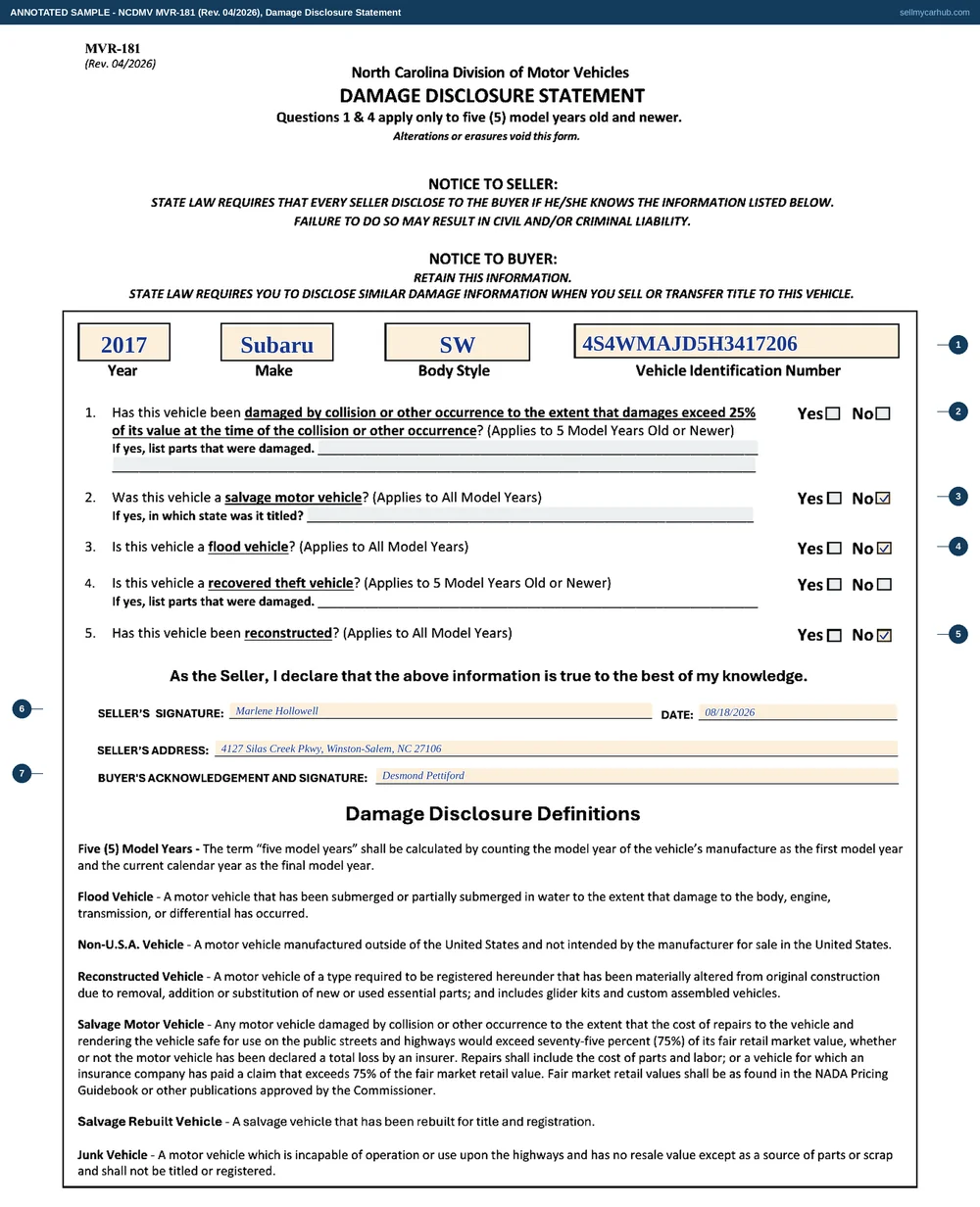
This is the actual MVR-181, rendered from the PDF the North Carolina Division of Motor Vehicles publishes and completed end to end: letterhead, every field, and the blocks at the foot.

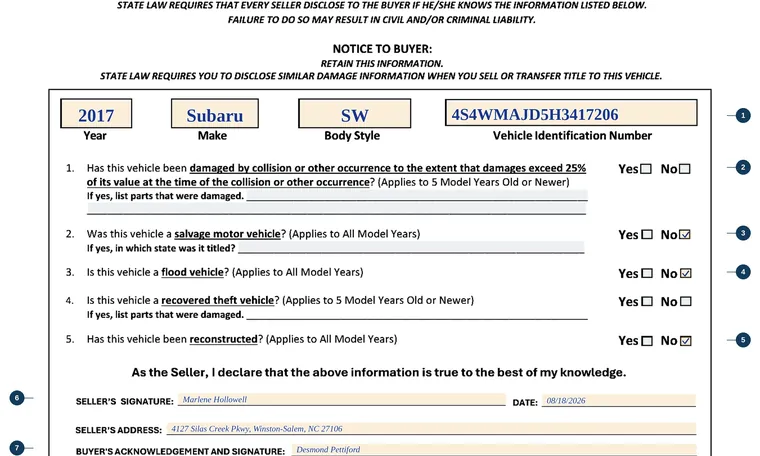
A North Carolina MVR-181 damage disclosure statement filled in for a 2017 Subaru Outback, VIN 4S4WMAJD5H3417206: the collision and recovered theft questions left unanswered because the vehicle is more than five model years old, and No ticked for the salvage, flood and reconstructed questions, with the seller Marlene T. Hollowell signing and dating it and the buyer Desmond A. Pettiford acknowledging underneath.
The actual MVR-181 at revision 04/2026. Questions 1 and 4 are greyed here because the printed heading limits them to vehicles five model years old and newer, and a 2017 sold in 2026 is outside that window. The other three are answered, because they apply to every model year.
Field by field

Every line, in the order you meet it

  1. 1
    You fill this in

    The vehicle row

    Year, make, body style and VIN — four boxes across the top, above question 1.

    Watch out: The year in this box is what decides whether questions 1 and 4 apply to you, so it is worth writing before you read the questions.

  2. 2
    You fill this in

    Question 1, collision damage

    Yes or No: damage exceeding 25% of value at the time of the occurrence, on a vehicle five model years old or newer.

    Watch out: It is not asking whether the car has ever been repaired. It is asking about one threshold on one occurrence, and if the answer is yes the parts that were damaged go on the two lines underneath.

  3. 3
    You fill this in

    Question 2, salvage

    Yes or No, and if yes, the state in which it was titled. This one applies to every model year.

    Watch out: The definitions block at the foot of the form is where salvage is defined, and it is a percentage of fair retail market value rather than a judgement about how bad it looked.

  4. 4
    You fill this in

    Question 3, flood

    Yes or No. All model years, no threshold, no exceptions.

    Watch out: The form's own definition is submerged or partially submerged to the extent that damage to the body, engine, transmission or differential has occurred. Water on the carpets after a window was left open is not that; water over the sills is.

  5. 5
    You fill this in

    Question 5, reconstructed

    Yes or No: materially altered from original construction by the removal, addition or substitution of essential parts.

    Watch out: The definition includes glider kits and custom assembled vehicles. A replacement engine on its own is not a reconstruction; a body swapped onto another chassis is.

  6. 6
    You fill this in

    Seller's signature, date and address

    One line each, directly under the declaration that the information is true to the best of your knowledge.

    Watch out: To the best of your knowledge is the standard, which is why a car you bought second-hand and know nothing about is still answered honestly rather than left blank.

  7. 7
    The buyer fills this in

    Buyer's acknowledgement

    The last line on the form: the buyer signs to acknowledge what you have disclosed.

    Watch out: Keep a copy with the buyer's signature on it. It is the only record you will have that the disclosure was made before the vehicle changed hands, which is what the statute requires.

At a glance

What goes where

On the formWhat to put in it
The headingQuestions 1 and 4 apply only to five model years old and newer, and beneath it the same warning the MVR-180 carries: alterations or erasures void this form.
Notice to sellerState law requires that every seller disclose to the buyer if he or she knows the information listed below, and failure to do so may result in civil and/or criminal liability.
Notice to buyerRetain this information — state law requires you to disclose similar damage information when you sell or transfer title to this vehicle. The form is telling the buyer they will be filling one in themselves one day.
Question 1Has this vehicle been damaged by collision or other occurrence to the extent that damages exceed 25% of its value at the time of the collision? Five model years old or newer only, with two lines to list the parts that were damaged.
Question 2Was this vehicle a salvage motor vehicle? All model years, with a line for the state in which it was titled.
Question 3Is this vehicle a flood vehicle? All model years.
Question 4Is this vehicle a recovered theft vehicle? Five model years old or newer, again with a line for the parts damaged.
Question 5Has this vehicle been reconstructed? All model years.
SignaturesSeller's signature and date, seller's address, then the buyer's acknowledgement and signature underneath.
The definitions blockThe whole bottom half of the sheet: what five model years means, and the department's definitions of flood vehicle, non-U.S.A. vehicle, reconstructed vehicle, salvage motor vehicle, salvage rebuilt vehicle and junk vehicle.

What gets this one rejected

Rules that decide whether it is accepted

Every line here was read off MVR-181 (Rev 04/2026) itself — the PDF is here — and off the North Carolina Division of Motor Vehicles pages. This is plain-language help with a form, not legal advice, and where our wording and the agency's differ, theirs governs.

Back to all North Carolina seller paperwork, or what selling a car in North Carolina involves.

Want the paperwork handled instead?

Get My Instant Offer → Online · about 2 minutes · free

Or send the details — we'll come to you

Flood history, a salvage brand, or a repair you would rather explain once than five times — tell us what happened to it and we will still make an offer.

or call/text (877) 405-1808