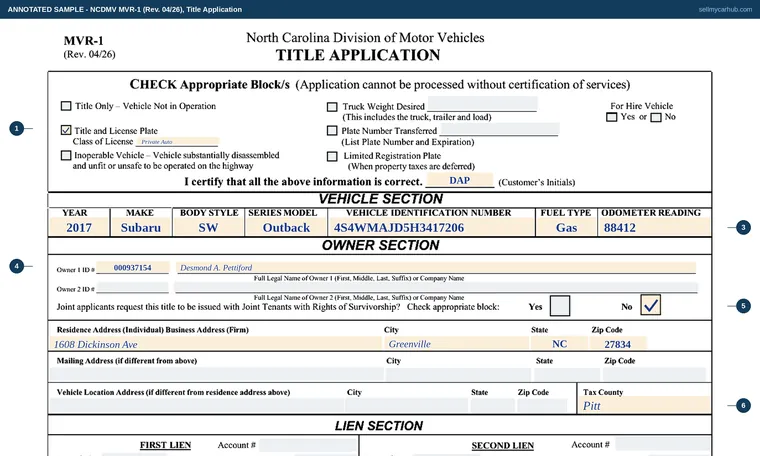
The buyer's application for a North Carolina certificate of title, and the sheet a licence plate agency works from. It is one page that does four jobs at once: it applies for the title, asks for a plate, declares every lien on the vehicle, and certifies that liability insurance is in force. It also has to be signed in front of a notary, which is the part people arrive without.
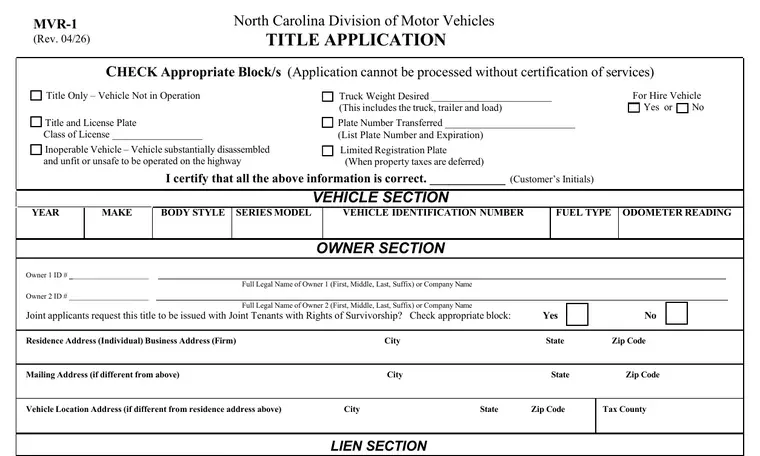
Written against MVR-1 (Rev 04/26), issued under N.C. General Statute 20-52 and 20-73. NCDMV revised this form in April 2026 and the copy in a glovebox or an old email is very likely out of date. Take a fresh one from ncdot.gov, and check the revision in the top-left corner against the one this page was written against.
Two documents, and they are not the same thing. Take the blank MVR-1 from the ncdot.gov copy so you get the revision that is current today, then print our MVR-1 guide and keep it beside you while you fill theirs in.
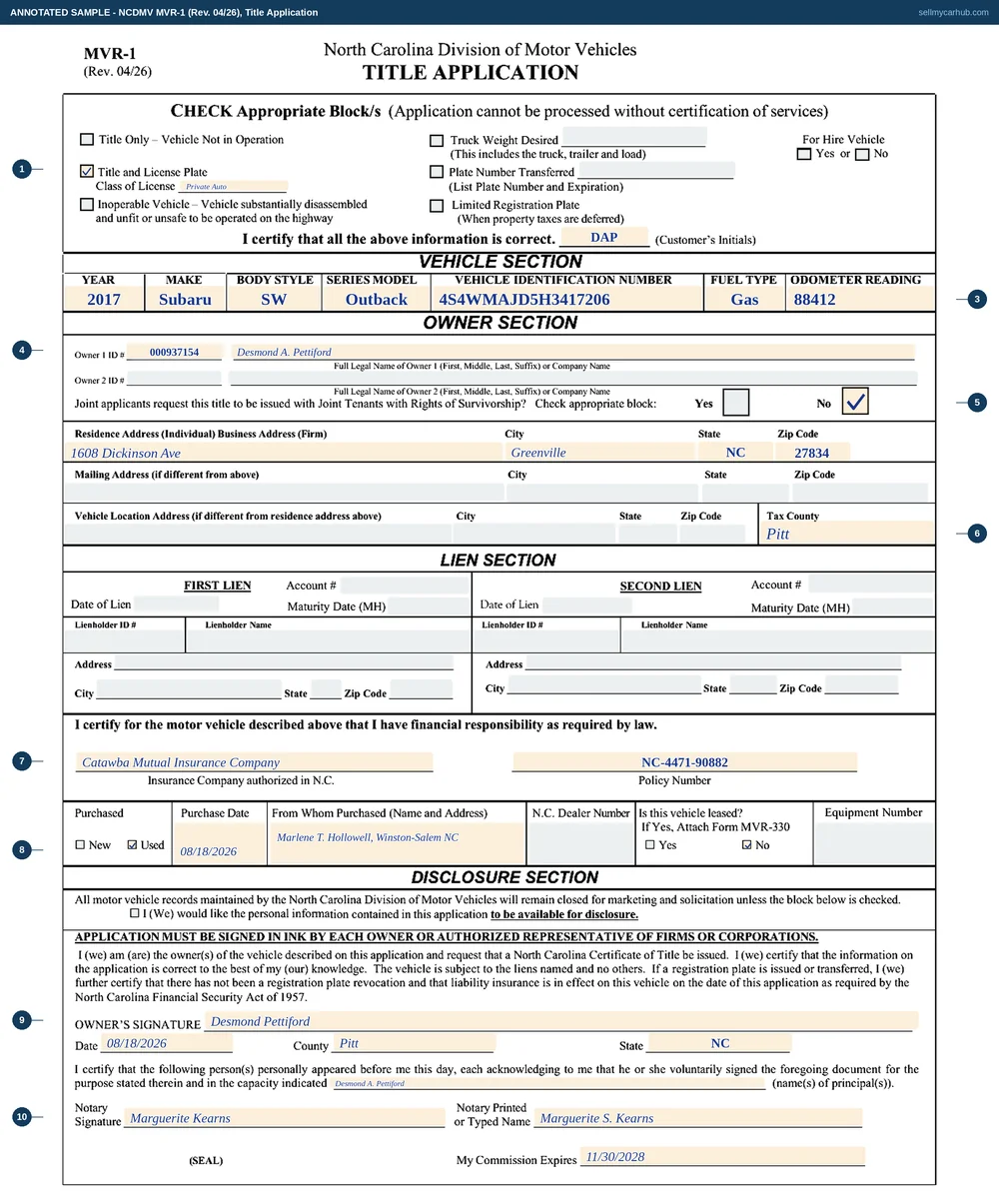
This is the actual MVR-1, rendered from the PDF the North Carolina Division of Motor Vehicles publishes and completed end to end: letterhead, every field, and the blocks at the foot.
Title and License Plate for a car that will be driven, with a class of licence written on the line underneath.
Watch out: Title Only is for a vehicle not in operation and Inoperable Vehicle is narrower still — it describes a car substantially disassembled and unfit or unsafe to be operated on the highway.
Year, make, body style, series model, VIN, fuel type and odometer reading, taken from the assigned certificate.
Watch out: Body style is the Division's two-letter abbreviation rather than a word — SW for a station wagon, 4S for a four-door, TK for a truck. NCDMV lists the acceptable codes on the MVR-92A.
Whole miles, matching the figure you wrote in the odometer window on the back of the title.
Watch out: Two documents with two different readings on them is a mileage discrepancy in NCDMV's eyes, and it brands the record. Copy the number, do not recall it.
The buyer's driver licence number and their full legal name with any suffix.
Watch out: Full legal name means what the licence says. A shortened first name here and the full one on the identification is a mismatch the agent has to resolve at the counter.
A yes/no pair, answered by joint applicants only.
Watch out: For one buyer the answer is No. For two, this single box decides what happens to the vehicle when one of them dies, and it cannot be added later without a fresh application.
The county the vehicle will be based in, on the vehicle location line.
Watch out: NCDMV collects the county vehicle property tax with the registration, so this line has a price attached to it. It is the buyer's county, not the one where the paperwork is being filed.
A company authorised in N.C. and the policy number, under the Financial Security Act certification.
Watch out: The certification is signed for the date of the application. A policy that starts the following Monday does not satisfy it.
The purchase date, and the seller's name and address — this is the only line on the form that mentions you.
Watch out: Whether the vehicle was purchased new or used is a separate tick beside it, and a private sale is always used, however few miles are on it.
Signed in ink by each owner or an authorised representative of a firm or corporation, then date, county and state.
Watch out: Signed in the notary's presence. The certificate underneath states that the person named personally appeared, which makes a signature added beforehand a defective one.
Names of the principals, the notary's signature and printed name, the seal and the commission expiry date.
Watch out: A licence plate agency will take the acknowledgment over the counter for the fee NCDMV publishes, which is usually cheaper than finding a notary separately and always faster.
| On the form | What to put in it |
|---|---|
| The check blocks at the top | Title Only – Vehicle Not in Operation, Title and License Plate with a class of licence, Inoperable Vehicle, Limited Registration Plate, plus truck weight desired, a plate number being transferred and a for-hire yes/no. The printed warning beside them: the application cannot be processed without certification of services. |
| Customer's initials | A small box in the middle of the block. The buyer initials to certify that all the above information is correct — the form asks for it separately from the signature at the foot. |
| Vehicle section | Year, make, body style, series model, vehicle identification number, fuel type and odometer reading, all copied from the certificate you assigned rather than off the dashboard. |
| Owner section | Owner 1 ID number and full legal name with suffix, then the same again for a second owner, then the survivorship question: joint applicants request this title to be issued with Joint Tenants with Rights of Survivorship, yes or no. |
| Three addresses | Residence or business address, mailing address if different, and vehicle location address if different — the last one carrying the tax county, which is what sets the county vehicle property tax. |
| Lien section | First and second lien: date of lien, account number, maturity date, lienholder ID number, lienholder name and full address. The certification the buyer signs says the vehicle is subject to the liens named and no others. |
| Financial responsibility | Insurance company authorised in N.C. and policy number, under a printed certification that liability insurance is in effect on the date of the application as required by the North Carolina Financial Security Act of 1957. |
| Purchased new or used | Two tick boxes, then purchase date, from whom purchased with name and address, an N.C. dealer number if there was one, and whether the vehicle is leased — with the instruction to attach an MVR-330 if it is. |
| Disclosure section | One box that opens the record to marketing and solicitation. The printed line says records remain closed unless the block is checked, so leaving it empty is the private answer. |
| Signature and acknowledgment | Owner's signature under the heading that the application must be signed in ink by each owner, then date, county and state, then the notary's certificate naming the principals, signature, printed name, seal and commission expiry. |
Every line here was read off MVR-1 (Rev 04/26) itself — the PDF is here — and off the North Carolina Division of Motor Vehicles pages. This is plain-language help with a form, not legal advice, and where our wording and the agency's differ, theirs governs.
Back to all North Carolina seller paperwork, or what selling a car in North Carolina involves.