Sell My Car Hub

How to fill out North Carolina MVR-180

Your certification of the mileage, signed by you and acknowledged by the buyer. North Carolina puts an odometer window on the certificate of title as well, so this form is not a substitute for that box — it is a second statement that has to agree with it, and it is the document that carries the exemption rule NCDMV's own web pages get wrong.
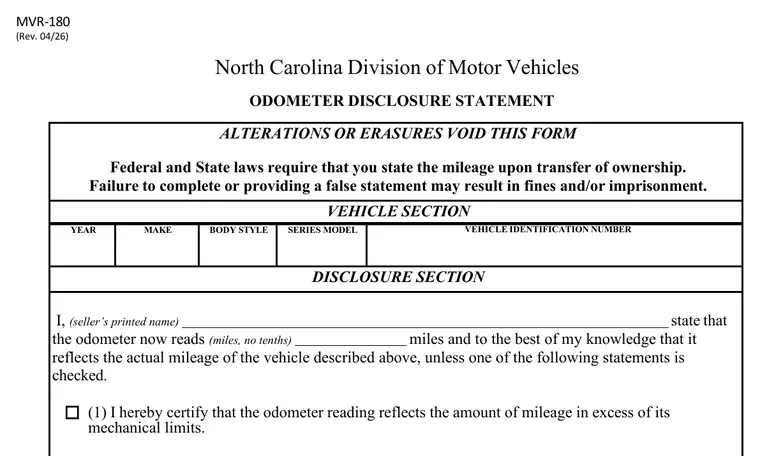
Written against MVR-180 (Rev 04/26), issued under 49 CFR Part 580 and N.C. General Statute 20-347. There are two places to write the mileage on a North Carolina sale and they have to say the same thing — this form and the printed window on the reverse of the title. Fill the title in first, then copy from it.

Two documents, and they are not the same thing. Take the blank MVR-180 from the ncdot.gov copy so you get the revision that is current today, then print our MVR-180 guide and keep it beside you while you fill theirs in.

Filled in

What a completed one looks like

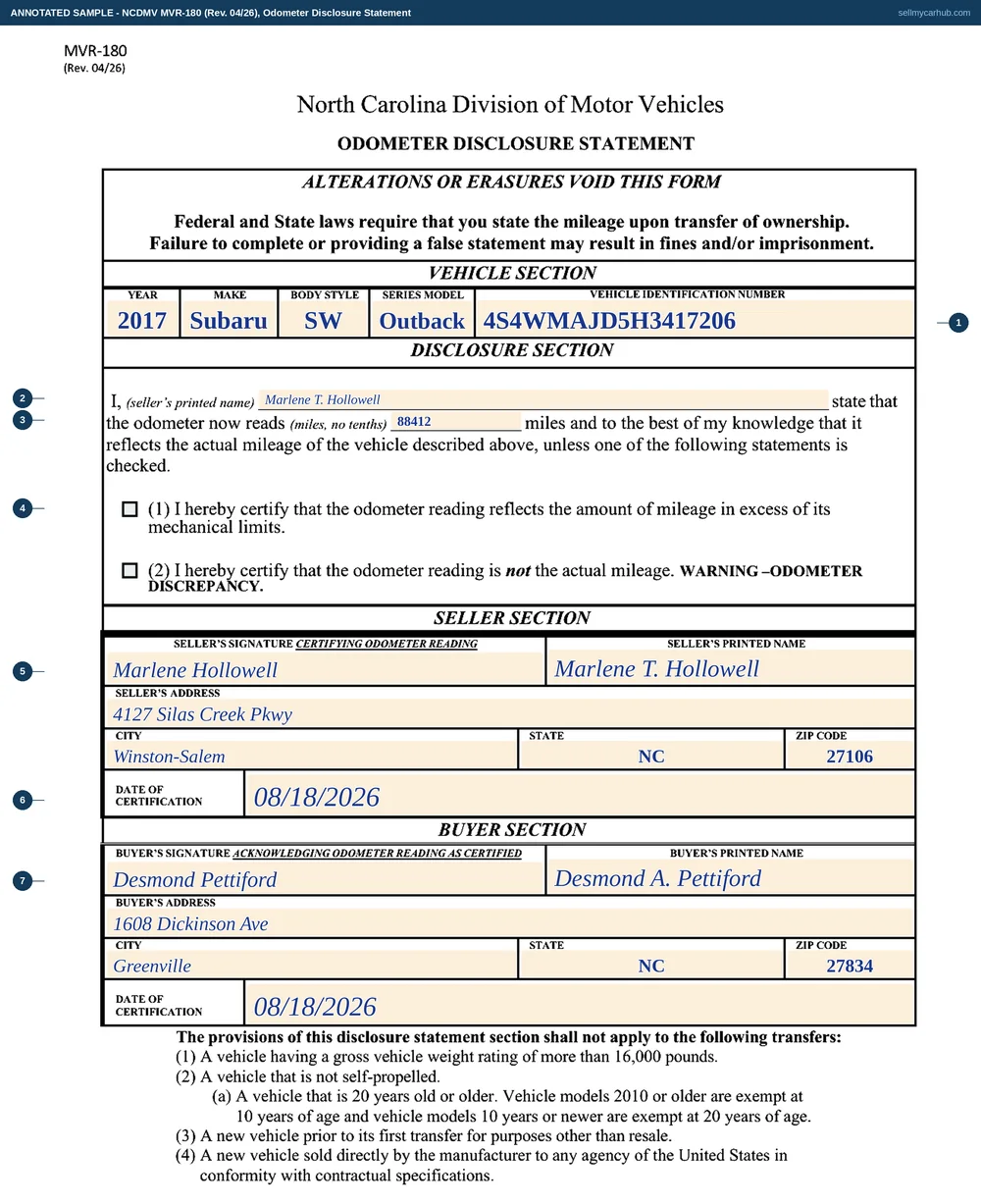
This is the actual MVR-180, rendered from the PDF the North Carolina Division of Motor Vehicles publishes and completed end to end: letterhead, every field, and the blocks at the foot.

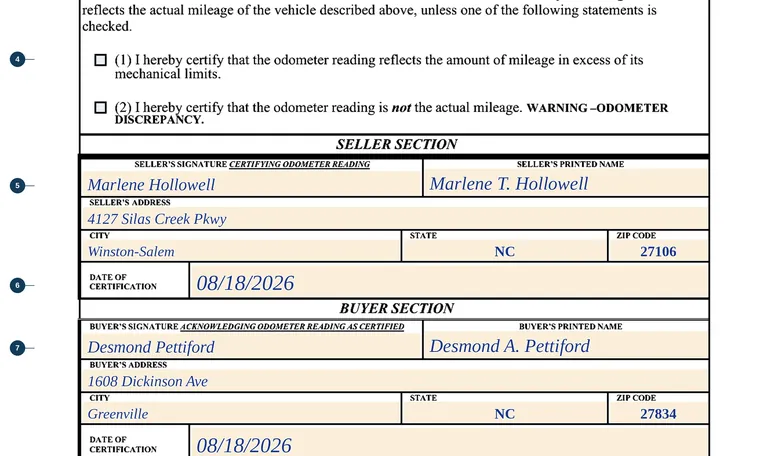
A North Carolina MVR-180 odometer disclosure statement filled in: a 2017 Subaru Outback, VIN 4S4WMAJD5H3417206, seller Marlene T. Hollowell certifying a reading of 88412 miles with neither exception box ticked, her signature, printed name and Winston-Salem address, a certification date of 18 August 2026, and the buyer Desmond A. Pettiford of Greenville signing and dating the acknowledgement underneath.
The actual MVR-180 at revision 04/26. Both exception boxes are deliberately empty, because the sentence above them already certifies the reading as actual mileage unless one is checked — and note the exemption list printed along the bottom, which is the rule that governs rather than the one on NCDMV's forms page.
Field by field

Every line, in the order you meet it

  1. 1
    You fill this in

    Vehicle section

    Five boxes across the head of the sheet: year, make, body style, series model, and then the VIN in the widest one.

    Watch out: Copy the VIN from the face of the title, not from the windscreen plate. Seventeen characters, and I and O never appear in one.

  2. 2
    You fill this in

    Seller's printed name

    Inside the sentence — I, seller's printed name, state that the odometer now reads.

    Watch out: The name on the face of the certificate. If the title has a middle initial, this line has one too.

  3. 3
    You fill this in

    The reading

    Miles, no tenths, in the short box in the middle of the sentence.

    Watch out: Read it on the day you sign, not on the day the buyer first looked at the car. A week of test drives is a different number.

  4. 4
    You fill this in

    The two exception statements

    Tick (1) if the reading is in excess of its mechanical limits, or (2) if the reading is not the actual mileage.

    Watch out: Ticking (2) puts WARNING – ODOMETER DISCREPANCY on the record permanently. It is also the honest answer where a cluster has been replaced, and failing to tick it is a false statement under the warning printed at the top.

  5. 5
    You fill this in

    Seller's signature, printed name and address

    The seller section: sign certifying the reading, print the same name, then street, city, state and ZIP.

    Watch out: This form is not itself notarised — only the title assignment and the MVR-1 are. That is easy to over-correct: do not go looking for a notary block that is not there.

  6. 6
    You fill this in

    Date of certification

    The date you signed, in the box at the foot of the seller section.

    Watch out: It should match the date of the assignment on the title. A gap between them invites a question about which reading was true on the day of sale.

  7. 7
    The buyer fills this in

    Buyer section

    The buyer signs acknowledging the reading as certified, prints their name, gives an address and dates it.

    Watch out: Federal law makes this an acknowledgement rather than a formality. A buyer who will not sign it is a buyer who has not accepted the mileage you have declared.

At a glance

What goes where

On the formWhat to put in it
The warning across the topAlterations or erasures void this form, and then: federal and state laws require that you state the mileage upon transfer of ownership, and failure to complete or providing a false statement may result in fines and/or imprisonment.
Vehicle sectionYear, make, body style, series model and the vehicle identification number. Five boxes across one row.
Disclosure sectionYour printed name, then the reading in miles with no tenths, inside a printed sentence that certifies it reflects the actual mileage unless one of the two statements below is checked.
Statement (1)The odometer reading reflects the amount of mileage in excess of its mechanical limits — the box for a five-digit odometer that has rolled past 99,999.
Statement (2)The odometer reading is not the actual mileage, printed with the words WARNING – ODOMETER DISCREPANCY under it.
Seller sectionSignature certifying the odometer reading, printed name, street address, city, state, ZIP and a date of certification.
Buyer sectionThe mirror image: signature acknowledging the odometer reading as certified, printed name, address, city, state, ZIP and their own date of certification.
The exemption list at the footFour numbered exemptions, and the third of them carries the age rule: a vehicle 20 years old or older, with models 2010 or older exempt at ten years of age and later models at twenty.

What gets this one rejected

Rules that decide whether it is accepted

Every line here was read off MVR-180 (Rev 04/26) itself — the PDF is here — and off the North Carolina Division of Motor Vehicles pages. This is plain-language help with a form, not legal advice, and where our wording and the agency's differ, theirs governs.

Back to all North Carolina seller paperwork, or what selling a car in North Carolina involves.

Want the paperwork handled instead?

Get My Instant Offer → Online · about 2 minutes · free

Or send the details — we'll come to you

Rolled-over odometer, a reading nobody trusts, or a clock that stopped years ago — none of it stops us buying the car.

or call/text (877) 405-1808