Sell My Car Hub

How to fill out North Carolina MVR-613

The form that stops the 3% Highway Use Tax being charged when a car moves between certain family members or in the other narrow situations the statute lists. It is signed by the person receiving the vehicle, not by the seller, and — like almost everything else in North Carolina — it has to be notarised.
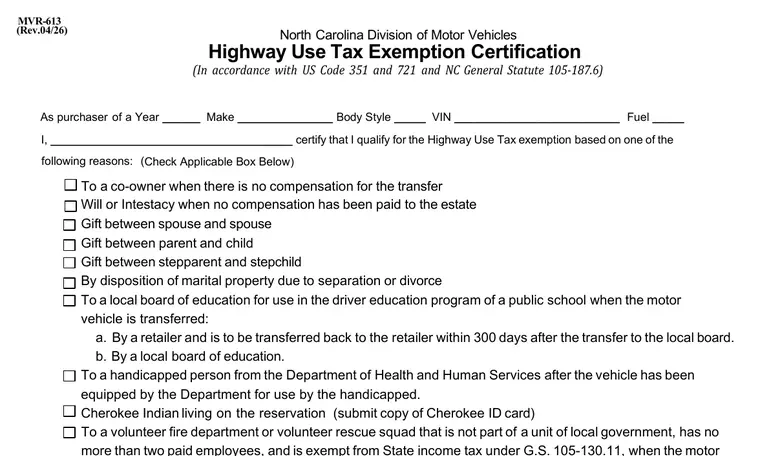
Written against MVR-613 (Rev 04/26), issued under N.C. General Statute 105-187.6. This is the buyer's form in a family transfer, which catches people out — the parent handing the car over signs the title assignment, and the child receiving it signs this. Both signatures need a notary, and they are two separate acknowledgments.

Two documents, and they are not the same thing. Take the blank MVR-613 from the ncdot.gov copy so you get the revision that is current today, then print our MVR-613 guide and keep it beside you while you fill theirs in.

Filled in

What a completed one looks like

This is the actual MVR-613, rendered from the PDF the North Carolina Division of Motor Vehicles publishes and completed end to end: letterhead, every field, and the blocks at the foot.

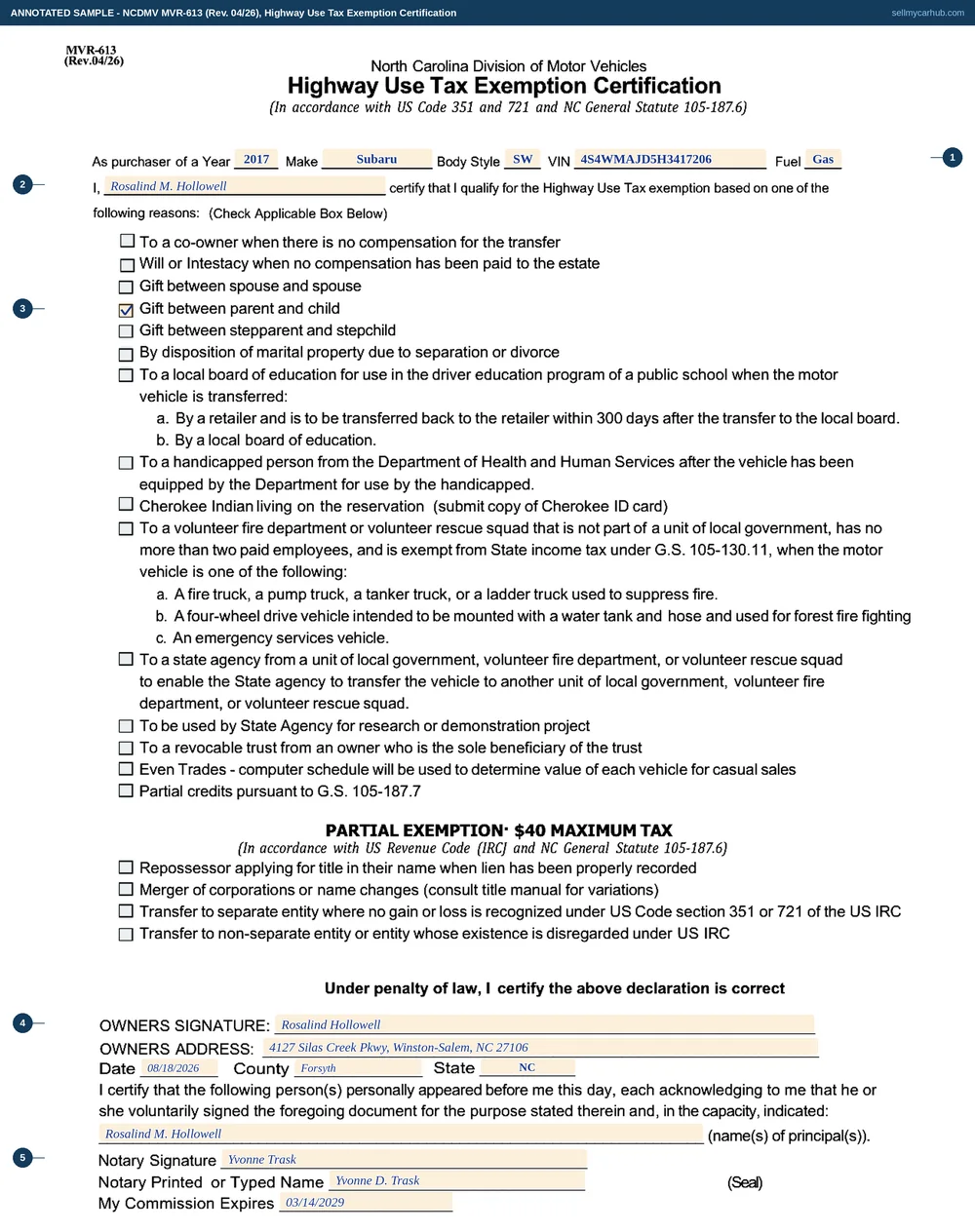
A North Carolina MVR-613 highway use tax exemption certification filled in for a 2017 Subaru Outback, VIN 4S4WMAJD5H3417206, in the name of Rosalind M. Hollowell, with the gift between parent and child box ticked and every other exemption box greyed, followed by the owner's signature, Winston-Salem address and a completed notary block.
The actual MVR-613 at revision 04/26, completed for a parent-to-child gift. Only one box is ticked out of eighteen, and the greyed blocks show how much of this form belongs to volunteer fire departments, boards of education and corporate mergers rather than to a family.
Field by field

Every line, in the order you meet it

  1. 1
    The buyer fills this in

    The vehicle line

    Year, make, body style, VIN and fuel, written into the sentence that starts as purchaser of a.

    Watch out: The sentence gives away who signs this form. It is the purchaser certifying, which in a gift means the person receiving the car.

  2. 2
    The buyer fills this in

    The certifying name

    Your full name in the second sentence, certifying that you qualify based on one of the reasons listed.

    Watch out: The name here should match the name going on to the new title, not the name of whoever drove the car over.

  3. 3
    The buyer fills this in

    The exemption box

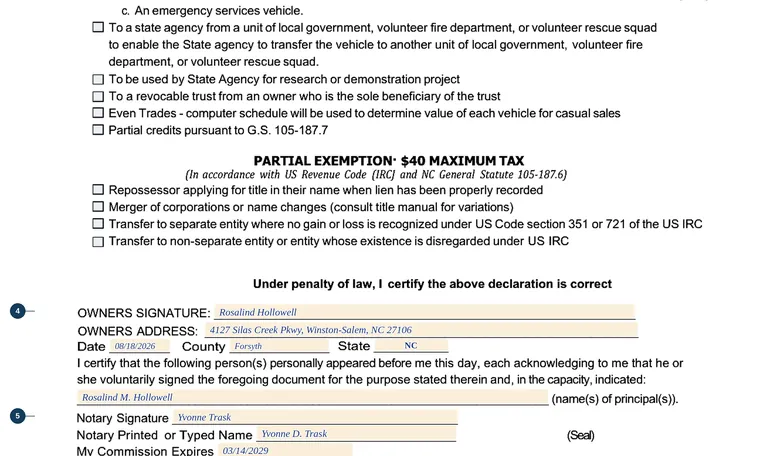
    One tick. For an ordinary family transfer it is gift between spouse and spouse, gift between parent and child, or gift between stepparent and stepchild.

    Watch out: There is no general family box. If the relationship is not one of the ones printed, the tax is due, and no amount of describing it in the margin changes that.

  4. 4
    The buyer fills this in

    Signature and address

    Under the line that reads: under penalty of law, I certify the above declaration is correct. Then the address, date, county and state.

    Watch out: Under penalty of law is not decoration on a tax certificate. A gift box ticked on a sale is a false declaration about money that was actually paid.

  5. 5
    The buyer fills this in

    The notary block

    Names of the principals, the notary's signature and printed name, the seal and the commission expiry.

    Watch out: Take it to the licence plate agency with the title and the MVR-1 and have all the acknowledgments done in one visit. They are charged per signature.

At a glance

What goes where

On the formWhat to put in it
The vehicle lineYear, make, body style, VIN and fuel type, written into a sentence that begins: as purchaser of a.
The certifying nameYour name, in a sentence certifying that you qualify for the exemption based on one of the reasons listed below.
The full exemptionsFourteen tick boxes, and only a handful of them describe an ordinary family: to a co-owner where there is no compensation, will or intestacy where nothing was paid to the estate, gift between spouse and spouse, gift between parent and child, gift between stepparent and stepchild, and disposition of marital property on separation or divorce.
The institutional exemptionsThe rest of the list: a local board of education for driver education, a handicapped person receiving a vehicle equipped by the Department of Health and Human Services, a Cherokee Indian living on the reservation with a copy of the ID card, volunteer fire departments and rescue squads, state agencies, research or demonstration projects, a revocable trust where the owner is the sole beneficiary, and even trades.
The partial exemption blockA separate heading — partial exemption, $40 maximum tax — with four boxes under it: a repossessor applying for title where the lien was properly recorded, a merger or name change, and two transfers to entities under sections 351 and 721 of the US Internal Revenue Code.
Signature blockUnder penalty of law, I certify the above declaration is correct — then the owner's signature, address, date, county and state.
Notary blockThe standard North Carolina acknowledgment: names of the principals, notary signature, printed or typed name, seal and commission expiry.

What gets this one rejected

Rules that decide whether it is accepted

Every line here was read off MVR-613 (Rev 04/26) itself — the PDF is here — and off the North Carolina Division of Motor Vehicles pages. This is plain-language help with a form, not legal advice, and where our wording and the agency's differ, theirs governs.

Back to all North Carolina seller paperwork, or what selling a car in North Carolina involves.

Want the paperwork handled instead?

Get My Instant Offer → Online · about 2 minutes · free

Or send the details — we'll come to you

If the family transfer has stalled and the car has been sitting on the drive since, we will take it as it is.

or call/text (877) 405-1808