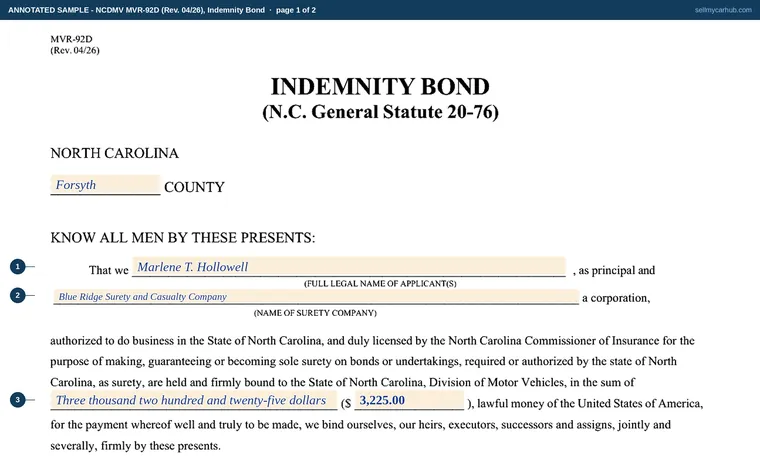
The bond itself: two pages of surety language in which you and an insurance company licensed in North Carolina bind yourselves jointly and severally to the State. It is the only document in the North Carolina seller's set with no notary block on it — the surety's corporate seal and its attorney-in-fact stand in place of one.
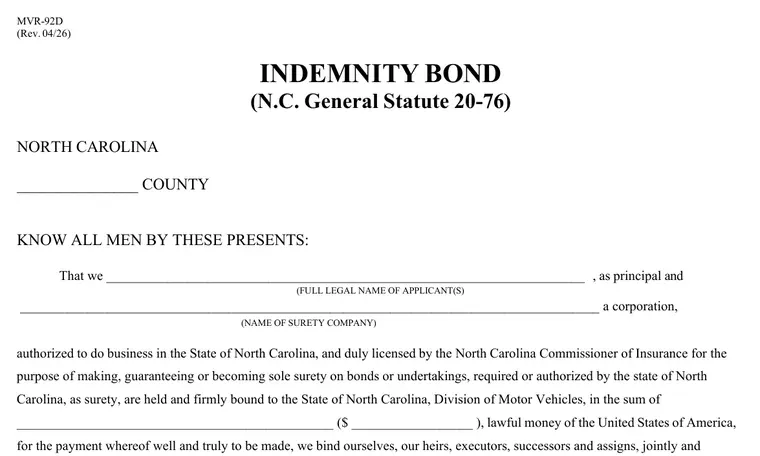
Written against MVR-92D (Rev 04/26), issued under N.C. General Statute 20-76. A surety will price this on the vehicle's value and on you, and the premium is not refunded if the Division rejects the application. That is why the instruction sheet tells you not to buy the bond until the affidavit, the inspection and the valuation are all done.
Two documents, and they are not the same thing. Take the blank MVR-92D from the ncdot.gov copy so you get the revision that is current today, then print our MVR-92D guide and keep it beside you while you fill theirs in.
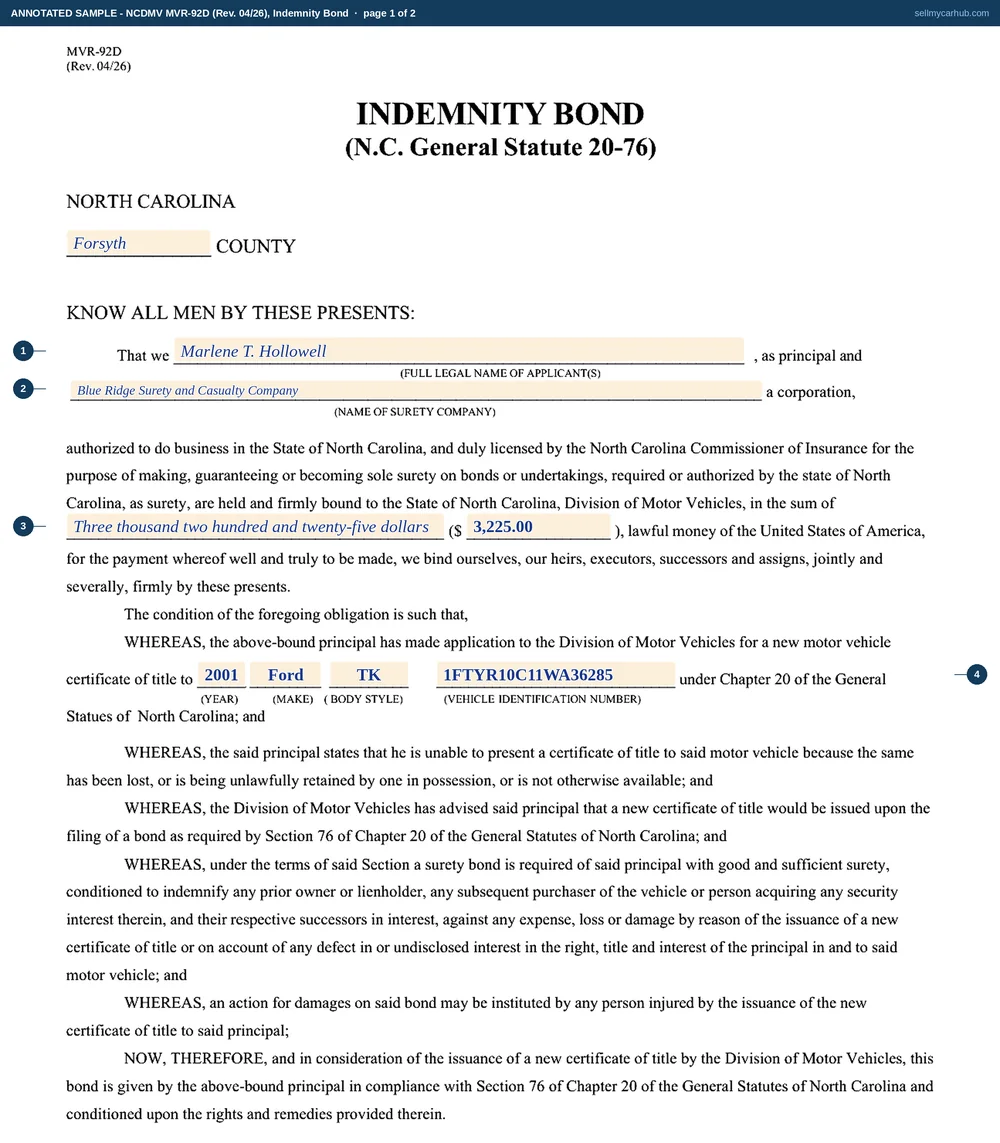
This is all 2 pages of the actual MVR-92D, rendered from the PDF the North Carolina Division of Motor Vehicles publishes and completed end to end: letterhead, every field, and the blocks at the foot.
Your full legal name on the first blank of page one, above the words as principal.
Watch out: It has to match the MVR-1 and the inspector's report exactly. The instruction sheet says identical, and licence plate agencies read it that way.
The name of the insurance company, on the line beneath yours.
Watch out: The printed text describes it as duly licensed by the North Carolina Commissioner of Insurance. Ask the agent to confirm that before you pay a premium.
Written out in words on the line, and again in figures in the bracket.
Watch out: One and one-half times the Division's schedule value, or one and one-half times the highest of two dealer appraisals where the vehicle is not in the schedule.
Year, make, body style and VIN inside the recital about the application to the Division.
Watch out: Body style is the Division's code, and the acceptable list is printed on the MVR-92A rather than on this form.
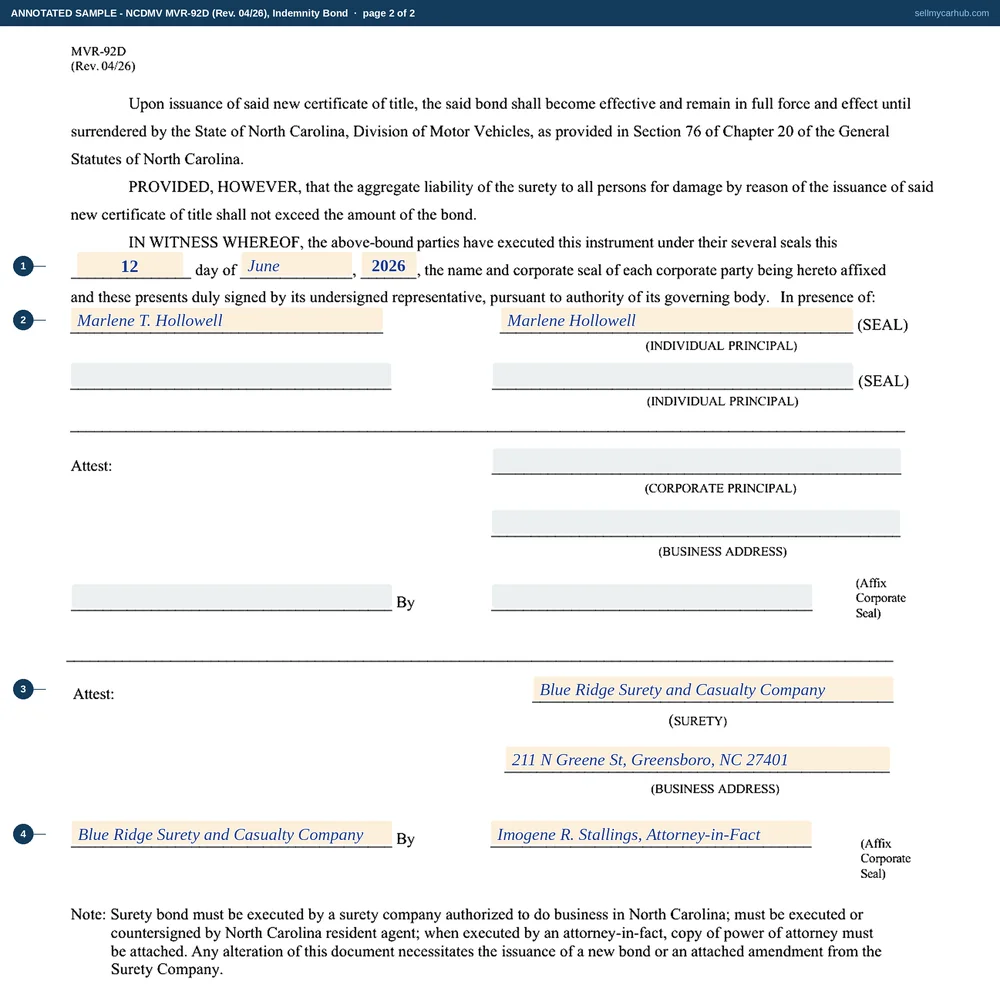
Day, month and year at the top of page two.
Watch out: The bond becomes effective when the certificate is issued rather than when it is signed — but the Division still reads the date, and a bond executed before the valuation was done invites a question.
Your signature under seal, with a witness signing in the column to the left.
Watch out: Both the applicant and the bonding company sign on this side. A bond returned with only the surety's signature on it is incomplete.
The company name, its business address, and an authorised signatory — usually an attorney-in-fact.
Watch out: The power of attorney appointing that person has to be attached to the bond. It is the document that proves the signature binds the insurer.
| On the form | What to put in it |
|---|---|
| County | The county the bond is executed in, on the line under the state heading. |
| Principal and surety | Your full legal name as principal, and the name of the surety company underneath — described in the printed text as a corporation authorised to do business in the State of North Carolina and duly licensed by the North Carolina Commissioner of Insurance. |
| The sum | Written in words on one line and in figures in the bracket beside it, described as lawful money of the United States of America. |
| The vehicle | Year, make, body style and vehicle identification number, inside the recital that the principal has applied for a new motor vehicle certificate of title under Chapter 20. |
| The recitals | Three whereas clauses: that the principal is unable to present a certificate because it has been lost, is being unlawfully retained by one in possession, or is not otherwise available; that a new certificate would be issued on the filing of a bond; and that the bond indemnifies any prior owner or lienholder, any subsequent purchaser and their successors. |
| The duration clause | On page two: upon issuance of the new certificate the bond becomes effective and remains in full force and effect until surrendered by the Division. |
| The liability cap | The aggregate liability of the surety to all persons for damage by reason of the issuance of the new certificate shall not exceed the amount of the bond. |
| The execution block | Day, month and year, then a witness column beside signature lines for the individual principals, a corporate principal with a business address, and the surety with its own business address and an authorised signatory. |
Every line here was read off MVR-92D (Rev 04/26) itself — the PDF is here — and off the North Carolina Division of Motor Vehicles pages. This is plain-language help with a form, not legal advice, and where our wording and the agency's differ, theirs governs.
Back to all North Carolina seller paperwork, or what selling a car in North Carolina involves.