Sell My Car Hub

How to fill out North Carolina MVR-92H

Nine questions, sworn in front of a notary, and the substance of the whole bonded-title application. The instruction across the top is not a suggestion: the following questions must be answered in detail, and any omissions or incomplete answers could result in a delay or denial in the issuance of a title.
Written against MVR-92H (Rev 04/26), issued under N.C. General Statute 20-76. Write this one out in rough first. Question 8 is the question the Division decides on, and a sworn statement is a poor place to be improvising a chronology you have not checked.

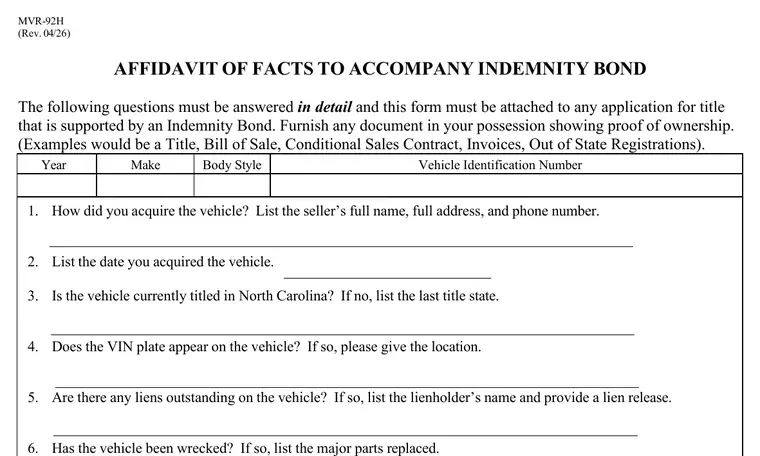
Two documents, and they are not the same thing. Take the blank MVR-92H from the ncdot.gov copy so you get the revision that is current today, then print our MVR-92H guide and keep it beside you while you fill theirs in.

Filled in

What a completed one looks like

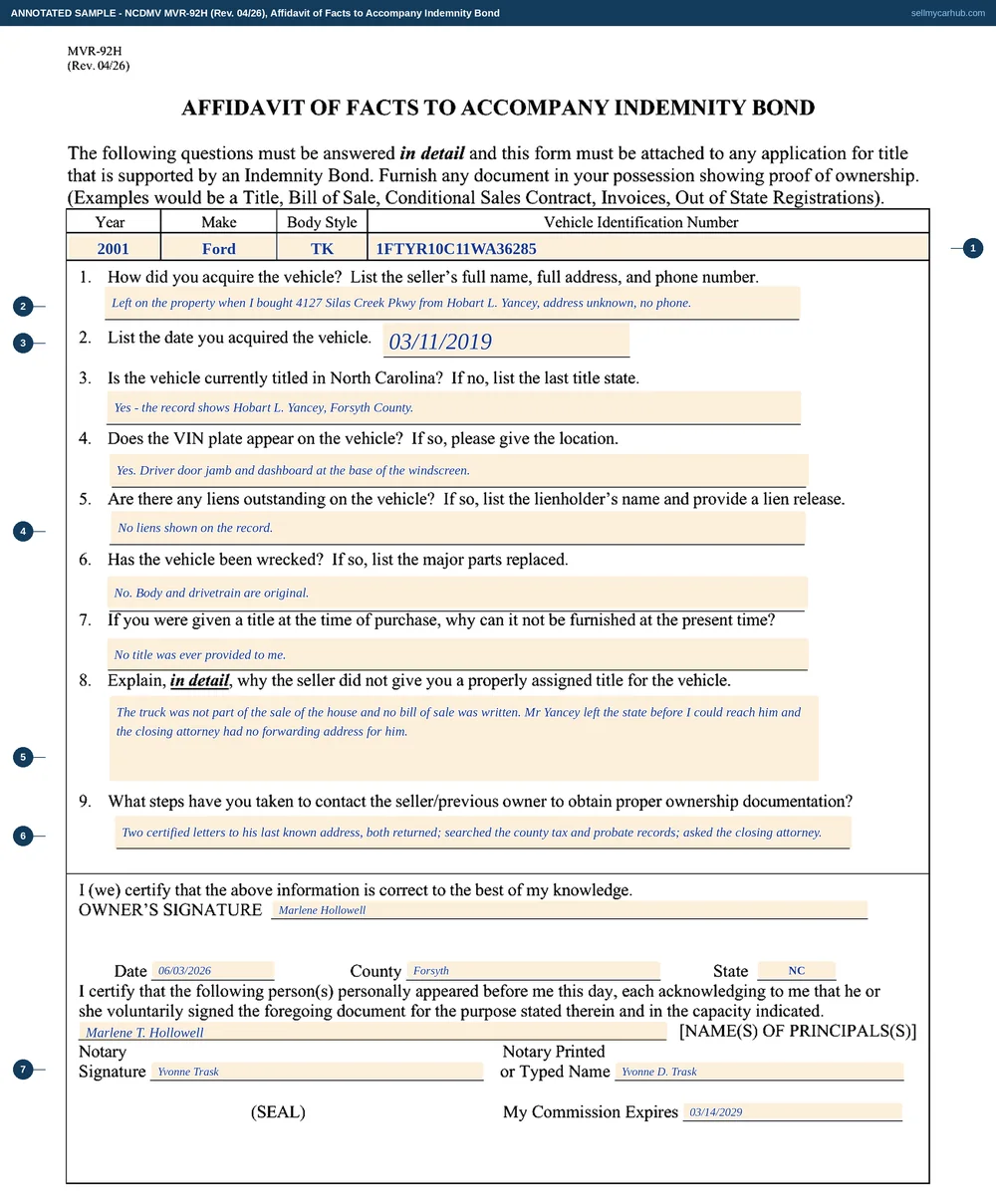
This is the actual MVR-92H, rendered from the PDF the North Carolina Division of Motor Vehicles publishes and completed end to end: letterhead, every field, and the blocks at the foot.

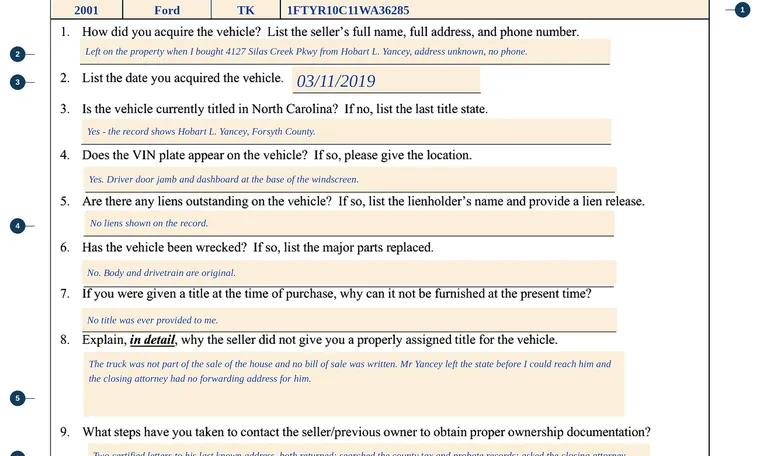
A North Carolina MVR-92H affidavit of facts filled in for a 2001 Ford Ranger with VIN 1FTYR10C11WA36285: nine answered questions describing a truck left on a property when the house was bought, acquired in March 2019, currently titled in North Carolina to the previous owner, with the VIN plate located on the driver door jamb, no liens, no accident damage, no title ever provided, and two certified letters and a records search among the steps taken to trace the seller, all sworn in front of a notary in June 2026.
The actual MVR-92H at revision 04/26. The interesting box is the ninth: NCDMV is deciding whether a bond is justified, and the answer to what steps you have taken is the one that argues your case. Every line here is amber because on this form everything is the applicant's.
Field by field

Every line, in the order you meet it

  1. 1
    You fill this in

    The vehicle row

    Four boxes in the strip above question 1: year, make, body style, and the vehicle identification number.

    Watch out: Note 1 on the instruction sheet is worth reading first: a 1981 or newer vehicle should have a seventeen-digit VIN, and a shorter one on a newer car is a problem in its own right.

  2. 2
    You fill this in

    Question 1, how you acquired it

    The seller's full name, full address and telephone number.

    Watch out: If you do not have them, say so and say why here rather than leaving the box empty. A blank reads as an unanswered question; an explanation reads as an answer.

  3. 3
    You fill this in

    Question 2, the date

    The date you acquired the vehicle.

    Watch out: Approximate it honestly if you have to. A date that conflicts with a document you attach is worse than a month you have described as approximate.

  4. 4
    You fill this in

    Question 5, outstanding liens

    Whether any lien is outstanding, the lienholder's name, and a release attached.

    Watch out: This is one of the nine refusals in disguise. A bond is not acceptable where there is an outstanding lien for which a cancellation cannot be furnished, so an honest yes here may end the application.

  5. 5
    You fill this in

    Question 8, why there was no assigned title

    The longest box on the form, and an explanation in detail.

    Watch out: Chronology, names, dates. The Division is being asked to issue a title against a bond and this paragraph is the reason it might.

  6. 6
    You fill this in

    Question 9, the steps you took

    What you did to contact the seller or previous owner.

    Watch out: Certified letters, county records, the closing attorney, the last known employer — list them with dates. Effort you cannot describe is effort the Division cannot count.

  7. 7
    You fill this in

    Signature and notary block

    Your signature, then date, county, state, the names of the principals, and the notary's signature, printed name, seal and expiry.

    Watch out: Do this before the inspection appointment, not after. The instruction sheet puts the affidavit at step 1 and the inspection at step 2 for a reason.

At a glance

What goes where

On the formWhat to put in it
Vehicle rowYear, make, body style and vehicle identification number.
Question 1How did you acquire the vehicle? List the seller's full name, full address and phone number.
Question 2List the date you acquired the vehicle.
Question 3Is the vehicle currently titled in North Carolina? If no, list the last title state.
Question 4Does the VIN plate appear on the vehicle? If so, please give the location.
Question 5Are there any liens outstanding on the vehicle? If so, list the lienholder's name and provide a lien release.
Question 6Has the vehicle been wrecked? If so, list the major parts replaced.
Question 7If you were given a title at the time of purchase, why can it not be furnished at the present time?
Question 8Explain, in detail, why the seller did not give you a properly assigned title for the vehicle. This is the longest box on the sheet, and deliberately so.
Question 9What steps have you taken to contact the seller or previous owner to obtain proper ownership documentation?
Signature and acknowledgmentOwner's signature under the certification that the information is correct, then date, county and state, and a full notary block.

What gets this one rejected

Rules that decide whether it is accepted

Every line here was read off MVR-92H (Rev 04/26) itself — the PDF is here — and off the North Carolina Division of Motor Vehicles pages. This is plain-language help with a form, not legal advice, and where our wording and the agency's differ, theirs governs.

Back to all North Carolina seller paperwork, or what selling a car in North Carolina involves.

Want the paperwork handled instead?

Get My Instant Offer → Online · about 2 minutes · free

Or send the details — we'll come to you

If a vehicle you cannot prove you own has been sitting on the drive for years, tell us the story. It is a more common one than you would think.

or call/text (877) 405-1808