Sell My Car Hub

How to fill out Connecticut H-115

The affidavit for a car whose paper trail has a hole in it. Connecticut asks a would-be owner to write out, in their own words, how they came to own the vehicle - and the box it gives them for the purpose is the largest single field in the state's whole vehicle set. It is used for a homemade vehicle, for a lien release that cannot be obtained because the lender no longer exists, and for the cars that arrive with a bill of sale and nothing else.
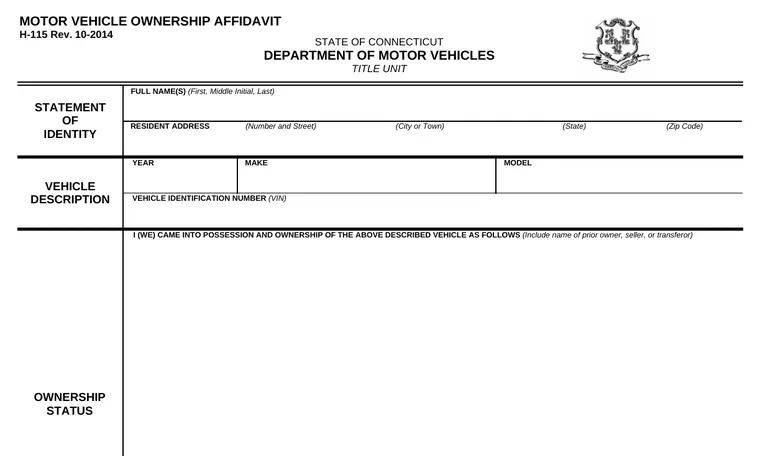
Written against H-115 (Rev 10-2014), issued under Conn. Gen. Stat. s. 14-171(a) and s. 14-176, administered by the DMV Title Unit. This is a sworn statement about how you came to own something, made to a commissioner who can revoke the resulting title and leave you liable to whoever had the better claim. Write the ownership status box carefully, name the person you got the car from, and keep whatever paperwork you do have rather than relying on the affidavit alone.

Two documents, and they are not the same thing. Take the blank H-115 from the portal.ct.gov copy so you get the revision that is current today.

Filled in

What a completed one looks like

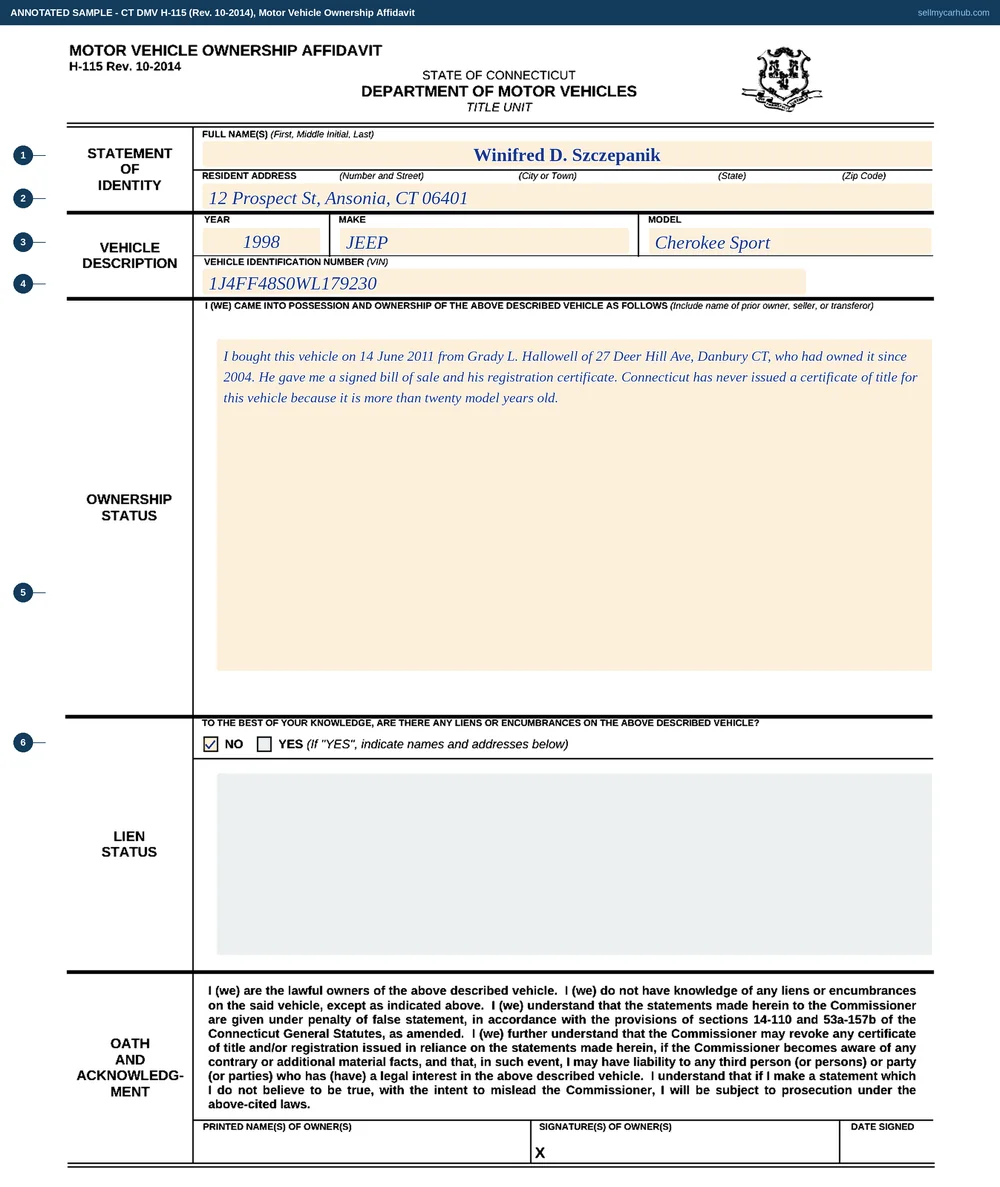
This is the actual H-115, rendered from the PDF the Connecticut Department of Motor Vehicles publishes and completed end to end: letterhead, every field, and the blocks at the foot.

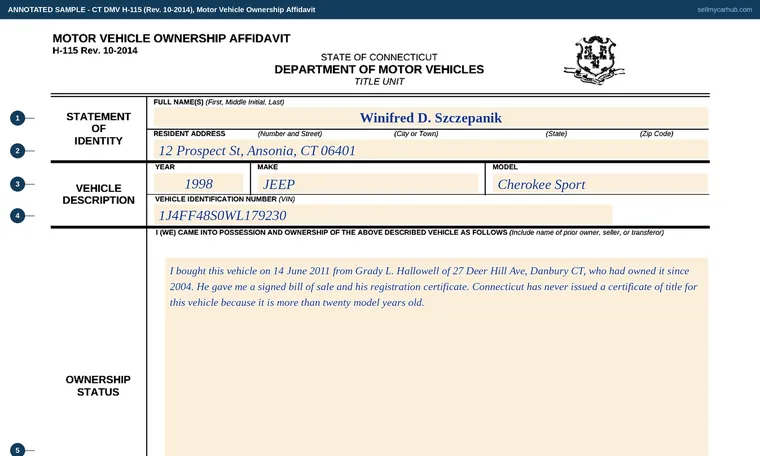
A completed Connecticut Motor Vehicle Ownership Affidavit, form H-115. The statement of identity names Winifred D. Szczepanik of 12 Prospect Street, Ansonia, CT 06401. The vehicle description gives the year 1998, make Jeep, model Cherokee Sport and the identification number 1J4FF48S0WL179230. The ownership status box carries a written account of buying the vehicle from a named prior owner in 2011 with a bill of sale and the last registration certificate, and of Connecticut never having issued a title for it. Under lien status the NO box is ticked.
Filled in for a car more than twenty model years old that Connecticut never titled, where the owner is being asked to account for a chain of ownership that has no certificate in it. The lien names box is greyed because the answer was no. Every name and number here is invented for the sample.
Field by field

Every line, in the order you meet it

  1. 1
    You fill this in

    Full Name(s)

    First, middle initial, last. Two people may swear one affidavit where two people own the car.

    Watch out: Use the form of your name that appears on the registration certificate and on whatever bill of sale you are relying on. Consistency across the documents is most of what this affidavit is buying you.

  2. 2
    You fill this in

    Resident Address

    One line, number and street through to ZIP.

    Watch out: A resident address, not a PO box - the department's registration forms refuse one and this affidavit sits alongside them.

  3. 3
    You fill this in

    Year, Make, Model

    Three description boxes.

    Watch out: Take them from the last registration certificate if there is one. An affidavit that describes the car differently from the department's own record raises the question it is meant to settle.

  4. 4
    You fill this in

    Vehicle Identification Number

    Seventeen characters, in a box of its own.

    Watch out: On a vehicle this old the VIN may be shorter than seventeen characters, and that is normal - copy exactly what is on the vehicle and the registration.

  5. 5
    You fill this in

    Ownership Status

    The largest box on the sheet, and the department's instruction is to include the name of the prior owner, seller or transferor.

    Watch out: Write a sequence with dates in it, not a sentence. When you got it, from whom, what changed hands, and what documents exist - that is what makes an affidavit worth reading.

  6. 6
    You fill this in

    Lien Status, and the oath beneath it

    NO or YES, with names and addresses in the box below where the answer is yes. Under that sits the oath, with printed name, signature and date rules.

    Watch out: A YES here is not fatal; an unanswered question is, because it is the half of the oath about encumbrances. There is no notary and no witness, which makes the affidavit quicker to sign and no less serious once signed.

At a glance

What goes where

On the formWhat to put in it
Statement of Identity: Full Name(s)First, middle initial, last. Two people can swear the same affidavit.
Resident AddressNumber and street, city or town, state and ZIP on one line.
Vehicle Description: Year, Make, ModelThree boxes across one row.
Vehicle Identification Number (VIN)A full-width box of its own beneath them.
Ownership StatusThe department's own question and the biggest box on the sheet: I (we) came into possession and ownership of the above described vehicle as follows - include name of prior owner, seller, or transferor.
Lien StatusTo the best of your knowledge, are there any liens or encumbrances on the above described vehicle? A NO/YES pair, and a large box for names and addresses where the answer is yes.
Oath and AcknowledgmentFive sentences. I (we) are the lawful owners of the above described vehicle. I (we) do not have knowledge of any liens or encumbrances on the said vehicle, except as indicated above - then the false statement warning, then a warning that the Commissioner may revoke any certificate of title and/or registration issued in reliance on the statements made herein, and that in that event the affiant may have liability to any third person or party with a legal interest in the vehicle.
Printed Name(s) of Owner(s), Signature(s) of Owner(s), Date SignedThree boxes across the foot. No notary block, no witness line.

What gets this one rejected

Rules that decide whether it is accepted

Every line here was read off H-115 (Rev 10-2014) itself — the PDF is here — and off the Connecticut Department of Motor Vehicles pages. This is plain-language help with a form, not legal advice, and where our wording and the agency's differ, theirs governs.

Back to all Connecticut seller paperwork, or what selling a car in Connecticut involves.

Want the paperwork handled instead?

Get My Instant Offer → Online · about 2 minutes · free

Or send the details — we'll come to you

A car with a bill of sale and no history behind it is still worth something. Tell us what you know about it and we will tell you what we can do.

or call/text (877) 405-1808