The last resort, and it is expensive. Where the commissioner is not satisfied that you own the car - or that there is no hidden lien on it - section 14-176 offers two outcomes: no certificate at all until you produce better documents, or a certificate against a bond. The bond is not for the value of the vehicle. It is for twice the value of the vehicle, it runs for five years, and this form is the instrument that creates it.
Written against H-113 (Rev 9-2018), issued under Conn. Gen. Stat. s. 14-176, withholding of certificate and bond requirement, with a bond filing fee under s. 14-192(a)(11). The number in the amount box is the one to check before anything else. Twice the value of the vehicle as determined by the commissioner is not the same as twice what you paid, and it is not negotiable at the counter - so establish the figure before you approach a surety, and expect the premium to be quoted against it.
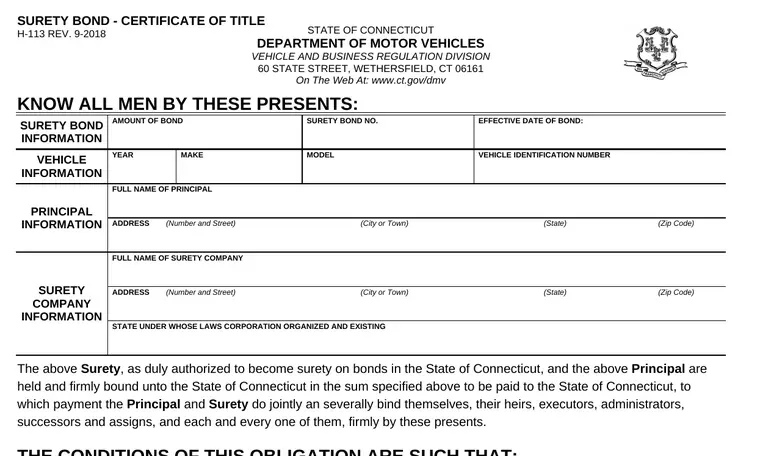
Two documents, and they are not the same thing. Take the blank H-113 from the portal.ct.gov copy so you get the revision that is current today.
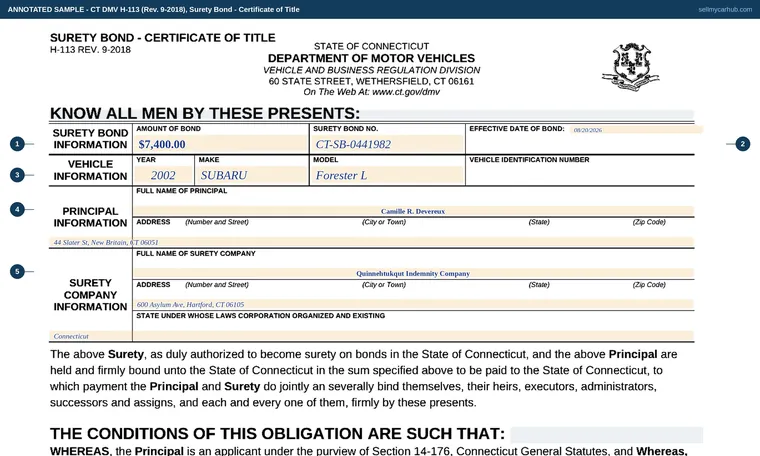
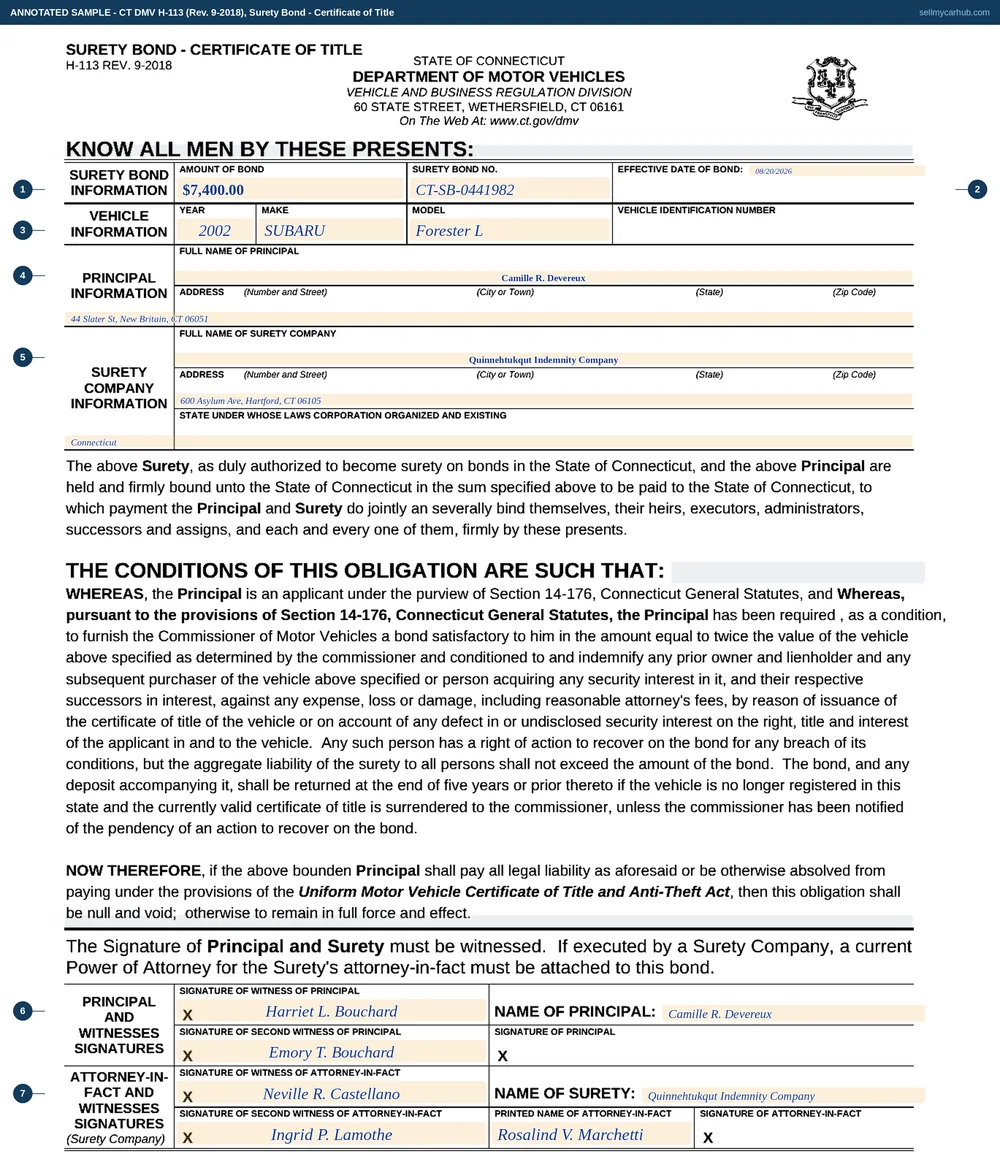
This is the actual H-113, rendered from the PDF the Connecticut Department of Motor Vehicles publishes and completed end to end: letterhead, every field, and the blocks at the foot.
Twice the value of the vehicle, as determined by the commissioner rather than by you or the surety.
Watch out: Establish this figure with the department first. A surety will quote a premium against it, and quoting the wrong number wastes the application.
Issued by the surety company. Not yours to invent.
Watch out: The effective date matters because the five-year clock in the conditions paragraph runs from it.
The vehicle the bond is attached to. A bond follows one car and one VIN.
Watch out: The VIN column on this form is the one cell the department ruled no line under, which is why it is empty in the sample above rather than filled - write it in by hand. It also appears on the title legend the department will print, so a mistyped one protects nobody.
You - the applicant for the certificate. The bond binds you jointly and severally with the surety.
Watch out: Jointly and severally means the state can come to you for the whole amount. This is not a fee, it is an obligation.
The company's full name, address, and the state under whose laws it is organised and existing.
Watch out: It has to be authorised to write bonds in Connecticut. A surety licensed elsewhere and not here does not satisfy the paragraph above the signatures.
Your signature and your printed name, each attested by two witness signatures.
Watch out: This is one of only two places in the Connecticut seller set where a signature needs anybody else present - the other is the A-83, which needs a notary as well.
The surety's side of the same block, with the printed name of the attorney-in-fact and the name of the surety.
Watch out: A current power of attorney for that attorney-in-fact has to be attached. A bond arriving without one is incomplete on the face of the form.
| On the form | What to put in it |
|---|---|
| Amount of Bond | The figure the commissioner sets. The obligation paragraph explains how: a bond in the amount equal to twice the value of the vehicle above specified as determined by the commissioner. |
| Surety Bond No., and Effective Date of Bond | Two boxes from the surety company that issues it. |
| Vehicle Information: Year, Make, Model, Vehicle Identification Number | Four boxes identifying the car the bond is attached to. |
| Principal Information: Full Name of Principal, and Address | You. The word principal means the person applying for the title, and the bond binds you as well as the surety. |
| Surety Company Information: Full Name of Surety Company, Address, and State under whose laws the corporation is organized and existing | The company standing behind the bond, and where it is incorporated. |
| The obligation paragraph | The above Surety, as duly authorized to become surety on bonds in the State of Connecticut, and the above Principal are held and firmly bound unto the State of Connecticut in the sum specified above ... jointly and severally. |
| The conditions paragraph | Conditioned to indemnify any prior owner and lienholder and any subsequent purchaser of the vehicle above specified or person acquiring any security interest in it, and their respective successors in interest, against any expense, loss or damage, including reasonable attorney's fees, by reason of the issuance of the certificate of title of the vehicle or on account of any defect in or undisclosed security interest on the right, title and interest of the applicant. |
| The five-year clause | The bond, and any deposit accompanying it, shall be returned at the end of five years or prior thereto if the vehicle is no longer registered in this state and the currently valid certificate of title is surrendered to the commissioner, unless the commissioner has been notified of the pendency of an action to recover on the bond. |
| Principal and Witnesses Signatures | Signature of witness of principal, signature of second witness of principal, name of principal and signature of principal - four boxes. The form's own instruction above them: the Signature of Principal and Surety must be witnessed. |
| Attorney-in-Fact and Witnesses Signatures (Surety Company) | The same again on the surety's side, with the printed name of the attorney-in-fact and the name of the surety. |
| The power of attorney requirement | If executed by a Surety Company, a current Power of Attorney for the Surety's attorney-in-fact must be attached to this bond. |
Every line here was read off H-113 (Rev 9-2018) itself — the PDF is here — and off the Connecticut Department of Motor Vehicles pages. This is plain-language help with a form, not legal advice, and where our wording and the agency's differ, theirs governs.
Back to all Connecticut seller paperwork, or what selling a car in Connecticut involves.