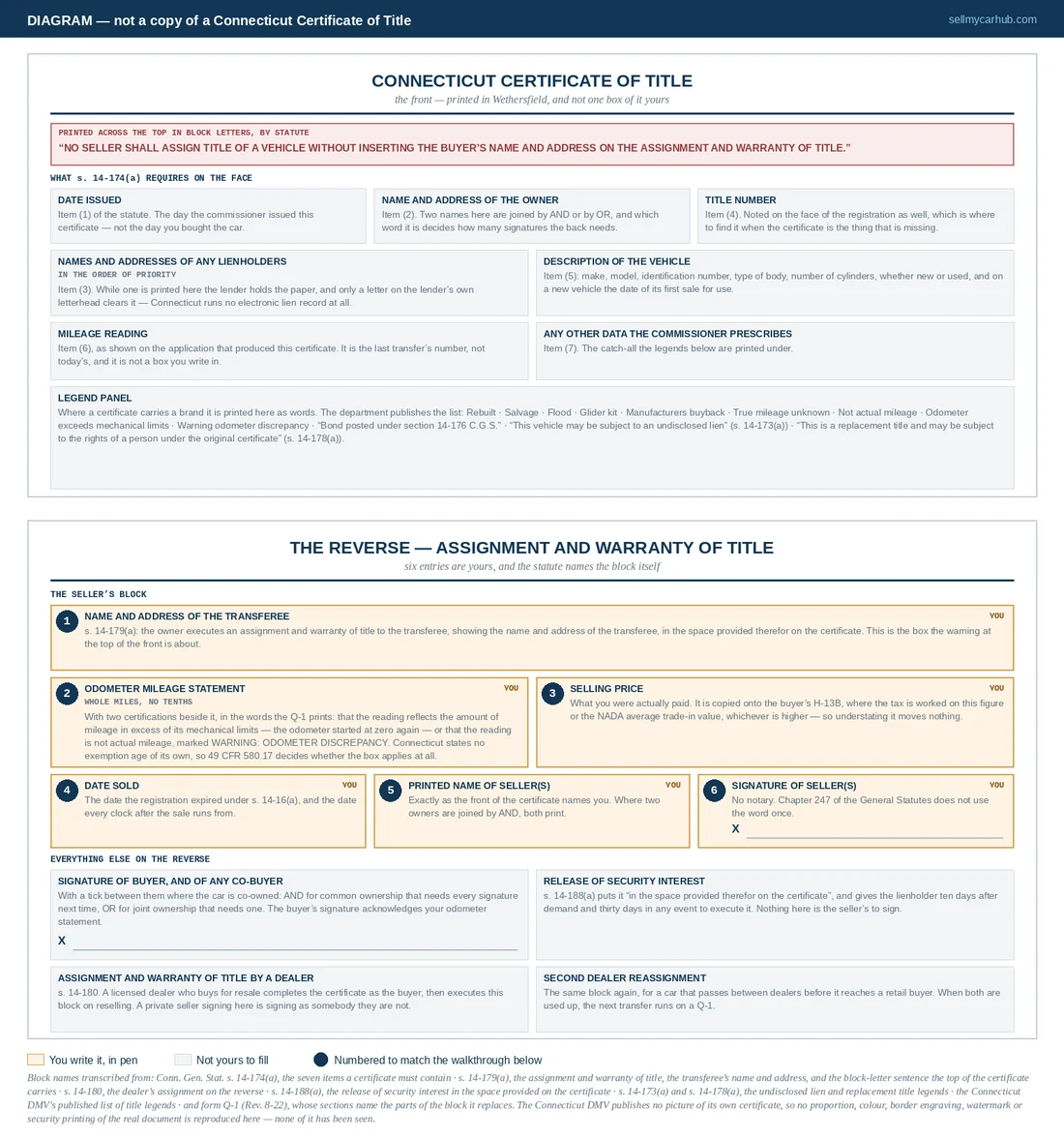
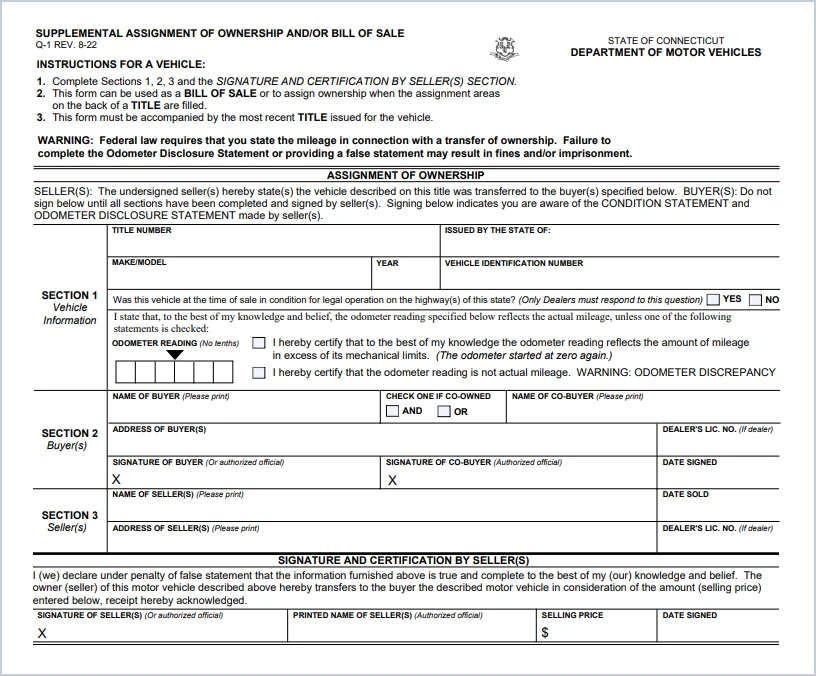
Connecticut's certificate prints the department's record on the front and gives the whole of your job to the back, in a block the statute calls the assignment and warranty of title. Six entries in that block belong to a private seller. The department publishes no photograph of its own certificate, so the picture below is a diagram, drawn from the statute that says what has to be on it - and beside it is something better than a drawing: the DMV's own image of the Q-1, the form whose three sections exist to replicate that block word for word.
Last updated .
Your 10 boxes
As a private seller you complete these and nothing else:
There is no blank Connecticut certificate to download and there never has been - it is controlled stock issued by the department, and Connecticut runs no electronic version of it either. What we can give you is beside this paragraph: a one-page checklist of the six entries that are yours, in the order the reverse of the certificate asks for them.
Strikeovers or erasures are not acceptable.
The department's order is short and it does not vary: complete and sign the reverse of the certificate, fill in the buyer's name and address, state the mileage if the car is a 2011 or newer, write the price, hand it over with a bill of sale, keep a copy of both, take the plates off, terminate the registration, and only then ring the insurer.
Drawn, not photographed
A Connecticut Certificate of Title, laid out from the statute that says what has to be on it
The Connecticut DMV publishes no image of its own certificate. Four sweeps went looking: all 101 pages of the department's own html sitemap, the 695 assets those pages link, the 601 PDFs among them scanned raster by raster, and the Dealer Online Manual's Chapter 10 appendix - which does publish pictures of four other documents and none of a title. The department has no video about selling a vehicle either; both of its YouTube channels were enumerated and searched. So this is a diagram, marked as one, and every block on it is named from a cited statute or a cited department page.
Amber — you write it, in pen
Grey — not yours to fill
Numbered — the six entries that are yours, in order
Click or tap the picture to open it full size.
A diagram, not a reproduction. Every block name on it is transcribed from a source: Conn. Gen. Stat. s. 14-174(a) for the seven things the commissioner must print on the face; s. 14-179(a) for the assignment and warranty of title and for the block-letter warning across the top; s. 14-180 for the dealer's assignment on the reverse; s. 14-188(a) for the release of security interest “in the space provided therefor on the certificate”; s. 14-173(a) and s. 14-178(a) for the two legends the commissioner may print; the department's own published list of title legends; and the Q-1, whose sections name the parts of the block it replaces. No proportion, colour, border engraving or security printing of the real certificate is shown, because none of it has been seen.
The department's own picture
The Q-1, which is the assignment block on a separate sheet
This is not our drawing. It is the image the Connecticut DMV publishes on page 82 of its Dealer Online Manual, of a form it does not otherwise publish at all: the Q-1, Supplemental Assignment of Ownership and/or Bill of Sale, revision 8-22. Its instruction line explains why it is worth reading even if your car has a title - "This form can be used as a BILL OF SALE or to assign ownership when the assignment areas on the back of a TITLE are filled." Section 1 is the vehicle and the odometer statement, Section 2 the buyer, Section 3 the seller, and the certification at the foot carries the selling price and the seller's signature. That is the certificate's assignment block, unpacked.
Click or tap the picture to open it full size.
Reproduced from the department's own Dealer Online Manual, November 2025, Chapter 10. The Q-1 is not on the DMV forms index - all 231 published PDFs were enumerated and it is not among them - because it is controlled stock. The department's instruction is to request one: "This form is also available at your local DMV office." The manual's own supplies table names the vendor it comes from.
Step by step
Every box, in the order you meet it
0
You fill this in
Before any box: check whether you have a certificate at all
Two Connecticut cars have no title in the owner's hands. One is financed, and the lender has the paper. The other is more than twenty model years old, and no certificate was ever issued.
Watch out: They need opposite responses. A lender's certificate needs a payoff and a release letter; a never-titled car needs the last registration certificate and a Q-1, and no amount of applying will produce a title unless you ask for one under s. 14-166(b) and pay for it.
1
You fill this in
The buyer's name and address
In the assignment block on the reverse, filled in by you, before the certificate leaves your hand.
Watch out: This is the one the statute puts in capitals across the top of the certificate. An assignment with the buyer's block empty is an open title, and an open title is how a car sold in August produces a parking ticket in your name in November.
2
You fill this in
The odometer mileage statement
Whole miles and no tenths, on any vehicle of model year 2011 or newer. Two tick boxes sit beside it - one for a reading in excess of the odometer's mechanical limits, one for a reading that is not the actual mileage.
Watch out: "In excess of mechanical limits" means the dial rolled past its maximum and started again, not that the car has done a lot of miles. Ticking it because a number looks large invents a discrepancy, and the department records it on the next certificate as a permanent legend.
3
You fill this in
The selling price
What you were actually paid. It gets copied onto the buyer's H-13B, where the form's own instruction sets out how it will be used.
Watch out: Writing it low does not help the buyer. The tax is charged on the current month's NADA Official Used Car Guide, Eastern Edition average trade-in value or your bill of sale, whichever is greater - so an understated price is a false statement that saves nobody anything.
4
You fill this in
The date of sale
The date the car and the certificate changed hands. It is the date the registration expired under s. 14-16(a), and the date every clock in the rest of this page starts from.
Watch out: Put the same date on the bill of sale and on the registration termination. Where they disagree, the insurance compliance unit reads the earliest one, and it is the earliest one that decides whether a lapse existed.
5
You fill this in
Your printed name
Printed, not signed, exactly as it appears on the face of the certificate. If two owners are named and the conjunction is AND, both print.
Watch out: "Exactly as on the face" means a middle initial that is on the title goes on the assignment. A name that has changed since the certificate was issued is corrected before the sale, not during it.
6
You fill this in
Your signature
The last thing you write, and the only thing on a Connecticut title that needs no witness, no notary and no appointment.
Watch out: Never sign until the money is in your hands. Section 14-179(a) puts the assignment at the time of delivery of the vehicle, and there is no step between signing and losing control of the car.
7
The buyer fills this in
The buyer signs the same block
The buyer's signature acknowledges your odometer statement. The Q-1's instruction spells out the reason it is not a formality: buyers are told not to sign until all sections have been completed and signed by the seller.
Watch out: If the buyer is not there, the disclosure is unfinished whatever else has been signed. That is a reason not to post a title to a distant buyer and hope.
8
The lienholder fills this in
The lien release, if a lienholder is printed on the front
A letter on the lender's letterhead naming the owners and the vehicle, stating the loan is paid in full or that the lender has no interest, and signed by an authorised agent.
Watch out: Connecticut has no lien release form, no electronic release and no way for the DMV to confirm one. If the loan originated more than ten years ago and the lender no longer exists, Section 2 of the H-6B stands in for the letter.
9
You fill this in
The bill of sale, and a copy of everything
The department's H-31 or your own sheet with the six required items on it. Then photocopy the completed title and the bill of sale before you hand them over.
Watch out: The DMV's own instruction is to keep a copy of the completed title and bill of sale for your records, and there are two later moments when you will be asked for exactly that: a property tax bill on a car you no longer own, and an insurance compliance case.
10
You fill this in
Take the plates off, then terminate the registration
Online in about seven minutes, or by post on an E-159. The plates themselves can be discarded, transferred to another vehicle for $21 or handed in to be held.
Watch out: Print the plate disposition receipt. It is the only proof the termination happened, and it is what the town assessor wants when a prorated property tax bill is argued.
11
You fill this in
Only now, cancel the insurance
After the termination is recorded, not before. The department's instruction is not to cancel the insurance on the vehicle until the registration has been cancelled with DMV.
Watch out: Reversing these two steps is the single most expensive mistake in a Connecticut private sale: $200 under s. 14-12g(b), and a possible driver's licence suspension under s. 14-12g(c) if thirty days go by without a response.
Before the pen
Six rules for the pen, on a document that cannot be corrected and cannot be replaced quickly
Six habits. The first two are about a document that cannot be corrected, and the last one is about a document that is not the title at all.
Ink, printed, and no second attempt
The H-6B carries the department's rule on title paper in one line: strikeovers or erasures are not acceptable. A spoiled Connecticut certificate is a $25 replacement and a wait, and Connecticut has no electronic copy to fall back on.
Read whether your title says AND or OR before you set a date
It is printed between the owners' names on the face and it decides whether you need one signature or two. Finding out on completion day is how a sale slips a fortnight while a co-owner drives back from somewhere.
Fill the buyer's block in yourself
The certificate carries a statutory warning in block letters about exactly this. Somebody who asks you to leave it blank so they can "put it in a friend's name" is asking you to keep the car in yours.
Leave the mileage boxes alone on a 2010 or older
It is exempt under the federal rule, and writing a reading into a box that does not need one manufactures a disclosure the buyer's next seller will have to explain.
Photocopy the finished title before it leaves the table
Not afterwards. Once it is gone it is gone, and the two people who will ask you to prove the sale - your town assessor and the insurance compliance unit - both ask months later.
Write the same date in all three places
On the assignment, on the bill of sale and on the registration termination. Three different dates for one sale is what turns a clean file into a case.
The ink rule is the CT DMV's own: “Please print in ink or type. (Strikeovers or erasures are not acceptable.)”
— CT DMV, Sell your vehicle.
Check your source
Three things Connecticut sellers tell each other that are not true
Three things Connecticut sellers tell each other. The second one is the one that costs $200, and the department's own seller page is where it is contradicted.
"Hand the plates in at the DMV counter when you sell."
There is no counter step in an ordinary Connecticut sale, and the department does not want the metal. Its cancellation page states it plainly: plates can be discarded at your discretion. What has to happen is that the registration is terminated - online in about seven minutes, or by post with an E-159 - and that you keep the receipt it produces. There is one case where the plates genuinely do go back, and it is not a sale: cancelling the registration of a deceased owner, where the executor returns the plates by post with a certified probate document. Everybody else keeps them, transfers them for $21, has them held, or bins them.
"Ring the insurance company the moment the car drives away."
Do that and the insurer reports a cancellation against a registration that is still live on the department's records, because terminating the registration is a separate act you have not done yet. That is a lapse. Section 14-12g(b) sets the civil penalty at two hundred dollars; subsection (a) lets the commissioner let it go where the gap cannot be shown to have run more than fourteen days, which is a narrower escape than it sounds. The seller page gives the order as an instruction rather than a suggestion: do not cancel the insurance on the vehicle until the registration has been canceled with DMV.
"No title means the car can't be sold - you have to apply for one first."
On a car more than twenty model years old there is no title to apply for, because Connecticut never issued one and s. 14-166(b) says none is required. The transfer runs on the last registration certificate and a Q-1, Supplemental Assignment of Ownership, with an H-31 bill of sale. The commissioner will issue a certificate for such a car if the owner asks and pays the fee, which is sometimes worth doing for a buyer in a state that titles everything - but it is a choice, not a precondition. For an out-of-state buyer who does not believe you, the department publishes a signed letter saying it in its own words, and the page below is where it states the rule and lists what a non-titled transfer needs instead.
Seven signature rules, and the second one catches almost everybody, because Connecticut's two conjunctions mean the opposite of what most people assume:
You, as the owner named on the face
In the assignment block on the reverse. No notary, no witness, no appointment - chapter 247 of the General Statutes does not use the word notary once.
Every owner, if the front says AND
Connecticut reverses the usual guess. AND is common ownership with no right of survivorship and needs all signatures; OR is joint ownership with survivorship and needs one.
Either owner, if there is no conjunction at all
The department's own answer where two names are printed with nothing between them: either party can transfer ownership and only one signature is required.
The surviving owner alone, where the title says OR and a co-owner has died
Joint ownership carries the right of survivorship, so the survivor acquires the deceased owner's interest. Form H-119 records the notification where the other joint owner is unavailable rather than dead.
An executor or administrator, where the title says AND
Common ownership has no survivorship. The Probate Court appoints a fiduciary and a certified copy of the decree - PC-160, PC-212B, PC-260, PC-264, PC-264S or PC-450 - travels with the certificate.
An attorney-in-fact, on an A-83
The only signature in the Connecticut set that is witnessed and acknowledged: two witnesses plus a notary public, justice of the peace or commissioner of the Superior Court.
Nobody at all, on a car more than twenty model years old
There is no certificate to sign. The registration certificate is the proof of ownership and the transfer happens on a Q-1.
Once it is signed
Signing the reverse is the middle of a Connecticut sale, not the end of it. What follows is the part with your name still on the record: the plates come off, the registration gets terminated, the receipt gets printed, and the insurance stays on until all three are done.