Sell My Car Hub

How to fill out Connecticut H-31

Two identical bills of sale printed on one sheet, which is the whole point of it: one goes with the car and one stays in your drawer. Connecticut does not require you to use it - the department says so in as many words - but it requires the same six things to appear on whatever you do use, and this sheet is those six things with the boxes already drawn. On a car more than twenty model years old it stops being a receipt and becomes part of the proof of ownership.
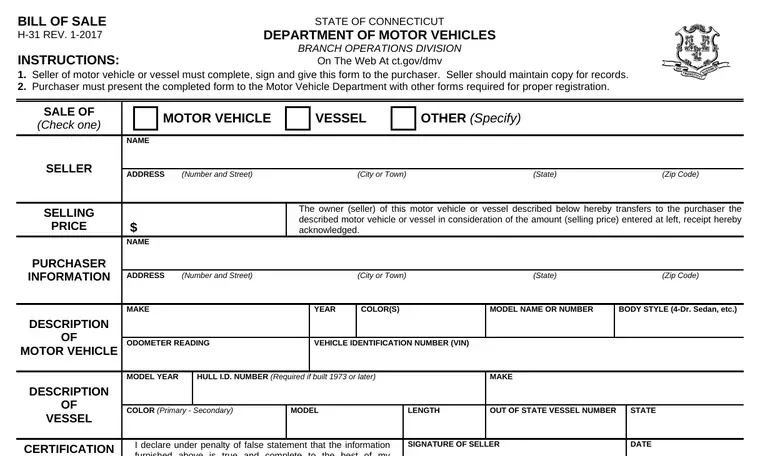
Written against H-31 (Rev 1-2017), issued under Conn. Gen. Stat. s. 14-16 and s. 14-171, declared under penalty of false statement per s. 53a-157b. This form is 1-2017 and predates the department's current bill-of-sale guidance, which asks for a buyer signature the sheet has no line for. Where you need the buyer's signature - and on a private sale to a stranger you do - write it in beneath the certification rather than assuming the printed form is complete.

Two documents, and they are not the same thing. Take the blank H-31 from the portal.ct.gov copy so you get the revision that is current today.

Filled in

What a completed one looks like

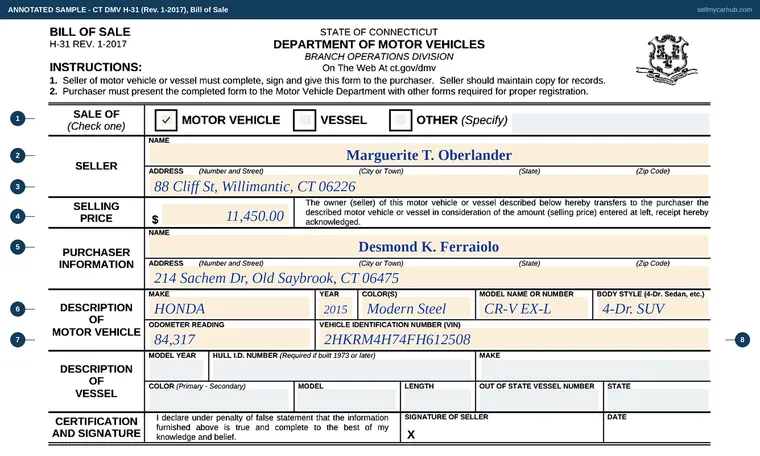
This is the actual H-31, rendered from the PDF the Connecticut Department of Motor Vehicles publishes and completed end to end: letterhead, every field, and the blocks at the foot.

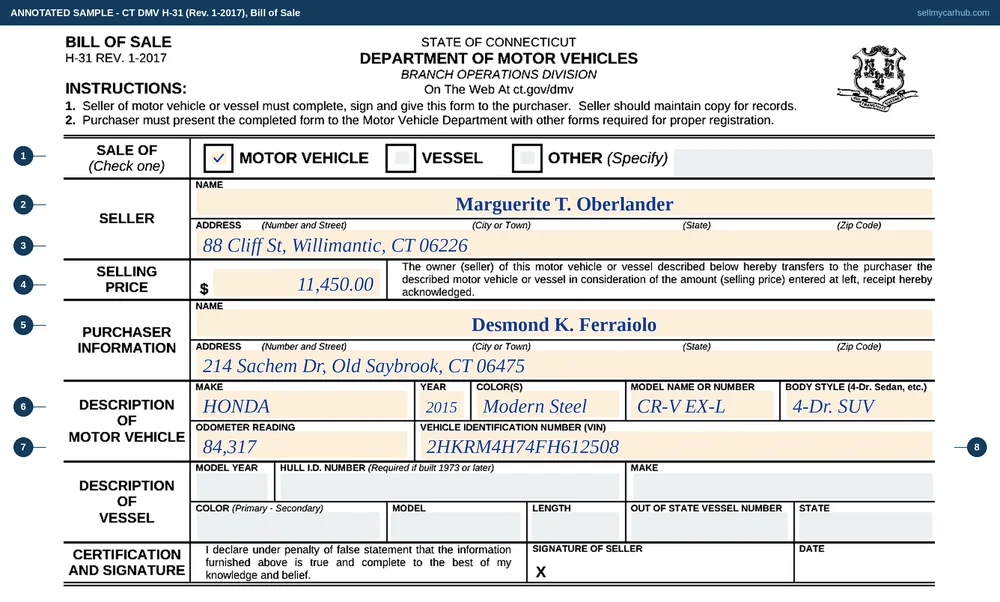
A completed Connecticut Bill of Sale, form H-31, with the MOTOR VEHICLE box ticked. The seller block reads Marguerite T. Oberlander of 88 Cliff Street, Willimantic, CT 06226; the selling price is 11,450.00; the purchaser block reads Desmond K. Ferraiolo of 214 Sachem Drive, Old Saybrook, CT 06475. The description block gives the make Honda, year 2015, colour Modern Steel, model CR-V EX-L, body style 4-Dr. SUV, an odometer reading of 84,317 and the vehicle identification number 2HKRM4H74FH612508. The vessel block is left empty and shaded.
The upper of the two identical bills of sale on the sheet, filled in. The vessel block below the vehicle description is greyed because nothing in it applies to a car - and the empty half of the sheet underneath is the copy the department expects you to keep. Nobody in this sample exists and no vehicle matches this VIN.
Field by field

Every line, in the order you meet it

  1. 1
    You fill this in

    Sale of - tick MOTOR VEHICLE

    The first tick on the sheet. VESSEL and OTHER are for boats and everything else the department registers.

    Watch out: Leaving it blank is the commonest thing wrong with a returned H-31, because the form then does not say what has been sold.

  2. 2
    You fill this in

    Seller name

    Your name, matching the face of the certificate you are assigning.

    Watch out: Use the name on the title, not a shortened version. A bill of sale from "Meg Oberlander" against a certificate issued to "Marguerite T. Oberlander" invites a question at the counter.

  3. 3
    You fill this in

    Seller address

    Number and street, city or town, state and ZIP on the line beneath your name.

    Watch out: Your address at the time of sale, not where you are moving to. This sheet may be produced months later to settle a property tax argument about that date.

  4. 4
    You fill this in

    Selling Price

    The figure you were actually paid, in the dollar box. The sentence beside it acknowledges receipt.

    Watch out: The words "receipt hereby acknowledged" are doing work. Do not fill this in and hand it over before the money has cleared.

  5. 5
    You fill this in

    Purchaser Information

    The buyer's name and address, which you write rather than they do.

    Watch out: Take it off their licence rather than from what they tell you, and check it against the name they want on the title. A mismatch here is how a car ends up registered to somebody who was never in the room.

  6. 6
    You fill this in

    Make, Year, Colour(s), Model, Body Style

    Five description boxes across one row, all copied from the certificate rather than from memory.

    Watch out: Colour is the one people improvise. Use the word printed on the certificate; the manufacturer's marketing name for the paint is not what the department recorded.

  7. 7
    You fill this in

    Odometer Reading

    Whole miles, the same figure that goes on the reverse of the title and on the buyer's H-13B.

    Watch out: Three documents, one number. Reading the odometer once and writing it three times beats reading it three times.

  8. 8
    You fill this in

    Vehicle Identification Number (VIN)

    Seventeen characters, copied from the certificate. Below it the certification and the signature of seller close the sheet.

    Watch out: On a car with no title - anything more than twenty model years old - this box is doing the work the certificate would otherwise do, so a transposed character here is a real problem rather than a typo. Sign and date underneath it with the same date you put on the title assignment.

At a glance

What goes where

On the formWhat to put in it
Sale of, one of three ticksMOTOR VEHICLE, VESSEL or OTHER with a line to specify. The same sheet serves boats, which is why half the boxes below it are about hulls.
Seller, Name and AddressYours, with number and street, city or town, state and ZIP on the line beneath.
Selling PriceA dollar box, with the operative sentence printed beside it: the owner (seller) of this motor vehicle or vessel described below hereby transfers to the purchaser the described motor vehicle or vessel in consideration of the amount (selling price) entered at left, receipt hereby acknowledged.
Purchaser Information, Name and AddressThe buyer, in the same shape as the seller block above it.
Description of Motor Vehicle, Make, Year, Colour(s), Model Name or Number, Body StyleFive boxes across one row, with body style given the form's own example - 4-Dr. Sedan, etc.
Odometer Reading, and Vehicle Identification Number (VIN)The second row of the description block. The mileage sits on the bill of sale as well as on the title, which is why the two have to agree.
Description of VesselModel year, hull identification number, make, colour, model, length and out-of-state vessel number. Eight boxes that stay empty on a car.
Certification and SignatureOne line: I declare under penalty of false statement that the information furnished above is true and complete to the best of my knowledge and belief. Then the signature of seller and the date. There is no buyer signature on this form at all.

What gets this one rejected

Rules that decide whether it is accepted

Every line here was read off H-31 (Rev 1-2017) itself — the PDF is here — and off the Connecticut Department of Motor Vehicles pages. This is plain-language help with a form, not legal advice, and where our wording and the agency's differ, theirs governs.

Back to all Connecticut seller paperwork, or what selling a car in Connecticut involves.

Want the paperwork handled instead?

Get My Instant Offer → Online · about 2 minutes · free

Or send the details — we'll come to you

No bill of sale, no title, no plates and a car that has not moved since last winter - none of that stops a collection. Tell us what you have and we will price it as it stands.

or call/text (877) 405-1808