Sell My Car Hub

How to fill out Connecticut H-13B

The single application that registers the car and applies for the title in one go, and the only document in a Connecticut private sale that both parties appear on. It belongs to the buyer and the buyer pays for it, but Section 3 is a block about you - your name, your address, the date you sold it and the price you took - and Section 6 is a certification that every property tax due on any vehicle previously registered in that name has been paid. A seller who has read Section 3 knows exactly what the buyer is about to write down about them.
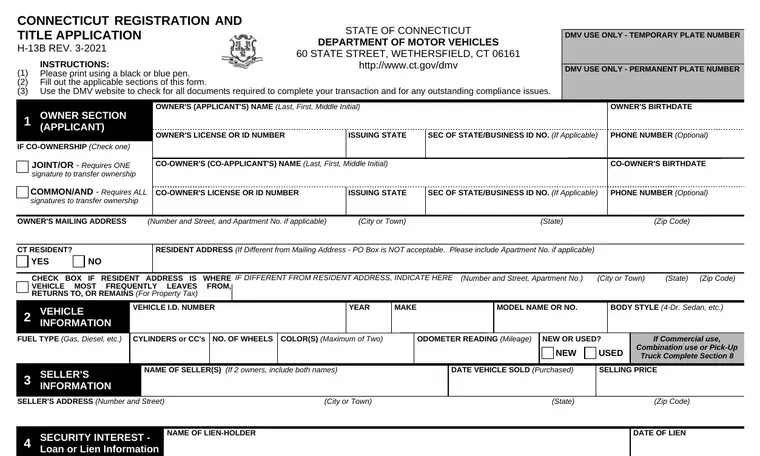
Written against H-13B (Rev 3-2021), issued under Conn. Gen. Stat. s. 14-12, s. 14-171 and s. 14-192, subscribed under penalty of false statement per s. 14-110 and s. 53a-157b. The revision matters on this one: an H-13B printed before March 2021 has a different section layout and different tax exemption codes on its reverse. Take a fresh copy from the department rather than reusing a saved PDF.

Two documents, and they are not the same thing. Take the blank H-13B from the portal.ct.gov copy so you get the revision that is current today.

Filled in

What a completed one looks like

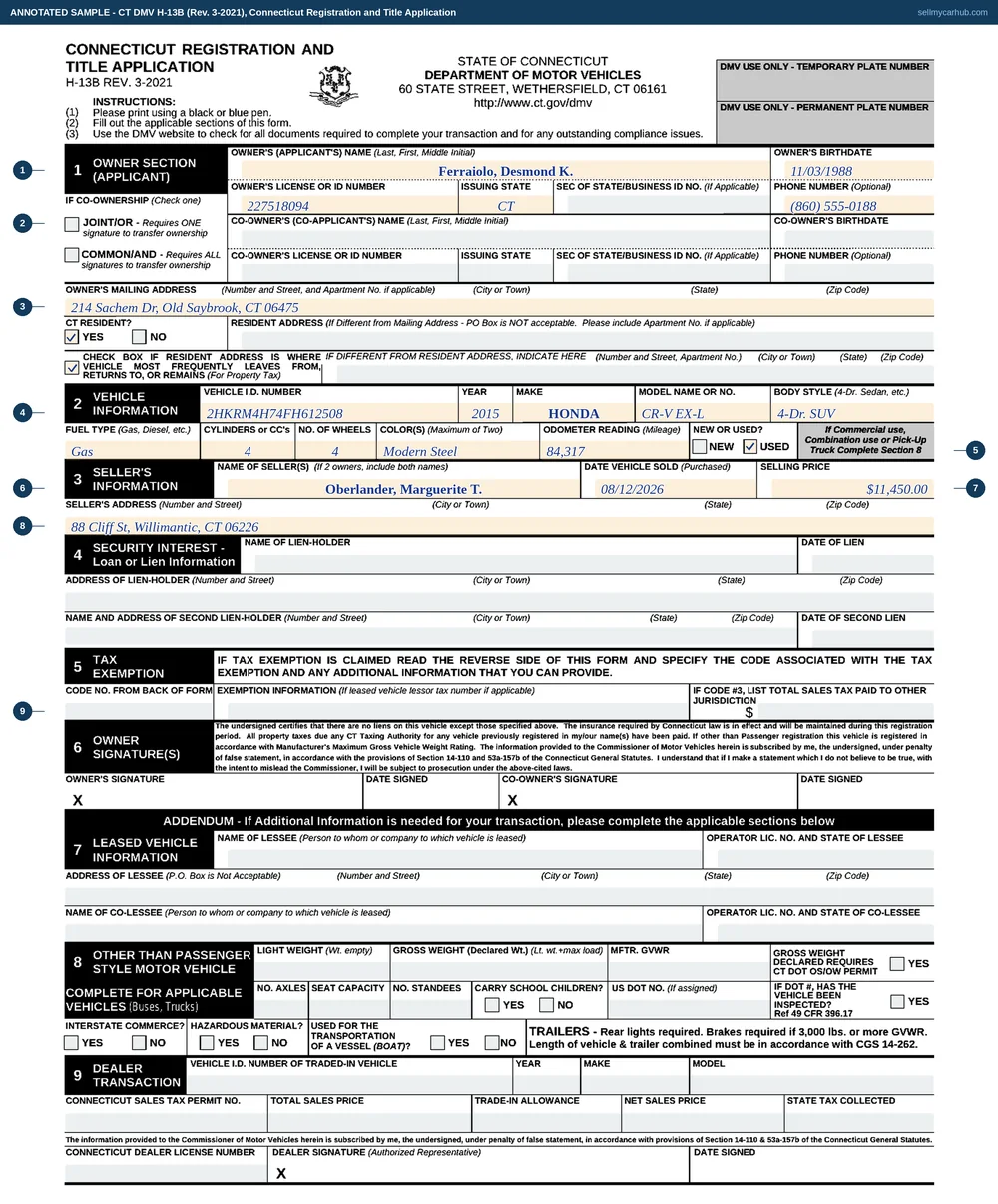
This is the actual H-13B, rendered from the PDF the Connecticut Department of Motor Vehicles publishes and completed end to end: letterhead, every field, and the blocks at the foot.

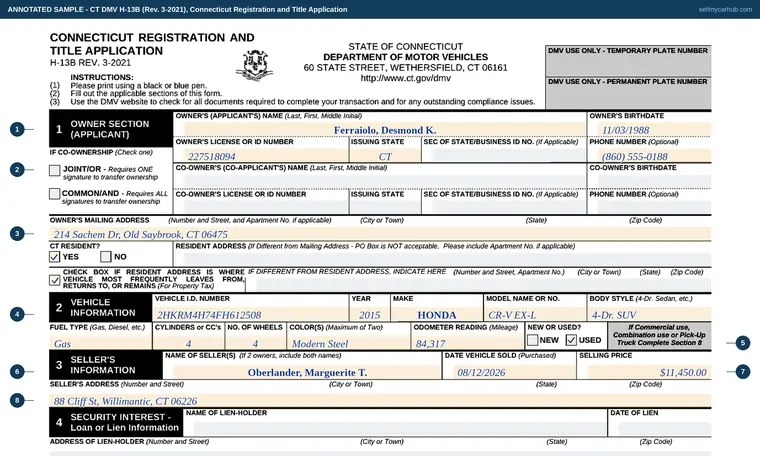
A completed Connecticut Registration and Title Application, form H-13B, filled in for a 2015 Honda CR-V bought in Old Saybrook: the buyer's name Ferraiolo Desmond K in Section 1 with a Connecticut licence number and a birth date, neither co-ownership tick marked, a mailing address in Old Saybrook, the vehicle identification number 2HKRM4H74FH612508 with year 2015, make Honda, model CR-V and body style 4-Dr. SUV, an odometer reading of 84,317 with the USED tick, and Section 3 naming the seller Oberlander Marguerite T of Willimantic with a sale date of 08/12/2026 and a selling price of $11,450.00.
Rendered from the department's own PDF and completed the way the buyer would complete it. Note what is missing from the whole sheet: there is no seller signature anywhere on it. Section 3 is a statement about you made by somebody else. Nobody in this sample exists and no vehicle matches this VIN.
Field by field

Every line, in the order you meet it

  1. 1
    The buyer fills this in

    Owner's (Applicant's) Name and birth date

    The buyer's legal name, last name first, exactly as it appears on the licence they will show at the counter.

    Watch out: This is the name that gets printed on the new certificate. A nickname here is a title correction later, at the full title fee and a fresh application.

  2. 2
    The buyer fills this in

    The co-ownership tick

    JOINT/OR for one signature to transfer, COMMON/AND for all signatures. Left blank on a single buyer.

    Watch out: Connecticut's meanings run against the intuition of most people who have bought a house together. OR is the survivorship one; AND is the one that needs everybody present next time.

  3. 3
    The buyer fills this in

    Owner's mailing address, and the property-tax box

    The mailing address, then a separate resident address if it differs, then a tick and a line for where the vehicle most frequently leaves from, returns to or remains.

    Watch out: That last line is not a formality. It sets the town that bills the motor vehicle property tax, and Connecticut's rates vary enough between towns to be worth getting right.

  4. 4
    The buyer fills this in

    Vehicle I.D. Number

    Seventeen characters, copied from the certificate you assigned.

    Watch out: Copy it from the title rather than the dash or the door jamb. If the two disagree, that is a conversation to have before money changes hands, not after.

  5. 5
    The buyer fills this in

    Odometer Reading (Mileage)

    Whole miles, matching the figure written on the reverse of the certificate.

    Watch out: Where the two disagree the department has to decide which is right, and the way it records the decision is a permanent legend on the next certificate.

  6. 6
    The buyer fills this in

    Section 3, Name of Seller(s)

    Your name - both names if the certificate carried two owners - written by the buyer onto their application.

    Watch out: This is the only place in the transaction where the buyer writes about you. Give them the spelling from the face of the certificate rather than from a text message.

  7. 7
    The buyer fills this in

    Date Vehicle Sold, and Selling Price

    The date and the figure from your bill of sale, copied across.

    Watch out: The reverse of the form sets out how that price will be used, and the answer is that it is a floor rather than the number. The tax is charged on the NADA average trade-in value if that is higher.

  8. 8
    The buyer fills this in

    Seller's Address

    Your full address on the line below Section 3 - number and street, city or town, state and ZIP.

    Watch out: Give the buyer the address the department holds for you rather than a forwarding one. It is the address the transfer will be recorded against.

  9. 9
    The buyer fills this in

    Section 5, Tax Exemption code

    One of five codes with an explanation beside it - and left blank, as it is here, on an ordinary arm's-length sale between strangers.

    Watch out: Code 1, the family exemption, needs the vehicle to have been in the relative's name for at least sixty days. Below it, Section 6 carries the buyer's signature under a certification about liens, insurance and unpaid property tax - and an unpaid town tax bill in the buyer's name stops the registration dead.

At a glance

What goes where

On the formWhat to put in it
Section 1, Owner's (Applicant's) NameThe buyer, last name first, with a birth date beside it. This is the name that will be printed on the new certificate.
Owner's Licence or ID Number, and Issuing StateA Connecticut licence or ID, or an out-of-state one with the state named beside it. A Secretary of State business ID goes in the next box where the buyer is a company.
If Co-Ownership, one of two ticksJOINT/OR - Requires ONE signature to transfer ownership, or COMMON/AND - Requires ALL signatures to transfer ownership. This tick is the conjunction that will be printed on the next certificate, and it decides how easily this car can be sold again.
Owner's Mailing Address, and Resident AddressTwo separate lines. The resident address will not take a PO box, and a third box asks where the vehicle most frequently leaves from, returns to or remains - which is the town that will bill the property tax.
Section 2, Vehicle I.D. Number, Year, Make, Model Name or No., Body StyleCopied from the certificate you signed, character for character. Body style is asked for in the form's own words - 4-Dr. Sedan, etc.
Fuel Type, Cylinders or CCs, No. of Wheels, Colour(s)Four descriptive boxes with a maximum of two colours, and then the odometer reading.
Odometer Reading (Mileage)Whole miles. It is the figure you wrote on the reverse of the title, carried onto the application, and the two are read against each other.
New or Used, one of two ticksUSED on any private sale. NEW belongs to a vehicle arriving on a manufacturer's certificate of origin.
Section 3, Name of Seller(s)You. The form's instruction is explicit where a car has two owners - if 2 owners, include both names.
Date Vehicle Sold (Purchased), and Selling PriceYour date and your figure. The Sales Tax Instructions on the reverse then explain what happens to that figure on a private sale.
Seller's AddressYours, in full, number and street, city or town, state and ZIP. It is on the application because the department's record of the transfer has to name where the car came from.
Section 4, Name of Lien-Holder and Date of LienThe buyer's new lender, not the one you paid off. A second lender has its own line beneath, with its own date.
Section 5, Tax Exemption, Code No. from Back of FormOne of five codes, explained on the reverse. Code 1 is an immediate family transfer, code 4 a vehicle bought while living out of state, code 5A a gift on an AU-463.
Section 6, Owner Signature(s)The buyer's signature, and a co-owner's where there is one. The paragraph above it certifies three things at once: no undisclosed liens, insurance in effect and maintained throughout the registration period, and all property taxes paid on any vehicle previously registered in that name.
Sections 7 to 9, the addendumLeased vehicle information, gross weight details for anything other than passenger style, and a dealer transaction block. All three are blank on an ordinary private sale.

What gets this one rejected

Rules that decide whether it is accepted

Every line here was read off H-13B (Rev 3-2021) itself — the PDF is here — and off the Connecticut Department of Motor Vehicles pages. This is plain-language help with a form, not legal advice, and where our wording and the agency's differ, theirs governs.

Back to all Connecticut seller paperwork, or what selling a car in Connecticut involves.

Want the paperwork handled instead?

Get My Instant Offer → Online · about 2 minutes · free

Or send the details — we'll come to you

If the buyer has gone quiet, the plates are in your garage and you cannot tell whether the transfer ever happened, tell us about the car and we will tell you what it is worth as it stands.

or call/text (877) 405-1808