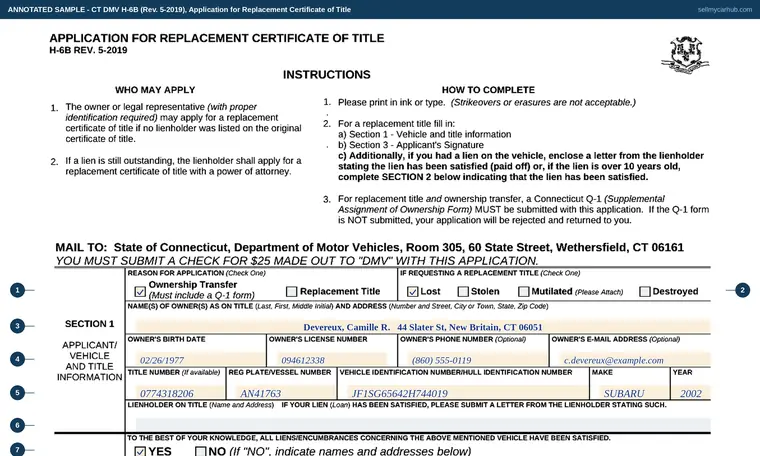
One sheet that does two entirely different jobs, and the tick at the top decides which. Ticked as a Replacement Title it gets you a fresh certificate for $25 and about twenty business days. Ticked as an Ownership Transfer it becomes the paperwork that lets you sell a car whose title you cannot find - and in that mode the department will reject it outright unless a Q-1 is stapled to it.
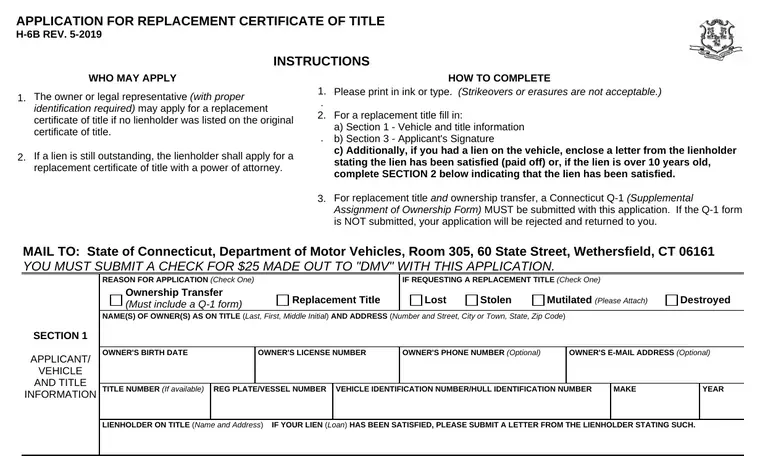
Written against H-6B (Rev 5-2019), issued under Conn. Gen. Stat. s. 14-178 and s. 14-192(a)(5), subscribed under penalty of false statement per s. 14-110 and s. 53a-157b. The two ticks at the top of this form are not interchangeable and they are the first thing a clerk reads. If you are selling rather than replacing, tick Ownership Transfer and attach the Q-1 - a Replacement Title tick puts your application in the wrong queue and posts a certificate to you weeks after the buyer has walked away.
Two documents, and they are not the same thing. Take the blank H-6B from the portal.ct.gov copy so you get the revision that is current today.
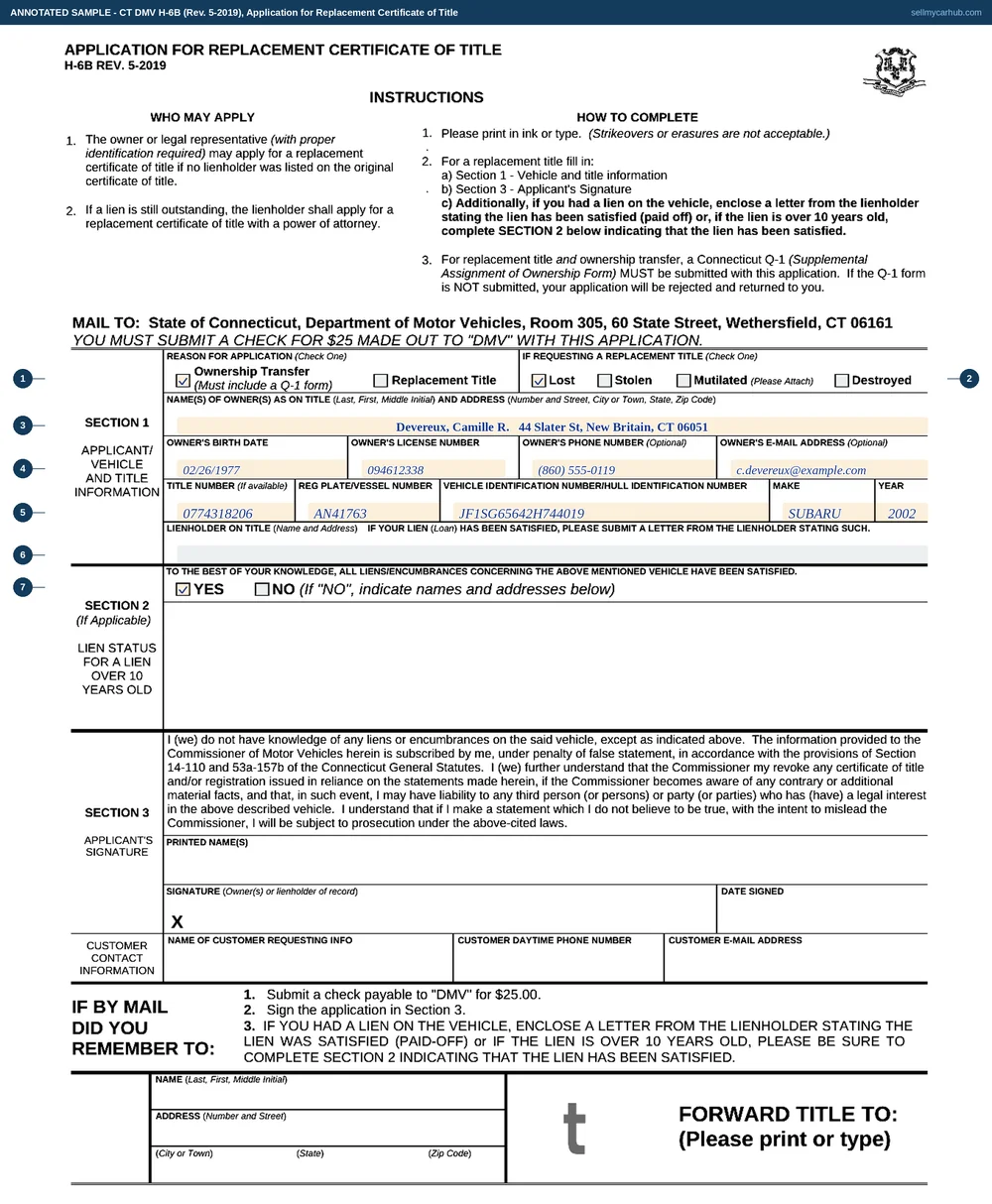
This is the actual H-6B, rendered from the PDF the Connecticut Department of Motor Vehicles publishes and completed end to end: letterhead, every field, and the blocks at the foot.
Ownership Transfer or Replacement Title. One tick, and it decides what this sheet is.
Watch out: Ownership Transfer is the one for a sale, and the form's own bracket says it: must include a Q-1 form. Get this tick wrong and the application is rejected and returned.
Lost, Stolen, Mutilated or Destroyed. Ticked in addition to the reason above.
Watch out: Mutilated means the certificate exists but is damaged, and the department wants it attached. Destroyed means it does not exist any more.
The names exactly as the certificate carried them - which means as the department holds them, not as you write them now.
Watch out: If the name has changed since the title was issued, that is a separate correction and it happens before this application rather than inside it.
Two identifying boxes, with an optional phone and e-mail beside them.
Watch out: Fill the optional ones in anyway. This is a postal transaction with a ninety-day tail on it, and a telephone number is the difference between a query and a rejection.
Five vehicle boxes. The title number is marked if available; the rest are not.
Watch out: The title number is on the old registration certificate as well as on the missing title - the department notes on the face of each registration that a certificate has been issued.
The lender printed on the certificate, if there was one, with the reminder to submit a release letter.
Watch out: Leave it blank only if the face of the certificate was genuinely clear. A lien you have forgotten about is still on the department's record, and this is where it surfaces.
A YES/NO answer on whether all liens have been satisfied, used in place of a release letter where the loan is more than a decade old. Below it, Section 3 takes a printed name, a signature and a date on printed rules.
Watch out: Section 2 is not a general-purpose substitute - under ten years and the department wants the lender's letter on the lender's paper. And read Section 3's certification before signing it: no notary and no witness, but it reaches your own liability to anybody with a legal interest in the vehicle.
| On the form | What to put in it |
|---|---|
| Reason for Application (Check One) | Ownership Transfer (Must include a Q-1 form), or Replacement Title. Two ticks, two different transactions. |
| If Requesting a Replacement Title (Check One) | Lost, Stolen, Mutilated (Please Attach) or Destroyed. Four ticks, and the mutilated one asks for the remains. |
| Section 1, Name(s) of Owner(s) as on Title, and Address | One long box for the names exactly as the certificate carries them, and the address. |
| Owner's Birth Date, Licence Number, Phone Number and E-mail Address | Four boxes, the last two marked optional. |
| Title Number (If available), Reg Plate/Vessel Number, Vehicle Identification Number, Make, Year | Five boxes across the vehicle row. The title number is the only one the form treats as optional. |
| Lienholder on Title (Name and Address) | With the instruction beside it: if your lien (loan) has been satisfied, please submit a letter from the lienholder stating such. |
| Section 2, Lien Status for a Lien Over 10 Years Old | A YES/NO pair on whether all liens and encumbrances have been satisfied, with room for names and addresses where the answer is no. It stands in for a release letter only where the loan is more than ten years old. |
| Section 3, Applicant's Signature | The certification, then a printed name box and a signature line, then a date. The certification runs to five sentences and one of them is about the applicant's own exposure: I may have liability to any third person or party who has a legal interest in the above described vehicle. |
| Customer Contact Information | Name of customer requesting info, daytime phone number and e-mail address - three boxes for whoever the department should ring back. |
| Forward Title To | A separate name and address block at the foot, for a certificate that should be posted somewhere other than the owner's address on file. |
| If by mail did you remember to: | The department's own three-item checklist at the foot: submit a check payable to DMV for $25.00, sign the application in Section 3, and enclose a lien release letter or complete Section 2. |
Every line here was read off H-6B (Rev 5-2019) itself — the PDF is here — and off the Connecticut Department of Motor Vehicles pages. This is plain-language help with a form, not legal advice, and where our wording and the agency's differ, theirs governs.
Back to all Connecticut seller paperwork, or what selling a car in Connecticut involves.