Sell My Car Hub

How to fill out West Virginia DMV-185-TR

The one-page route through an estate nobody opened: where no administrator or administratrix has been appointed and no will has been left - the form's own conditions - the legal heirs swear who inherits the vehicle and sign in the owner's place, with a copy of the death certificate stapled to it. Its header also answers the question families always ask about the plate: license plates are transferable from the decedent to legal heirs, provided a valid certificate of insurance in the new owner's name backs the registration. Anything with a will or a court appointment goes the probate route instead - the Division will not accept a raw copy of a will.
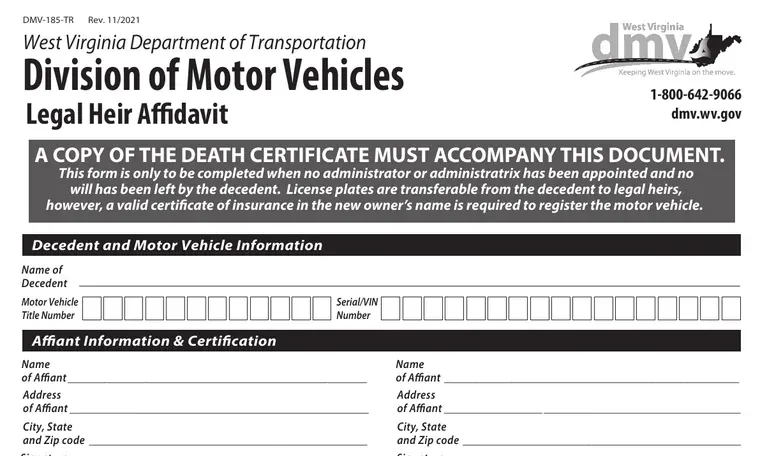
Written against DMV-185-TR (Rev 11/2021), issued under W. Va. Code 17A-4-5 and ch. 42. The affidavit is only as strong as the family's honesty about who the heirs are. Statutory descent and distribution - Chapter 42's ladder of spouse, children, parents, siblings - decides who counts, not who was closest to the car, and swearing yourself in while a legitimate heir goes unmentioned is false swearing on a document the Division keeps. When the family tree is complicated, a probate clerk's advice is cheaper than the argument.

Two documents, and they are not the same thing. Take the blank DMV-185-TR from the webapps.transportation.wv.gov copy so you get the revision that is current today, then print our DMV-185-TR guide and keep it beside you while you fill theirs in.

Filled in

What a completed one looks like

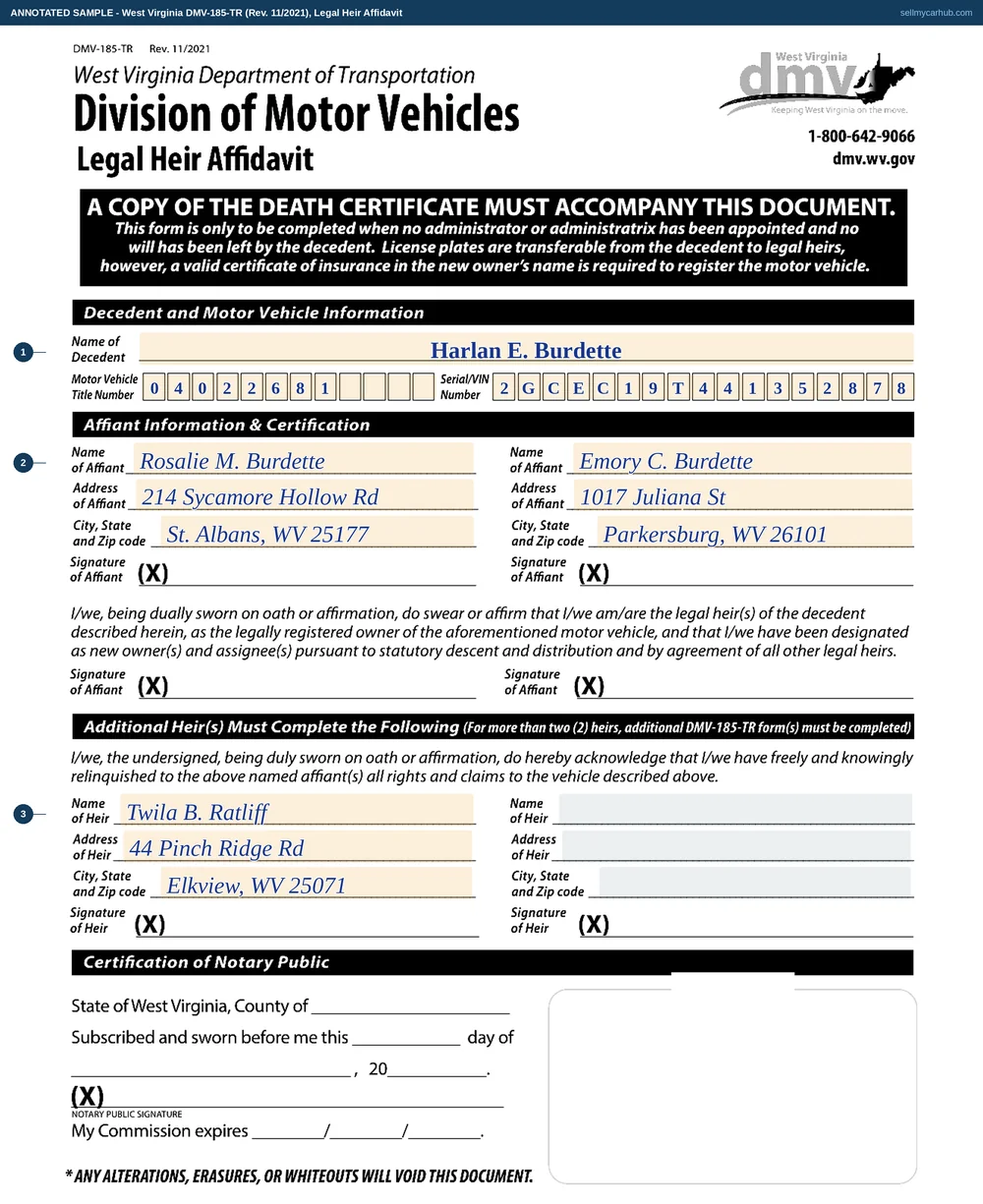
This is the actual DMV-185-TR, rendered from the PDF the West Virginia Division of Motor Vehicles publishes and completed end to end: letterhead, every field, and the blocks at the foot.

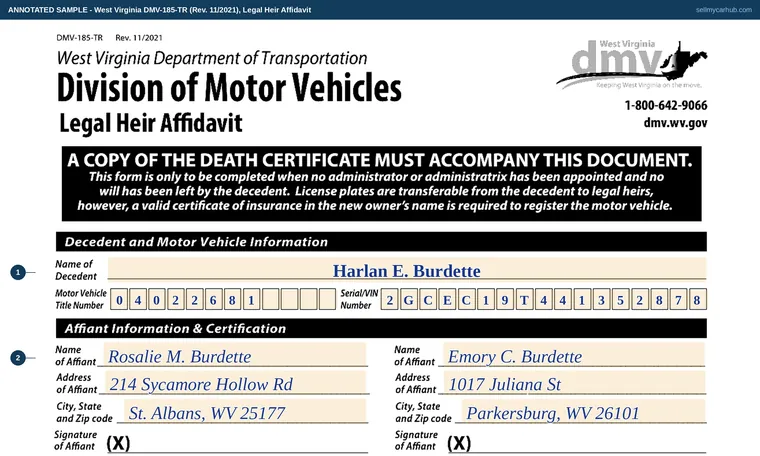
The West Virginia DMV-185-TR legal heir affidavit filled in: for the late Harlan E. Burdette's 2004 Chevrolet Silverado, affiants Rosalie M. Burdette and Emory C. Burdette entered as legal heirs, their sister Twila B. Ratliff in the relinquishment block, and every signature line and the notary certification left for the sworn sitting.
Two heirs taking the truck, one stepping aside, and a single notary block to cover every signature in one sitting - with the death certificate copy stapled behind, because the header makes it a condition of the whole document.
Field by field

Every line, in the order you meet it

  1. 1
    You fill this in

    Decedent and vehicle

    The late owner's name, the title number and the VIN, from the certificate if the family holds it.

    Watch out: No certificate in the house? Order the duplicate first - this affidavit signs for the owner, but the assignment still needs paper to be written on.

  2. 2
    You fill this in

    The affiants - the heirs taking the vehicle

    Name, address and both signatures for each heir becoming an owner, around the sworn designation sentence.

    Watch out: The oath includes by agreement of all other legal heirs. Read Chapter 42's order before you swear it - the agreement has to include everyone the statute would count.

  3. 3
    Somebody else fills this in

    The relinquishing heirs

    Heirs not taking the vehicle sign the acknowledgement that they freely and knowingly relinquish all rights and claims.

    Watch out: Get these signatures even from the sibling who says they don't care. The affidavit's strength later is exactly the signatures it carries now.

  4. 4
    Somebody else fills this in

    The notary certification

    County, date, notary signature, commission expiry, stamp - after watching the signing.

    Watch out: Everyone signs in front of the commission or the sheet is re-signed. One sitting with the whole family present is the version that works.

  5. 5
    You fill this in

    Then the ordinary transfer

    Affidavit, death certificate copy and title travel together - into a retitle in the heirs' names, or straight into a sale's paperwork.

    Watch out: If the heirs sell at once, the buyer's packet carries the whole story: this affidavit explains why the assignment's signature is not the name on the face of the certificate.

At a glance

What goes where

On the formWhat to put in it
Decedent and motor vehicle informationThe decedent's name, then the vehicle's title number and serial/VIN number - the estate's car, identified by record rather than description.
Affiant information and certificationTwo side-by-side affiant columns - name, address, city, state and zip, signature - wrapped around the sworn sentence: being duly sworn, the affiants swear they are the legal heir(s) of the decedent, designated as new owner(s) and assignee(s) pursuant to statutory descent and distribution and by agreement of all other legal heirs. Each affiant signs twice, above and below the oath.
Additional heir(s) relinquishmentTwo more columns for the heirs stepping aside, acknowledging they have freely and knowingly relinquished to the above named affiant(s) all rights and claims to the vehicle described above - with the instruction that more than two heirs means additional DMV-185-TR forms.
Certification of notary publicState of West Virginia, county, the subscribed-and-sworn date, notary signature, commission expiry and stamp panel - one block certifying every signature on the sheet.
The footOne starred sentence: any alterations, erasures, or whiteouts will void this document.

What gets this one rejected

Rules that decide whether it is accepted

Every line here was read off DMV-185-TR (Rev 11/2021) itself — the PDF is here — and off the West Virginia Division of Motor Vehicles pages. This is plain-language help with a form, not legal advice, and where our wording and the agency's differ, theirs governs.

Back to all West Virginia seller paperwork, or what selling a car in West Virginia involves.

Want the paperwork handled instead?

Get My Instant Offer → Online · about 2 minutes · free

Or send the details — we'll come to you

An inherited car nobody in the family wants is our commonest call. One affidavit, one pickup, and the estate is lighter.

or call/text (877) 405-1808