Sell My Car Hub

How to fill out Washington REV 32 2501

The one tax document a Washington private seller signs, and it is not the Department of Licensing's - it belongs to the Department of Revenue. It appears when the buyer is asked to justify a price that sits below the department's own value for the vehicle. Both of you sign it, under penalty of perjury, and the department reserves the right to audit what you both wrote.
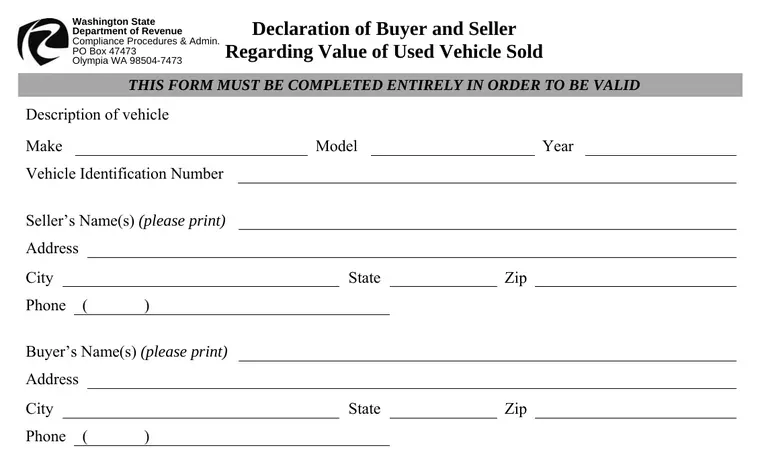
Written against REV 32 2501 (07/12/13), issued under Chapter 82.12 RCW and RCW 82.12.010(7)(a). This form arrives late, usually at the counter, and by then you may be a hundred miles away. If the car is genuinely worth less than a valuation guide says - a failed head gasket, a rusted sill, a seized engine - agree with the buyer before you part that you will sign one, and write the condition down while you can both still see the vehicle.

Two documents, and they are not the same thing. Take the blank REV 32 2501 from the dor.wa.gov copy so you get the revision that is current today.

Filled in

What a completed one looks like

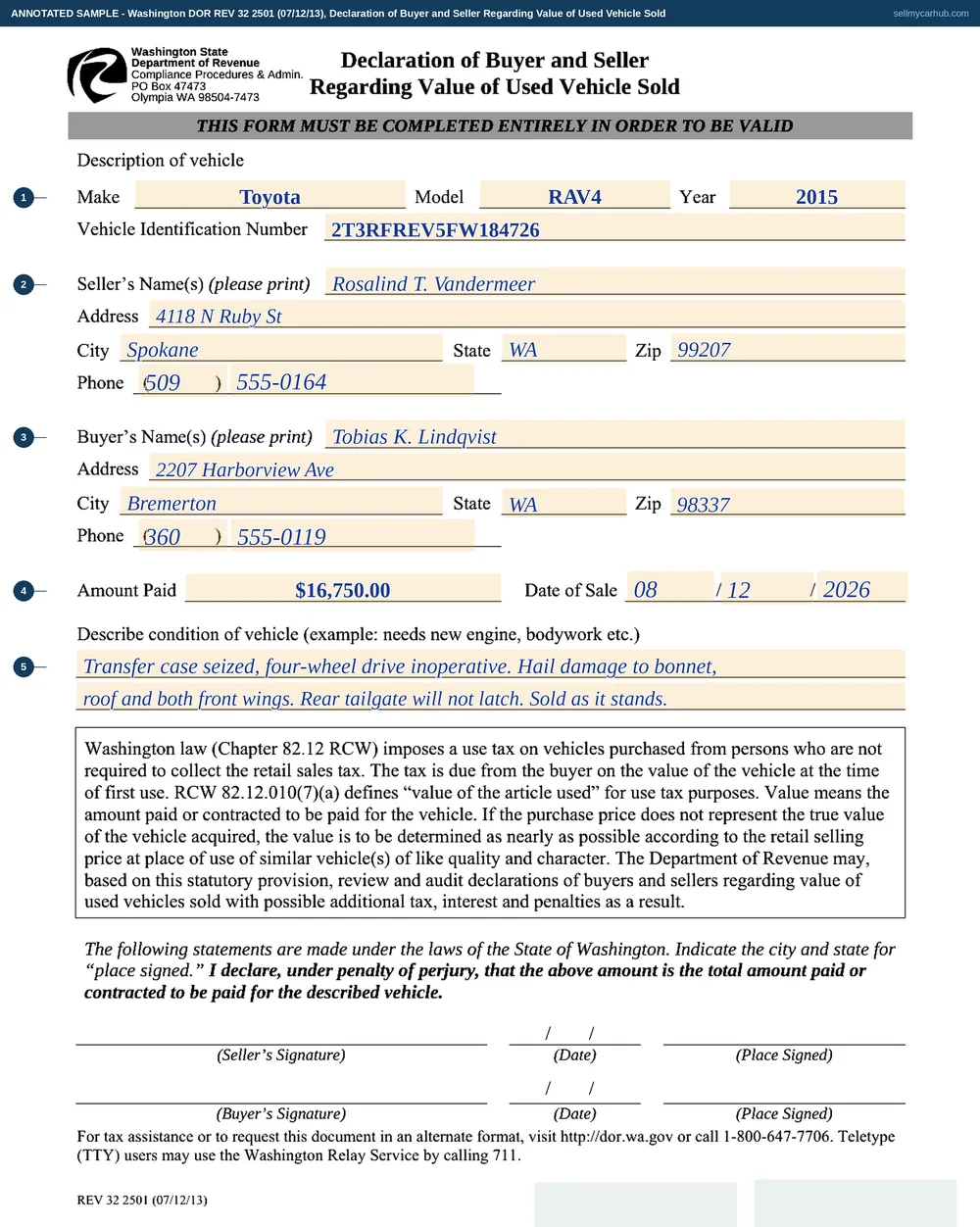
This is the actual REV 32 2501, rendered from the PDF the Washington State Department of Licensing publishes and completed end to end: letterhead, every field, and the blocks at the foot.

A completed Washington Department of Revenue Declaration of Buyer and Seller Regarding Value of Used Vehicle Sold, describing a 2015 Toyota RAV4 with a seized transfer case and hail damage, an amount paid of 16,750 dollars, a sale date of 12 August 2026, seller Rosalind Vandermeer of Spokane and buyer Tobias Lindqvist of Bremerton, and the two signature lines at the foot left empty because the form prints them as rules rather than boxes.
The Department of Revenue's form rather than the Department of Licensing's, which is why it looks nothing like the rest of the set. The block in the middle is where the work happens: a specific, checkable description of what is wrong with the vehicle carries far more weight than an assertion that the price was fair.
Field by field

Every line, in the order you meet it

  1. 1
    You fill this in

    The vehicle description

    Make, model, year and the identification number.

    Watch out: This form reaches a different department from everything else in the sale. Nothing is pre-filled and nothing is checked against the licensing record until somebody looks.

  2. 2
    You fill this in

    The seller block

    Your name printed, address, city, state, postcode and telephone number.

    Watch out: A working telephone number matters here more than anywhere else in the sale, because this is the form an auditor rings about.

  3. 3
    The buyer fills this in

    The buyer block

    The same details for the person buying the vehicle.

    Watch out: Both blocks are printed, not signed. The signatures are separate lines at the foot and both are needed.

  4. 4
    You fill this in

    Amount paid and date of sale

    The figure that changed hands and the day it did.

    Watch out: It has to agree with the bill of sale and with the Report of Sale. Three documents with three different numbers is what an audit looks for.

  5. 5
    You fill this in

    Describe the condition of the vehicle

    The free-text block, and the substance of the whole form.

    Watch out: Be concrete and be checkable. The department's own example is needs new engine, bodywork etc - a specific defect, not a general opinion that the car was tired.

  6. 6
    You fill this in

    Sign, date, and say where you were

    Your signature, the date, and the city and state where you signed it.

    Watch out: Sign it while the car is in front of you. Agreeing afterwards to describe a vehicle you can no longer inspect is how a declaration under penalty of perjury becomes somebody else's recollection.

At a glance

What goes where

On the formWhat to put in it
Make, Model, YearThe vehicle description band at the top, and the form says it must be completed entirely in order to be valid.
Vehicle Identification NumberOne line, taken from the certificate rather than the car.
Seller's Name(s), Address, City, State, Zip, PhonePrinted rather than signed - the signature comes later, at the foot.
Buyer's Name(s), Address, City, State, Zip, PhoneThe same block again for the person buying.
Amount PaidThe figure both of you are declaring. This is the number the whole form exists to establish.
Date of SaleThree boxes for month, day and year.
Describe condition of vehicleA free-text block, and the reason the form works. The example the department prints is: needs new engine, bodywork etc.
Seller's Signature, Date, Place SignedYour signature, and the city and state where you signed it.
Buyer's Signature, Date, Place SignedThe same again for the buyer, on the line underneath.

What gets this one rejected

Rules that decide whether it is accepted

Every line here was read off REV 32 2501 (07/12/13) itself — the PDF is here — and off the Washington State Department of Licensing pages. This is plain-language help with a form, not legal advice, and where our wording and the agency's differ, theirs governs.

Back to all Washington seller paperwork, or what selling a car in Washington involves.

Want the paperwork handled instead?

Get My Instant Offer → Online · about 2 minutes · free

Or send the details — we'll come to you

A car whose real value is an argument with a valuation guide is a car worth getting a straight offer on. Tell us what is wrong with it.

or call/text (877) 405-1808