Sell My Car Hub

How to fill out Washington 420-001A

The overflow sheet. The Vehicle Title Application has room for two registered owners and one lienholder; a car going into three names, or one carrying two lenders, runs out of boxes. This continuation sheet carries owners three and four and lienholders two and three, and it is stapled to the application rather than filed on its own.
Written against 420-001A (R/5/19), issued under RCW 46.12.530. A seller never touches this sheet, but it is worth knowing it exists: a buyer who turns up with three names for the certificate and no continuation sheet will be sent away to print one, and that is a wasted appointment for both of you.

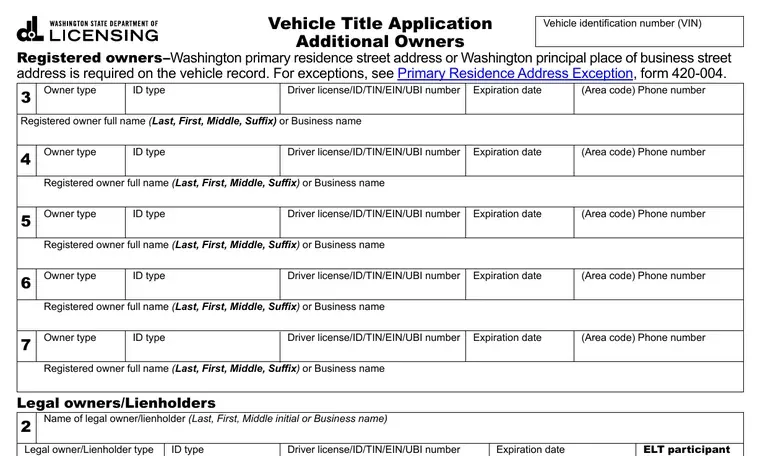
Two documents, and they are not the same thing. Take the blank 420-001A from the dol.wa.gov copy so you get the revision that is current today.

Filled in

What a completed one looks like

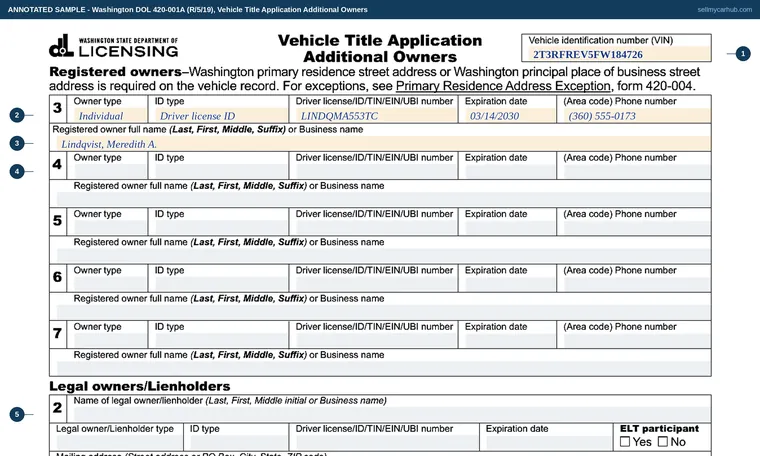
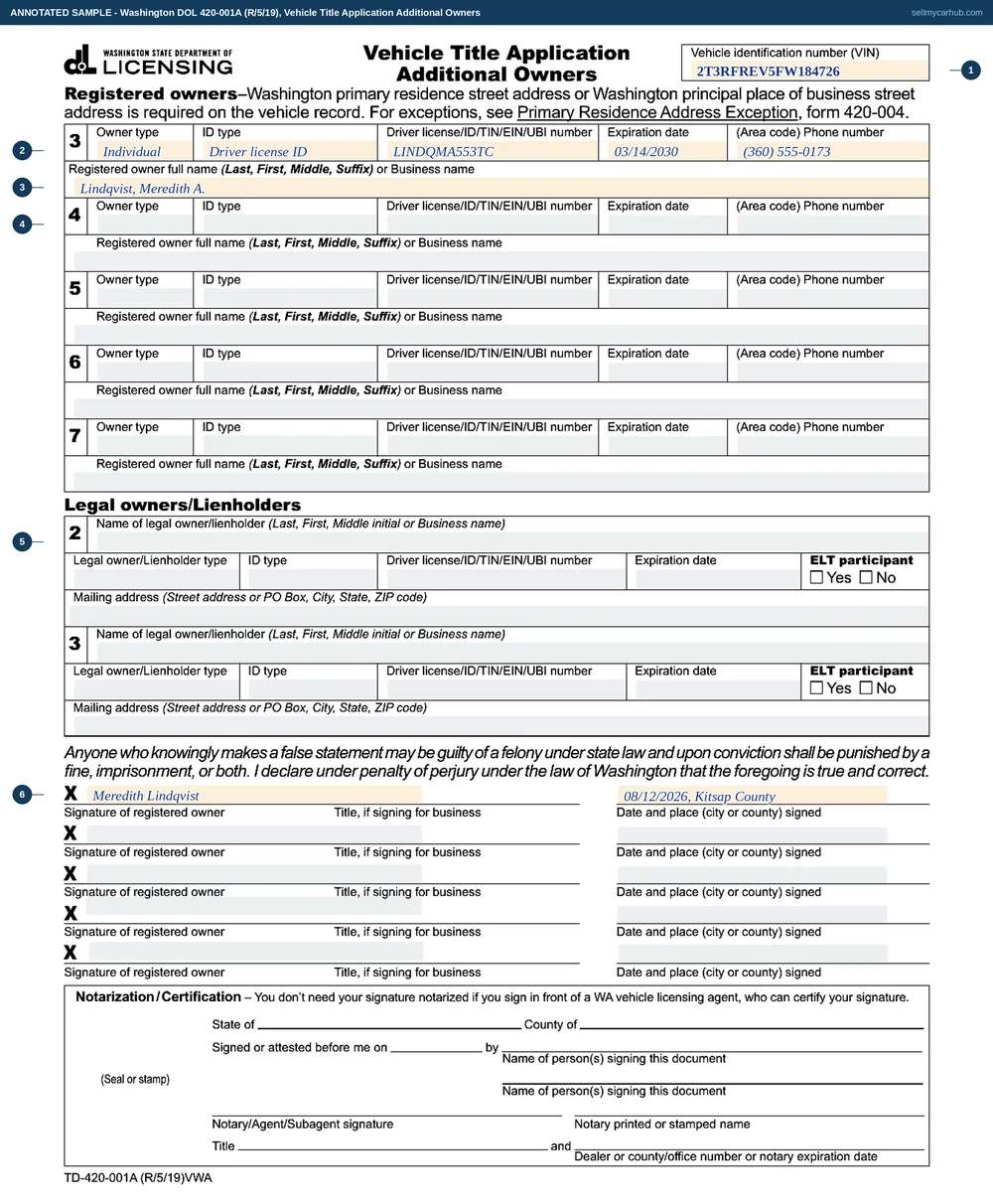
This is the actual 420-001A, rendered from the PDF the Washington State Department of Licensing publishes and completed end to end: letterhead, every field, and the blocks at the foot.

A completed Washington Vehicle Title Application Additional Owners sheet, form 420-001A, carrying the identification number of a 2015 Toyota RAV4 at the top and a third registered owner, Meredith A. Lindqvist of Bremerton, with her Washington driver licence number, date of birth, phone number and signature, with the notarisation block underneath left for the witness.
The continuation sheet, filled in for a third buyer joining the same purchase. The identification number in the top right corner is the only thing tying it to the application it belongs with - which is why an unsigned or unnumbered copy is worth nothing at the counter.
Field by field

Every line, in the order you meet it

  1. 1
    The buyer fills this in

    The identification number at the top

    Seventeen characters, repeated from the main application.

    Watch out: Fill this in first. A continuation sheet that becomes separated from its application and carries no identification number cannot be matched back to anything.

  2. 2
    The buyer fills this in

    Registered owner 3

    Owner type, identification type and number, expiry, phone type and number.

    Watch out: The numbering continues from the main form. Starting again at one here is how an application ends up appearing to name two owner threes.

  3. 3
    The buyer fills this in

    Owner 3's full name and address

    Last, first, middle and suffix, then the Washington primary residence street address.

    Watch out: The same address rule applies to every additional owner. A third owner living out of state needs the residence exception form, not a mailing address in the residence line.

  4. 4
    The buyer fills this in

    Registered owner 4 and survivorship

    A second owner band with the joint tenants with right of survivorship question beside it.

    Watch out: Answer it deliberately. With three or four names on a certificate the difference between survivorship and tenants in common is the difference between a phone call and a probate.

  5. 5
    The lienholder fills this in

    Legal owner or lienholder 2 and 3

    Two further lender blocks with identification and an electronic-titles tick each.

    Watch out: Rare on a private sale, and worth querying if a buyer is filling them in - two lenders on one used car is unusual enough to be a mistake.

  6. 6
    The buyer fills this in

    Signatures, one per additional owner

    Each additional owner signs with the date and the city or county where they signed.

    Watch out: They have to be present. A signature collected at home and brought along is exactly what the notarisation block below exists to prevent.

  7. 7
    The buyer fills this in

    The notarisation block

    State, county, date, the names of the people signing, and the notary or agent's details.

    Watch out: It names the people signing this document. An owner who could not come to the counter is not covered by it, however many other signatures are.

At a glance

What goes where

On the formWhat to put in it
Vehicle identification numberRepeated at the top right, because the sheet is meaningless once it is separated from the application it belongs to.
Registered owner 3 - owner type, ID type, driver licence, ID, TIN, EIN or UBI number, expiry date, phoneThe same band as the main form, numbered to continue from it.
Registered owner 3 full name or business nameLast, first, middle and suffix, or the full registered business name.
Registered owner 4 and the survivorship tickA second owner band, with the joint tenants with right of survivorship question attached to it.
Legal owner/lienholder 2 and 3Two further lender blocks, each with an identification type, number, expiry and an electronic-titles participant tick.
Signature lines for each additional registered ownerEvery additional owner signs here, with the date and the place - city or county - the signature was made.
Notarization / CertificationThe same block as the main application: state, county, date, the name of the person signing, and the notary's or agent's signature, printed name, title and number.

What gets this one rejected

Rules that decide whether it is accepted

Every line here was read off 420-001A (R/5/19) itself — the PDF is here — and off the Washington State Department of Licensing pages. This is plain-language help with a form, not legal advice, and where our wording and the agency's differ, theirs governs.

Back to all Washington seller paperwork, or what selling a car in Washington involves.

Want the paperwork handled instead?

Get My Instant Offer → Online · about 2 minutes · free

Or send the details — we'll come to you

Three names on a title and only one of them answering the phone is a common reason a sale stalls. If that is where you are, tell us about the car.

or call/text (877) 405-1808