Sell My Car Hub

How to fill out Washington 420-737

The other value form, and it answers a different question. The Department of Revenue's declaration is about what was paid for a vehicle the department already has a value for. This one is for a vehicle the department has no value for at all - homemade, assembled, foreign, or simply not listed in the excise tax schedules - and it asks the owner to estimate what the vehicle was worth when it was new.
Written against 420-737 (R/2/18), issued under Chapter 82.44 RCW and WAC 308-57-030. Most private sellers will never see this form, and the ones who do are usually selling something unusual: a kit car, an assembled trailer, an import with no domestic listing. If that is what you have, expect the buyer to be sent back to you for a description of the vehicle you are the only person who can write.

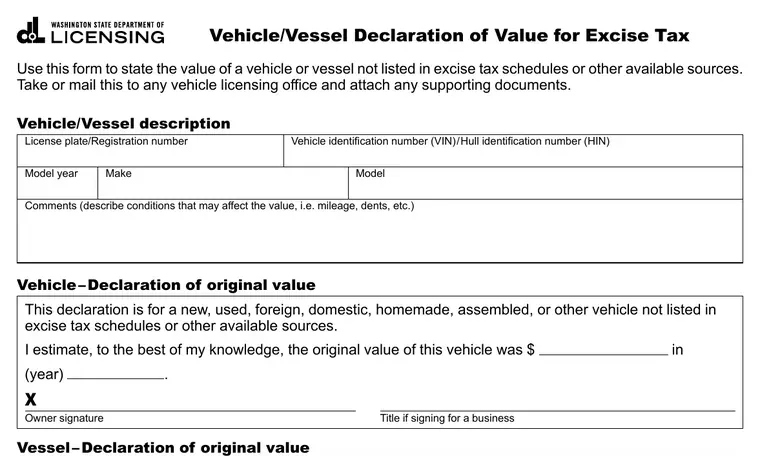
Two documents, and they are not the same thing. Take the blank 420-737 from the dol.wa.gov copy so you get the revision that is current today.

Filled in

What a completed one looks like

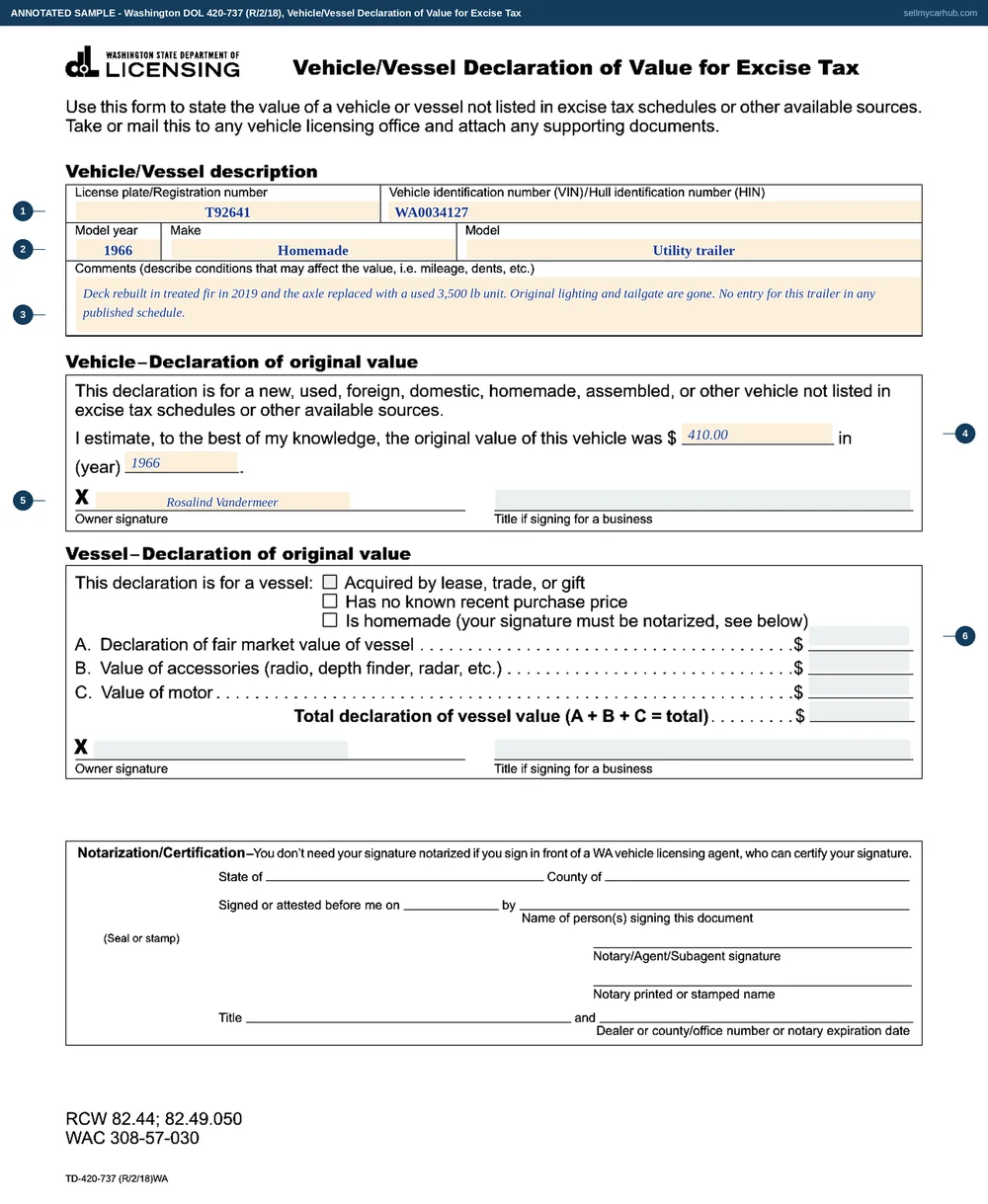
This is the actual 420-737, rendered from the PDF the Washington State Department of Licensing publishes and completed end to end: letterhead, every field, and the blocks at the foot.

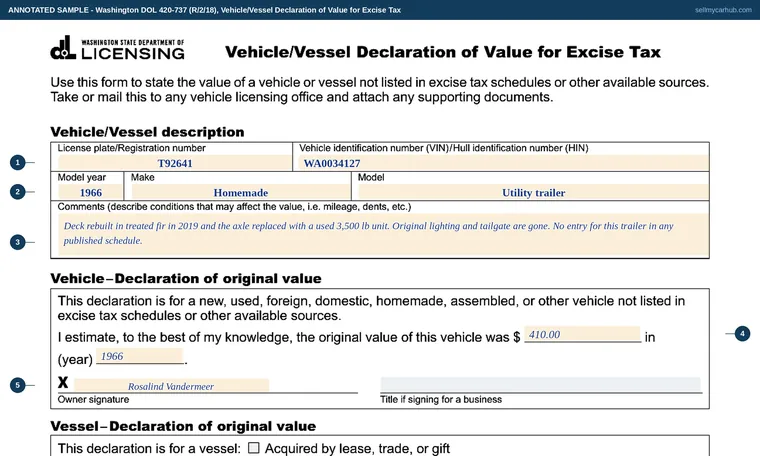
A completed Washington Vehicle/Vessel Declaration of Value for Excise Tax, form 420-737, for an assembled 1966 utility trailer: the plate and identification numbers, a comments block describing a rebuilt deck and replacement axle, an estimated original value with the year, the owner's signature, and an empty notarisation block waiting for the agent who watches it signed.
Filled in for the kind of vehicle it actually exists for - one with no entry in any excise tax schedule. The vessel half of the form has been left grey because it is not the seller's to complete on a vehicle, and the sum at its foot is the only arithmetic anywhere on the page.
Field by field

Every line, in the order you meet it

  1. 1
    You fill this in

    Plate and identification number

    The plate or registration number, and the identification number of the vehicle or hull.

    Watch out: On an assembled or homemade vehicle the identification number may be one the department assigned rather than one a manufacturer stamped. Use the number the certificate carries.

  2. 2
    You fill this in

    Model year, make and model

    Three boxes, as the certificate describes the vehicle.

    Watch out: For something assembled, the make and model are whatever the department recorded when it was first titled - not what the parts came from.

  3. 3
    You fill this in

    Comments

    The description block, for conditions that may affect the value.

    Watch out: The form gives its own examples - mileage, dents - so this is the place for the specific and the physical rather than for an opinion about the market.

  4. 4
    You fill this in

    The declaration of original value

    One sentence with two blanks: the estimated original value, and the year the vehicle had it.

    Watch out: It says to the best of my knowledge for a reason. An estimate you can explain is what is being asked for; a number chosen to reduce the tax is a declaration you have signed.

  5. 5
    You fill this in

    Sign it, and say if you are signing for a business

    One owner signature line, with a title box beside it.

    Watch out: Print the form before signing. The line says so, and an electronically typed name in it is not a signature.

  6. 6
    You fill this in

    The vessel half stays empty

    Three ticks and a four-line total for a boat, its accessories and its motor.

    Watch out: Nothing here applies to a car. Filling it in because it looks like part of the same form produces a declaration about a vessel that does not exist.

  7. 7
    You fill this in

    The notarisation block

    State, county, date, name of the person signing, and the notary's or agent's details.

    Watch out: Take the form to a licensing office and the agent certifies it while you wait, which costs nothing extra and saves finding a notary.

At a glance

What goes where

On the formWhat to put in it
License plate/Registration numberThe plate on the vehicle, or the registration number where there is no plate.
Vehicle identification number (VIN) / Hull identification number (HIN)One box serving both vehicles and vessels.
Model year, Make, ModelThree boxes on the same row as the identification number.
CommentsA free-text block, and the form tells you what belongs in it: describe conditions that may affect the value, i.e. mileage, dents, etc.
Vehicle - Declaration of original valueA single sentence with two gaps in it - an estimate, to the best of the owner's knowledge, of the original value of the vehicle, and the year it had that value.
Owner signature and Title if signing for a businessOne line, printed and signed.
Vessel - Declaration of original valueThree ticks and a four-line sum. It is the vessel half of the form and stays empty for a car.
Notarization / CertificationIdentical to the block on the main application: a place, a date, the signer named, and the witness identified by signature, printed name, title and number.

What gets this one rejected

Rules that decide whether it is accepted

Every line here was read off 420-737 (R/2/18) itself — the PDF is here — and off the Washington State Department of Licensing pages. This is plain-language help with a form, not legal advice, and where our wording and the agency's differ, theirs governs.

Back to all Washington seller paperwork, or what selling a car in Washington involves.

Want the paperwork handled instead?

Get My Instant Offer → Online · about 2 minutes · free

Or send the details — we'll come to you

Homemade, assembled, imported, or simply not in anybody's price guide - if nobody can tell you what your vehicle is worth, ask us.

or call/text (877) 405-1808