Sell My Car Hub

How to fill out Washington 420-001

The buyer's form, and the one a seller most needs to understand without ever signing. It is what turns your signed certificate into their certificate, it carries the notarisation Washington actually requires, and it has to reach a vehicle licensing office within fifteen days of delivery. If the buyer gets it wrong the transfer stalls - and until it completes, your Report of Sale is doing all the work.

Written against 420-001 (R/5/19), issued under RCW 46.12.530 and RCW 46.12.650(6). Nothing on this form is the seller's to sign, and a seller who helpfully fills it in has created a document the buyer then has to swear to in front of a notary. Hand over the certificate, keep your copy of the bill of sale, and let them complete this at the counter.

Two documents, and they are not the same thing. Take the blank 420-001 from the dol.wa.gov copy so you get the revision that is current today.

Filled in

What a completed one looks like

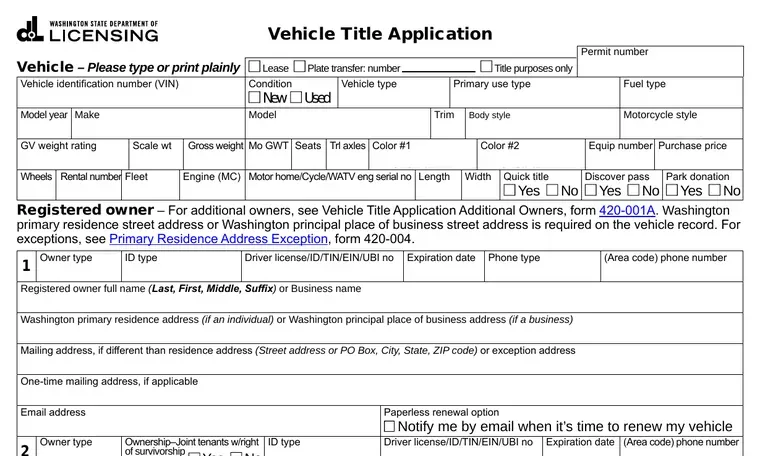
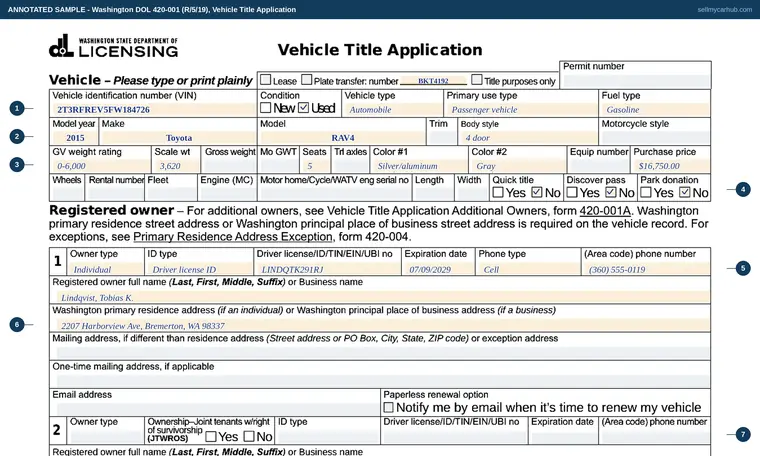
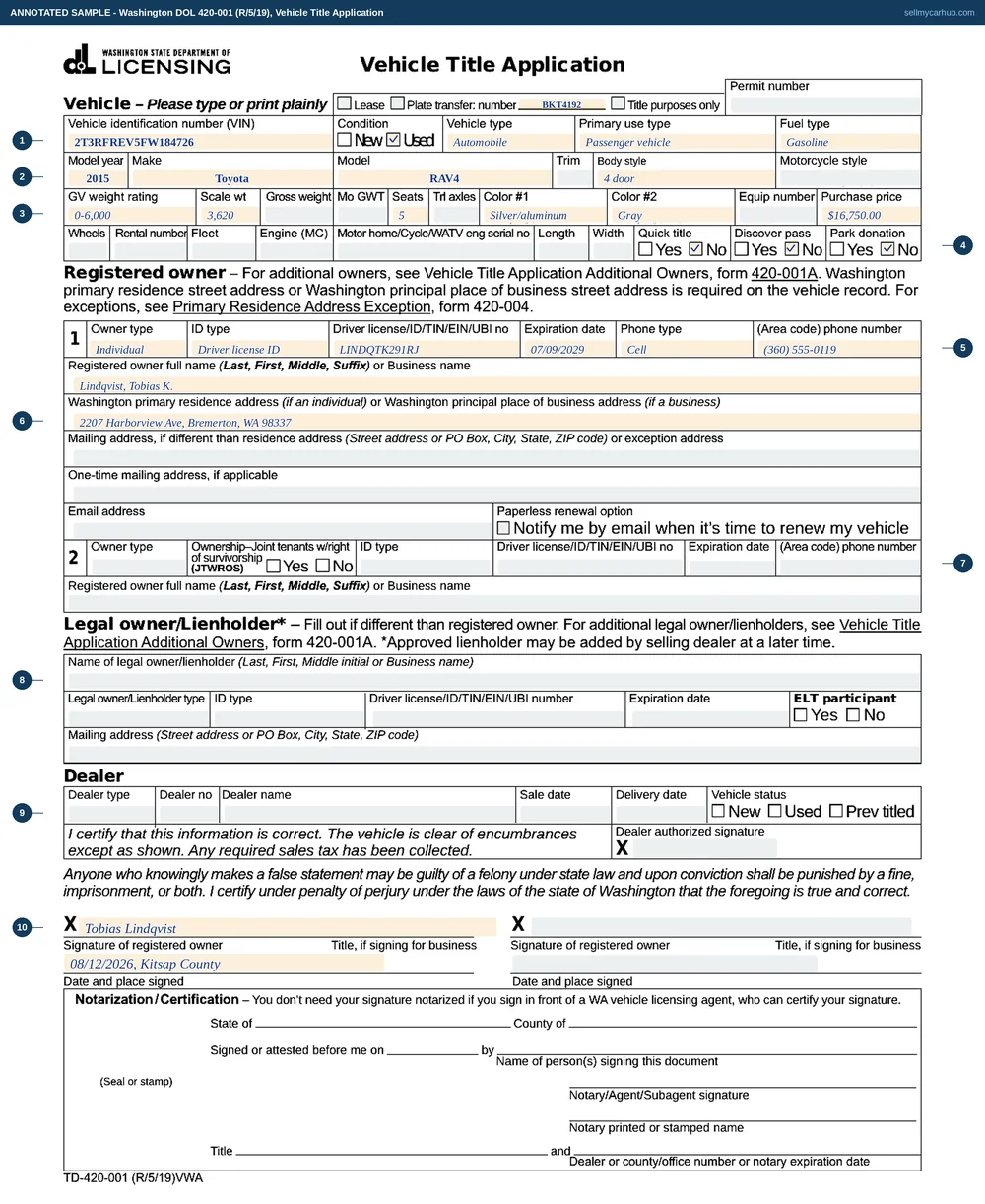
This is the actual 420-001, rendered from the PDF the Washington State Department of Licensing publishes and completed end to end: letterhead, every field, and the blocks at the foot.

A completed Washington Vehicle Title Application, form 420-001, for a 2015 Toyota RAV4 bought by Tobias Lindqvist of Bremerton: the identification number and vehicle description band, scale weight and colours, the registered owner block with a Washington driver licence number and a Bremerton street address, an empty lienholder block, an empty dealer block, the buyer's signature over the perjury declaration, and the notarisation block at the foot left blank because it is the witness's to complete.
The buyer's side of a Washington sale, filled in. Two things worth noticing as a seller: the dealer band across the middle stays completely empty on a private sale, and the block at the very foot is a notary's - which is where Washington puts the witnessed signature, rather than on the certificate you signed.
Field by field

Every line, in the order you meet it

  1. 1
    The buyer fills this in

    The identification number band

    Vehicle identification number, condition, vehicle type, primary use and fuel type across the top of the page.

    Watch out: The identification number is checked against a national database while the application is processed. A vehicle that comes back reported stolen is sent to the state patrol and no certificate is issued.

  2. 2
    The buyer fills this in

    Model year, make, model and body style

    Copied from the certificate the seller signed over.

    Watch out: If the department finds the model year or make on the certificate is wrong it corrects the record and sends a written explanation of what it changed and why.

  3. 3
    The buyer fills this in

    Weights, seats and colours

    Gross vehicle weight rating, scale weight, seats, and up to two colours chosen from the department's list rather than described in words.

    Watch out: Scale weight is the empty weight of the vehicle. Where the certificate does not show it, the vehicle has to be weighed and the weight documentation goes in with the application. And the colour is a menu: a car most people would call champagne is beige, gold or cream/ivory on this form, and the one you pick is the one that goes on the record.

  4. 4
    The buyer fills this in

    Quick title, and the two donations

    Three yes-or-no ticks at the end of the vehicle band.

    Watch out: Quick title is the only one of the three that changes when the certificate arrives. The other two are a park donation and an annual pass, and both can be declined.

  5. 5
    The buyer fills this in

    The registered owner block

    Owner type, identification type and number, expiry, phone and the full legal name.

    Watch out: Every registered owner has to show an unexpired Washington driver licence at the counter unless they are exempt, and the exemption is its own form.

  6. 6
    The buyer fills this in

    The Washington residence address

    A Washington primary residence street address, or a principal place of business address for a company.

    Watch out: The mailing address line underneath is where a post office box goes. Putting one in the residence line means either an exception form or a rejected application.

  7. 7
    The buyer fills this in

    Survivorship, where there are two buyers

    A yes-or-no tick beside the second registered owner.

    Watch out: Two people buying a car together and leaving this blank get tenants in common. The tick is the only thing that gives the survivor the vehicle outright.

  8. 8
    The lienholder fills this in

    Legal owner or lienholder

    The lender's name, identification and whether it takes electronic titles.

    Watch out: Where a lender is recorded, the certificate goes to them rather than to the buyer - and if they are in the electronic programme, no paper certificate is printed at all until the loan is cleared.

  9. 9
    Dealers only

    The dealer band

    Dealer type, number, name, sale and delivery dates and the dealer's own certification.

    Watch out: On a private sale this whole band stays empty. A buyer who fills it in because they think it means the previous owner has created a false statement on a form signed under penalty of perjury.

  10. 10
    The buyer fills this in

    Sign it, and where

    Signature, title if signing for a business, and the date and place - city or county - the signature was made.

    Watch out: The place-signed line is not decoration. It has to agree with the county the notary or agent enters in the block below it.

  11. 11
    The buyer fills this in

    The notarisation block

    The witness fills this one in: where in Washington the signing happened, on what day, whose signature was watched, and then their own name twice - once written and once stamped - with a commission date or a county office number.

    Watch out: This is the block a licensing agent completes for free while you stand there. Paying a notary first is a choice, not a requirement.

At a glance

What goes where

On the formWhat to put in it
Vehicle - identification number, condition, vehicle type, primary use type, fuel typeThe top band. Condition is a new-or-used tick. Vehicle type offers six choices - automobile, truck, motorcycle, mobile or manufactured home, trailer, other. Fuel type offers twelve, and they are more particular than a forecourt is: gasoline, diesel, electric, hybrid, comp natural gas, liq natural gas, liq petroleum gas, butane, propane, steam, unpowered and other. Primary use type is a list of thirty-eight, and passenger vehicle is only the first of them.
Model year, make, model, trim, body styleCopied from the certificate being surrendered, not from the advertisement it was bought from. A motorcycle gets one extra drop-down beside these, and it is the department's own nine-way split of what kind of machine it is: 3-wheel, adventure bike, cruiser bike, dirt bike, dual sport bike, scooter, sport bike, standard and touring bike.
GV weight rating, scale wt, gross weight, seats, trailer axlesThe physical description band. Gross vehicle weight rating is a drop-down in eight bands from 0-6,000 up to 33,001-99,999. Scale weight is the empty weight, and where the certificate does not carry it the vehicle has to be weighed and the documentation submitted.
Color #1 and Color #2Not free text. Both are drop-downs and the palette is the department's own twenty-eight: beige, black, blue, blue dark, blue light, brown, bronze, chrome/steel, copper, cream/ivory, gold, gray, green, green dark, green light, ivory, lavender, maroon/burgundy, multicolor, orange, pink, purple, red, silver/aluminum, tan, turquoise, white and yellow. Colour one is the primary colour; on a single-colour vehicle the second stays empty.
Plate transfer: number, Lease, Title purposes only, Permit numberFour small boxes across the top right that change what the application is for.
Quick title / Discover pass / Park donationThree yes-or-no ticks at the end of the vehicle band. The first is what decides whether the certificate is printed at the counter or posted.
Registered owner - owner type, ID type, driver licence or business ID number, expiry date, phoneThe buyer's block. A Washington primary residence street address is required on the vehicle record, and for the exceptions there is a separate form.
Registered owner full name and Washington primary residence addressCompleted as the buyer wants it to read on the registration. A post office box goes in the mailing line, never in the residence line.
Second registered owner and Ownership - joint tenants with right of survivorship (JTWROS)A yes-or-no tick that decides what happens to the vehicle if one of two owners dies.
Legal owner/Lienholder, ID type and ELT participantFilled in only where a lender is being recorded, with a tick for whether that lender is in the electronic titles programme.
Dealer blockDealer type, number, name, sale date, delivery date and vehicle status - and a certification signed by the dealer. It stays empty on a private sale.
Registered owner signatures, with date and place signedTwo signature lines, each with the city or county where it was signed, above a printed declaration under penalty of perjury.
Notarization / CertificationThe seal block at the very foot of the page. It names a state and a county, records the day the buyer signed or attested before the notary, repeats the signer's name, and is closed by the witness with a signature, a printed or stamped name, a title, and either a notary commission expiry date or an agent's office number.

What gets this one rejected

Rules that decide whether it is accepted

Every line here was read off 420-001 (R/5/19) itself — the PDF is here — and off the Washington State Department of Licensing pages. This is plain-language help with a form, not legal advice, and where our wording and the agency's differ, theirs governs.

Back to all Washington seller paperwork, or what selling a car in Washington involves.

Want the paperwork handled instead?

Get My Instant Offer → Online · about 2 minutes · free

Or send the details — we'll come to you

If you would rather not depend on a stranger lodging a form within fifteen days to end your connection with the car, there is a shorter route - tell us what you have.

or call/text (877) 405-1808