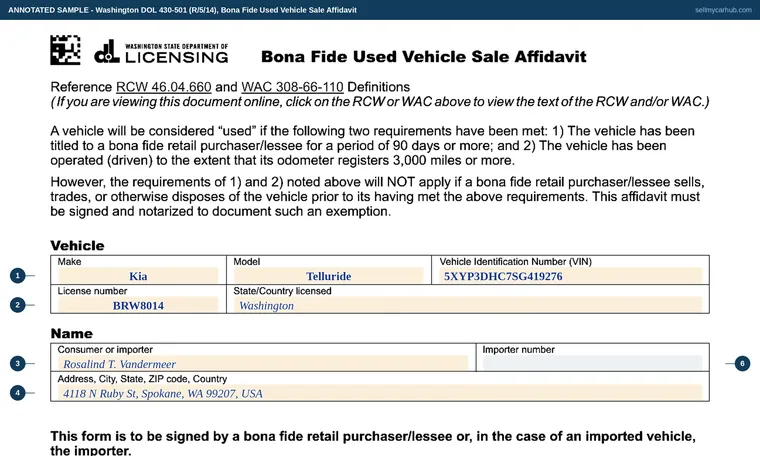
The form for the seller nobody plans to be: somebody parting with a car they bought new only weeks ago. Washington treats a vehicle as used only once it has been titled to a retail purchaser for 90 days or more and driven 3,000 miles or more. Sell before both of those are true and the vehicle is legally still new - unless you sign this affidavit, which is the exemption.
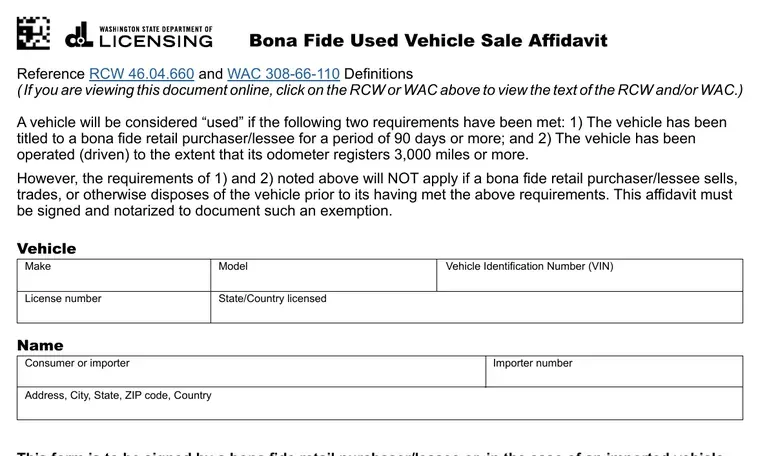
Written against 430-501 (R/5/14), issued under RCW 46.04.660 and WAC 308-66-110. This is a narrow form and most sellers will never meet it. It matters if you are selling or trading a car you bought new within the last three months or three thousand miles, because without it the vehicle is legally a new one and the dealer taking it in cannot treat it as used stock.
Two documents, and they are not the same thing. Take the blank 430-501 from the dol.wa.gov copy so you get the revision that is current today.
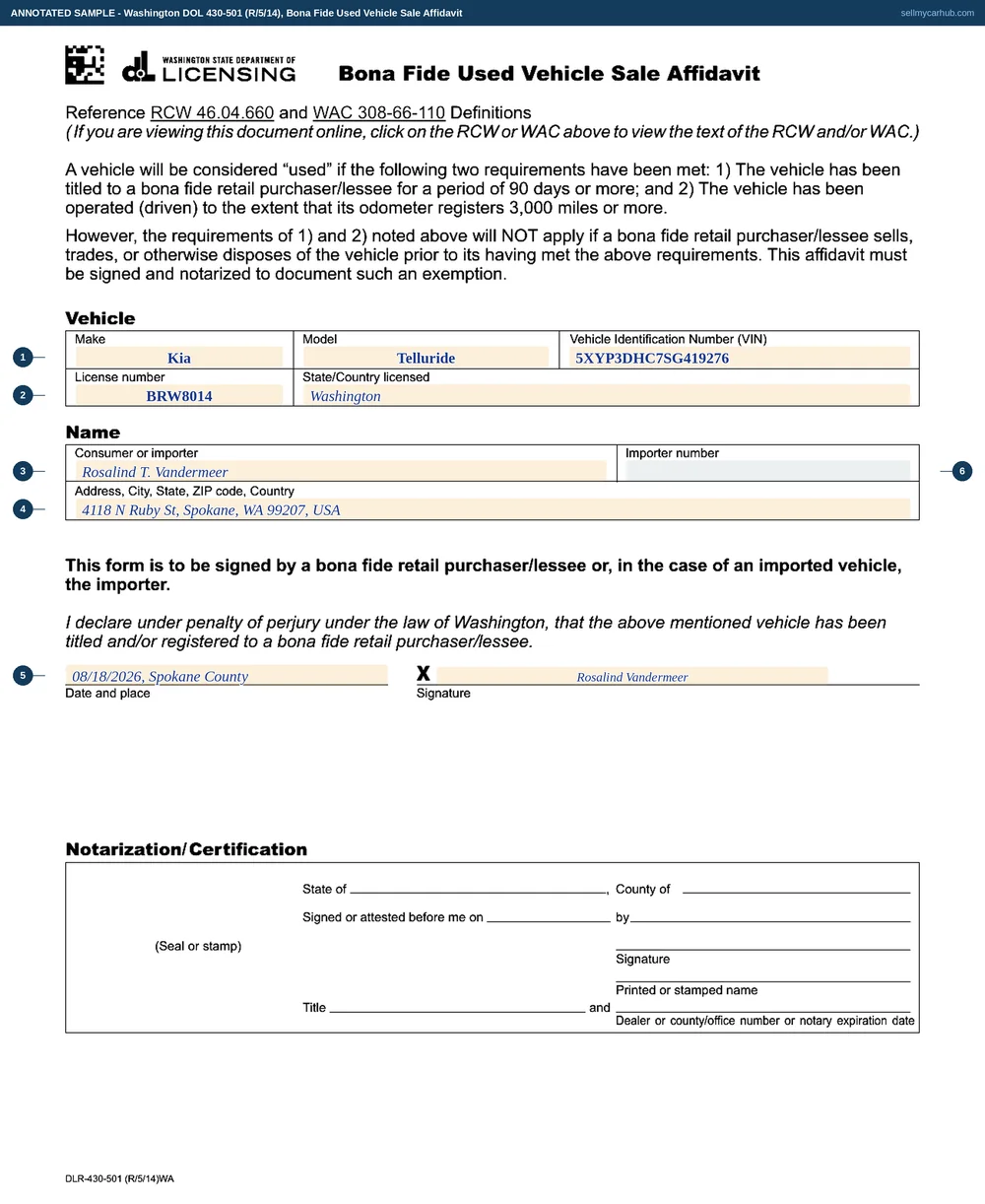
This is the actual 430-501, rendered from the PDF the Washington State Department of Licensing publishes and completed end to end: letterhead, every field, and the blocks at the foot.
Three boxes describing the vehicle you bought new and are now parting with.
Watch out: Take them from the certificate rather than the sales invoice - the certificate is what the department will compare this against.
The plate on the vehicle, and the state or country that issued it.
Watch out: On an imported vehicle this is the line that shows the department which of the two signers the affidavit is coming from.
Your name, as the person who bought the vehicle new at retail.
Watch out: The importer number beside it stays empty. It belongs to the other kind of signer, and filling it in describes you as somebody you are not.
Address, city, state, postcode and country on one line.
Watch out: The country box is not optional padding - it is there because half the cases this form covers involve a vehicle brought into the country.
The declaration under penalty of perjury, then the date and place signed, then the signature.
Watch out: The line asks you to print the completed form and sign it. Sign in front of the notary or the licensing agent, not before you get there.
State, county, the date, the signature and the printed or stamped name of the notary or agent, with their title and number.
Watch out: As everywhere else in the Washington set, an agent at a licensing office can certify instead of a notary, and it costs nothing to have it done there.
| On the form | What to put in it |
|---|---|
| Make, Model, Vehicle Identification Number | The vehicle description band, three boxes across. |
| License number and State/Country licensed | The plate and where it was issued, which matters because an imported vehicle reaches this form by a different route. |
| Consumer or importer | Your name. The form is signed either by the bona fide retail purchaser or lessee, or by the importer where the vehicle came in from abroad. |
| Importer number | Left empty by a private seller and completed only where the signer is an importer. |
| Address, City, State, ZIP code, Country | One block, with a country line because of the import case. |
| Declaration and signature | A declaration under penalty of perjury under the law of Washington that the vehicle has been titled or registered to a bona fide retail purchaser or lessee, then the date, place and signature. |
| Notarization / Certification | A seal block in the department's house style, filled in by whoever watched the affidavit being signed - place, date, then their signature, their name printed or stamped, their title and their number. |
Every line here was read off 430-501 (R/5/14) itself — the PDF is here — and off the Washington State Department of Licensing pages. This is plain-language help with a form, not legal advice, and where our wording and the agency's differ, theirs governs.
Back to all Washington seller paperwork, or what selling a car in Washington involves.