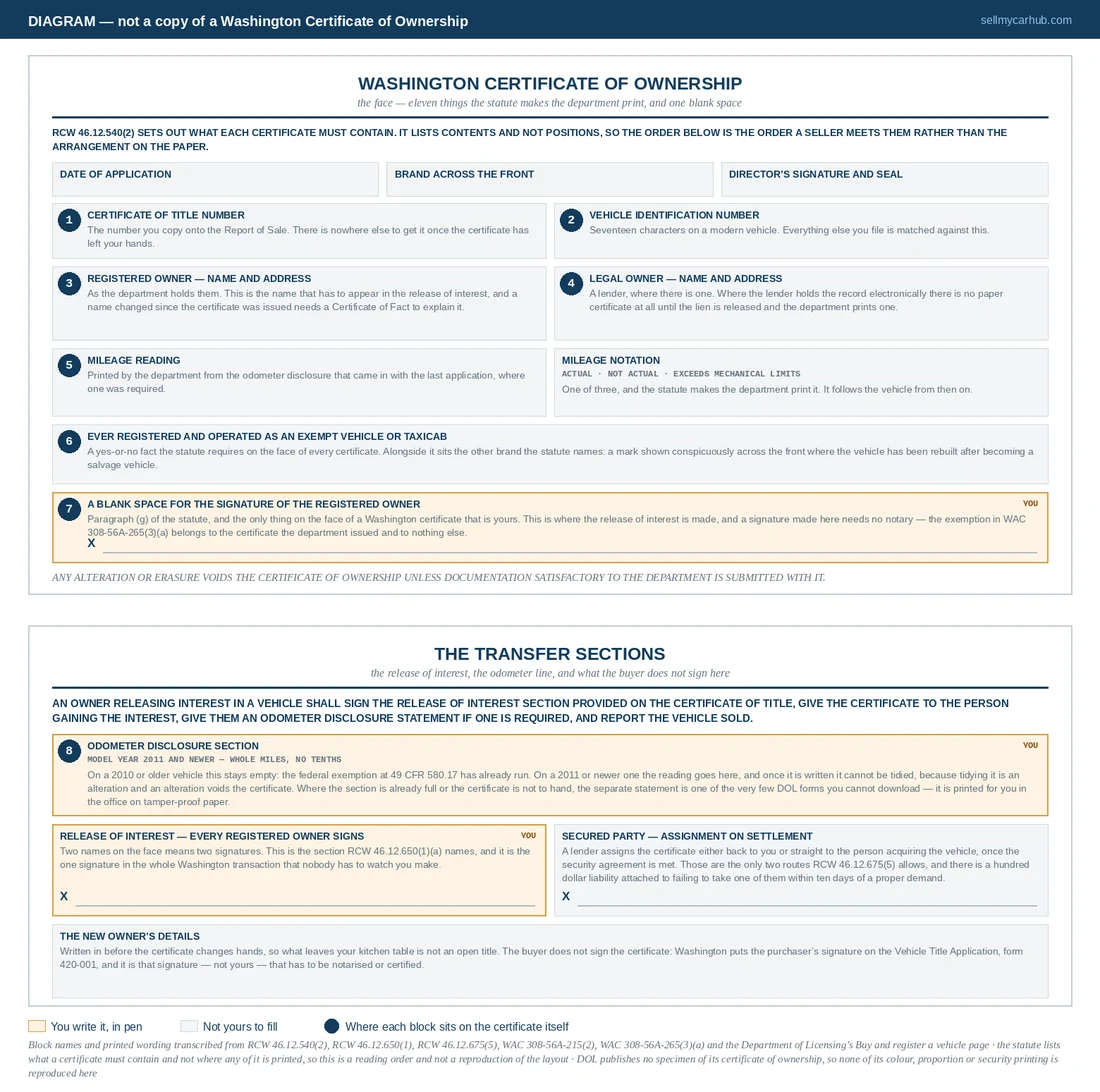
Washington calls its title a Certificate of Ownership, and RCW 46.12.540 lists the eleven things the department has to print on it. Only two of them are yours to touch: the release of interest section and, on a 2011 or newer vehicle, the odometer disclosure. Everything below is transcribed from the statute, the rules and DOL's own instructions, with the source named beside each block.
Last updated .
Your 8 boxes
As a private seller you complete these and nothing else:
There is no blank Washington certificate of ownership to download, and no picture of one either - the department publishes samples of driver licences and identity cards but nothing at all for a title. What you can download is the printable checklist beside this paragraph, which lists the blocks in the order you meet them and marks the two that are yours.
Any alteration or erasure voids the certificate of ownership. There is no correcting a Washington title - there is only replacing it.
DOL's order is fixed and it is short: locate the title, complete a bill of sale, collect payment and sign the title over, take the plates off, take your belongings out, file the Report of Sale, then drop the car from your License eXpress account.
The certificate itself
What sits where on a Washington Certificate of Ownership
The eight markers below number the certificate's own blocks in the order a seller meets them, front then back. They are a different set from the numbered steps further down the page, which run through the whole sale rather than through the document. Every block name here is transcribed from a source named in the caption; none of the certificate's colour, proportion or security printing is reproduced.
Amber — you write it, in pen
Grey — not yours to fill
Numbered — where each block sits on the certificate itself
Click or tap the picture to open it full size.
Drawn, and labelled as a drawing across the top. The Department of Licensing publishes no specimen of its certificate of ownership: its media library was enumerated end to end by HTTP HEAD request - every id from 1 to 9,200 - and all 1,923 published files were read by name. DOL does publish specimen documents and has a naming convention for them, DLsample and IDsample, with thirteen driver licence and identity card samples under it; there is nothing for a title under that convention or any other. Block names here are transcribed from RCW 46.12.540(2), RCW 46.12.650(1), WAC 308-56A-265 and DOL's Buy and register a vehicle page.
The form that is yours alone, filled in
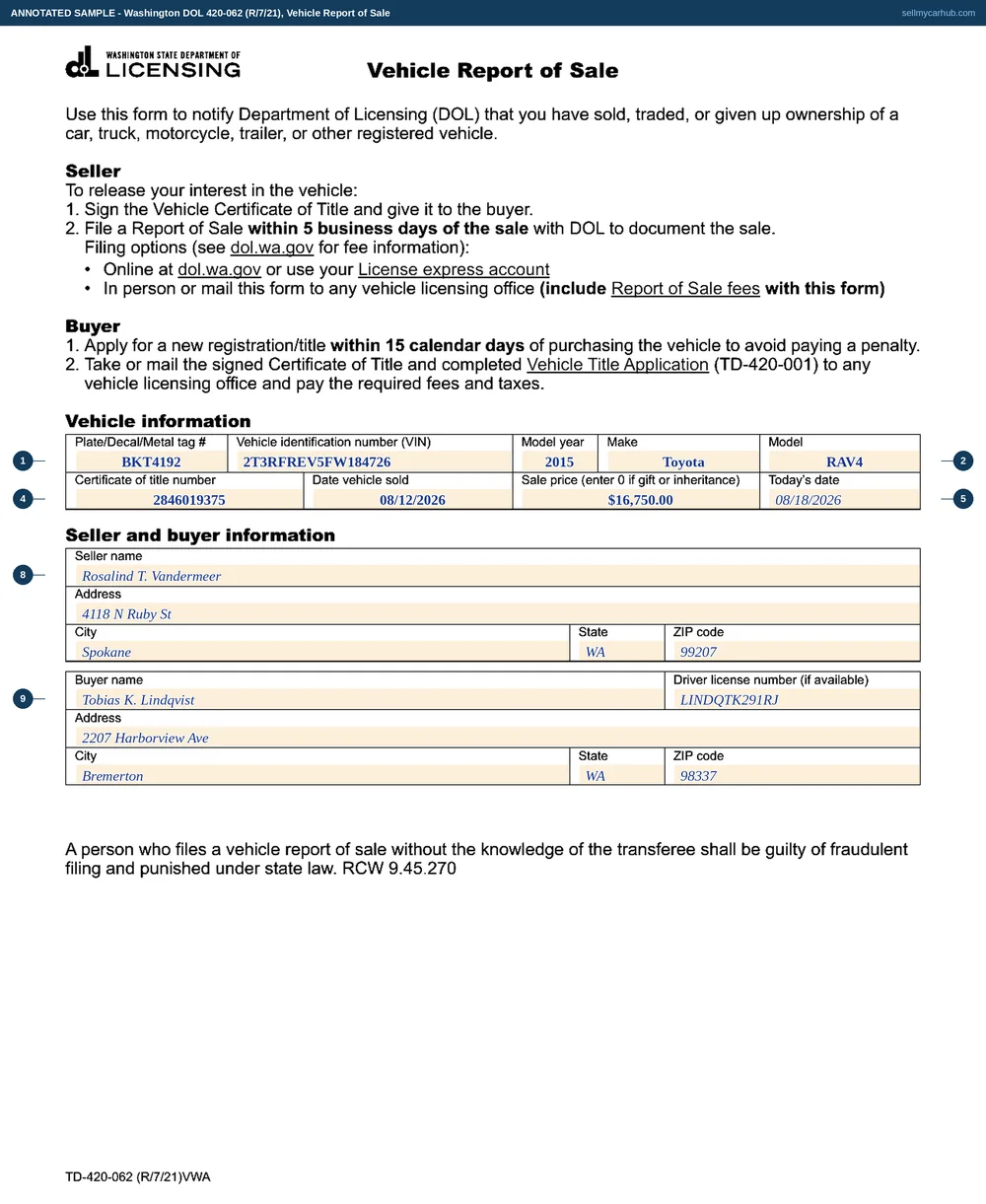
A completed Vehicle Report of Sale, the one document a Washington buyer never touches
Every other piece of paper in a Washington sale is shared. This one is not: you fill it in, you file it, and it is the only thing standing between you and the next owner's tolls. Here it is completed for the sale this whole section follows, with six of its blocks numbered on the image and picked up one by one underneath.
Click or tap the picture to open it full size.
Look at the date sold box. Everything about this form runs off that one date: five business days from it, counted without Saturdays, Sundays or state and federal holidays, and measured on the day the department receives the form rather than the day you post it. And note there is no signature line anywhere on it - Washington does not ask the seller to swear to a report of sale, it asks them to file one.
Before you watch. This is the department's own video and it is old - published in March 2009, and nothing has replaced it. Treat it as the argument for filing rather than as the current instructions: since it was made, DOL has added online filing through License eXpress and a no-login route, and the fee for filing on paper is now $18. The deadline it is about has not moved - five business days - but check the figures on this page rather than in the film.
Three minutes from the department on why the Report of Sale matters and what happens to a seller who skips it. Nothing loads from YouTube until you press play.
Step by step
Every box, in the order you meet it
0
You fill this in
Before any box: find the certificate
Washington will not let the sale proceed on a promise. DOL's first step is to locate the title, and if it cannot be found the replacement takes four to eight weeks by post.
Watch out: A quick title office prints one at the counter for $89.50 instead. Look at the map before you agree a completion date, because quick title offices are a subset of licensing offices, not all of them.
1
You fill this in
The release of interest section
Printed on the certificate itself. Sign it, and have every other registered owner sign it too.
Watch out: This is the signature that needs nobody watching. Sign the same words on form 420-050 instead and it must be notarised or certified - the exemption belongs to the certificate, not to the sentence.
2
You fill this in
The odometer disclosure section
Whole miles, on the face of the certificate, for any vehicle of model year 2011 or newer.
Watch out: If the section is already full or the certificate is not to hand, the separate odometer statement is one of the few things DOL refuses to publish - it is printed for you in the office on tamper-proof paper.
3
You fill this in
The buyer's name and address
Filled in before the certificate changes hands, so that what leaves your kitchen table is not an open title.
Watch out: An open certificate is how a car ends up abandoned with your name still on the record. The report of sale alone will not save you there - RCW 46.12.650(4)(b) says it is not proof of a completed transfer where nothing shows the buyer accepted the vehicle.
4
You fill this in
The bill of sale, form 420-065
Both of you sign it. DOL's instruction is that you need one unless the sale price and date are included on the title.
Watch out: Keep your copy. DOL does not hold one for you: if you lose it, the department's own advice is to file a public records request.
5
You fill this in
Take the plates off
Before the buyer drives away, not after. They cannot use them and they will be issued new ones.
Watch out: Moving them onto another vehicle of yours costs $10 and has to be like for like. A car plate does not go on a truck.
6
You fill this in
File the Report of Sale, form 420-062
Plate number, date of sale, sale price, the buyer's name and address, and the VIN. Online, in person, or by post.
Watch out: Five business days, counted on receipt. Post it and there is no confirmation and no receipt, and DOL says processing takes another 7 to 10 business days after it arrives.
7
The buyer fills this in
The buyer's Vehicle Title Application
Form 420-001, signed in front of a notary or a licensing agent, lodged within 15 days of delivery.
Watch out: Their clock is not yours and it is longer. Do not wait for them to finish before you file your own form - a report of sale filed on time protects you whether or not they ever apply.
8
You fill this in
Drop the car from License eXpress
The last step on DOL's own list. Open the vehicle in your account and use the remove from list button under I Want To.
Watch out: Do it after the transfer shows as complete, not before. Removing it from a list is housekeeping - it is not a notice to the department and it does not replace the Report of Sale.
Before the pen
Six things to settle before the certificate leaves your kitchen table
Six habits. Five of them are about not writing something, which is the shape of a state where correcting a title destroys it.
Nothing erased, ever
Alteration or erasure voids the certificate outright. There is no version of a corrected Washington title that a licensing office will take.
Fill the buyer's name in yourself
Handing over a signed certificate with the transferee blank is the one mistake that outlives the sale.
Whole miles, and only if it is a 2011 or newer
Under that year the odometer section stays empty, and putting a number in it invents a disclosure the federal rule did not ask for.
Do not sign the buyer's application
Form 420-001 is theirs, it is notarised, and your signature has no place on it.
Keep a copy of everything before it leaves
DOL keeps no copy of your bill of sale, and the only way to get one back afterwards is a public records request.
Read the perjury line
Almost every DOL vehicle form carries the same declaration under penalty of perjury under the law of Washington, and a knowingly false statement is a felony carrying up to $5,000 or ten years.
The ink rule is DOL's own: “Make sure everything is correct before you file. If you find an error, you'll have to visit a vehicle licensing office to explain the error. The report will be deleted, and you'll need to file a new one.”
— DOL, Sell a vehicle.
Check your source
Three sentences about selling a car in Washington that are not true
Three sentences you will find repeated about selling a car in Washington. Each has its source underneath it, and each one costs a seller either a wasted trip or an unpaid toll bill in their own name.
"Leave the plates on so the buyer can get it home."
The exact opposite of the Washington rule, and DOL gives the reason rather than just the instruction: removing them protects you from being held liable for towing charges, parking tickets, speed camera tickets, and toll bills. The buyer cannot use them anyway - they are required to be issued new plates because the vehicle has changed ownership - and if they need to drive it away unplated they buy a trip permit for $36 that lasts three days.
Five business days, which is a different number in the week you are actually selling in. RCW 46.12.650(2) says five business days, form 420-062 says five business days on its own face, and rule 308-56A-525(2) spells out that the five exclude Saturdays, Sundays, and state and federal holidays. DOL's Sell a vehicle page is the odd one out - it drops the word business - so a seller who reads only that page counts short and thinks they are late when they are not, or files on a Monday believing a Wednesday sale is already overdue.
It does not, and the confusion is understandable because half the Washington paperwork is notarised. Rule 308-56A-265(3)(a) exempts a signature releasing interest that is provided on the certificate of ownership issued by the department. What must be notarised or certified is a release given on any other document, and the buyer's Vehicle Title Application. A vehicle licensing agent can certify in place of a notary, which is why DOL suggests both parties simply meet at the office.
Six signature rules, and the first is the surprising one:
You, in the release of interest section
Your signature, and every other registered owner's. No notary, no witness, no appointment - the exemption is written into rule 308-56A-265 for a release given on the certificate itself.
You again, on the odometer disclosure
Only on a model year 2011 or newer vehicle, and only in whole miles. On anything 2010 or older the section stays blank.
Every registered owner, not just one
Two names on the face means two signatures. DOL's instruction to the buyer is to make sure it is signed by all owners of the vehicle before they take it.
The lienholder, if one is named
A secured party assigns the certificate to you or straight to your buyer once the loan is clear. RCW 46.12.675(5) gives it those two routes and no third.
The buyer, on form 420-001 rather than on the title
Washington puts the buyer's signature on the application, not on the certificate, and that one has to be notarised or certified.
Nobody, in pencil
The certificate is the document of record for eleven statutory facts. Anything erased on it voids it and sends both of you back for a duplicate.
Once it is signed
Signing is the middle of the job in Washington, not the end of it. What follows is the part with the clock on it: the plates come off the car, and the Report of Sale goes in within five business days.