Sell My Car Hub

How to fill out Vermont VT-010

A two-part form on which you complete the top half and somebody in uniform completes the bottom. Vermont requires it in exactly three cases, and two of them are ones a seller can walk into without meaning to: a vehicle with salvage documentation from any state, a vehicle being titled under bond, and a vehicle carrying a registration from any foreign country including Canada. The verification also runs the number through the National Crime Information Center, so what the second half of this form certifies is not just that the digits are right but that the car is not reported stolen.
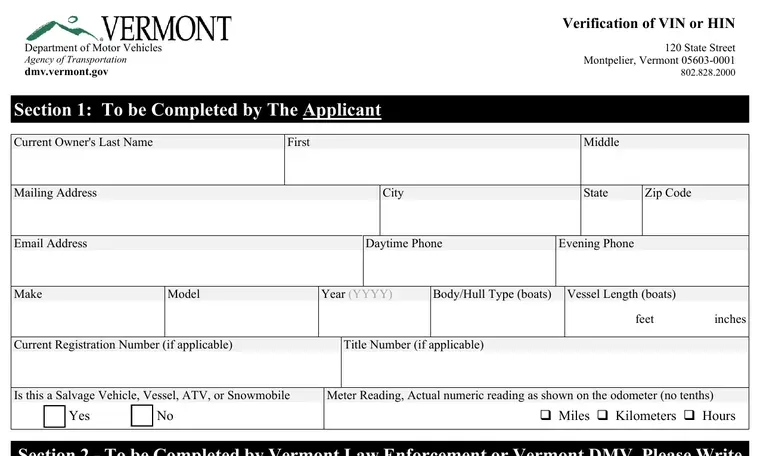
Written against VT-010 (06/2023), issued under 23 V.S.A. s. 2016, Commissioner to check identification number, certified under penalties of 23 V.S.A. s. 201, s. 202 and s. 203. Book the verification before you agree a completion date rather than after. It depends on somebody else's shift, it cannot be done by post, and on a bonded or salvage car nothing else can move until it is done.

Two documents, and they are not the same thing. Take the blank VT-010 from the dmv.vermont.gov copy so you get the revision that is current today, then print our VT-010 guide and keep it beside you while you fill theirs in.

Filled in

What a completed one looks like

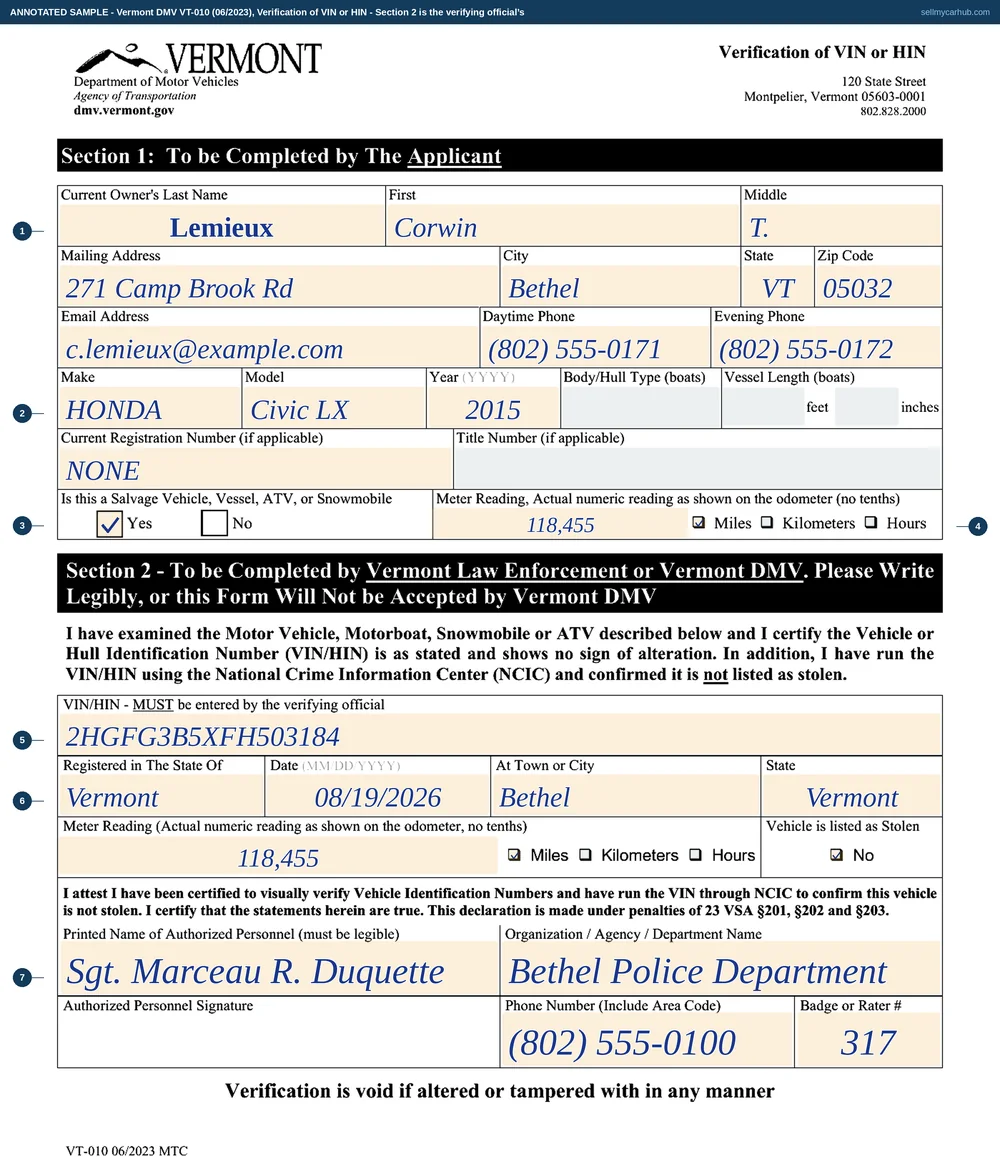
This is the actual VT-010, rendered from the PDF the Vermont Department of Motor Vehicles, Agency of Transportation publishes and completed end to end: letterhead, every field, and the blocks at the foot.

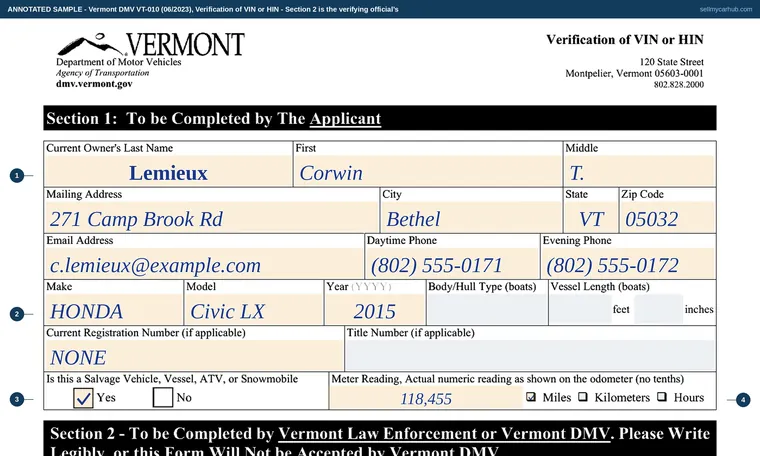
A completed Vermont Verification of VIN or HIN, form VT-010, for a rebuilt 2015 Honda Civic: Section 1 names Lemieux, Corwin T. of Bethel with an email address and two phone numbers, the vehicle described as a 2015 Honda Civic, no current registration number, the salvage question answered Yes and a meter reading of 118,455 miles. Section 2 is completed by the verifying official with the vehicle identification number 2HGFG3B5XFH503184, the state of Vermont, an inspection date, the town of Bethel, the same meter reading, the vehicle not listed as stolen, and a printed name, agency, phone number and badge number.
Rendered from the department's own PDF. Section 2 is drawn in amber rather than grey for once, even though it is not the seller's to complete, because the whole value of this page is showing what a verifying officer writes and what an applicant must not: the identification number in that section is entered by the official, in capitals on the form itself. The signature line has no fillable box behind it and is left empty. Nobody in this sample exists and no agency in it is real.
Field by field

Every line, in the order you meet it

  1. 1
    You fill this in

    Section 1, Current Owner's name

    Last, first and middle, in three boxes at the head of your half of the form.

    Watch out: Use the name that will appear on the title application. The verification and the application are read together.

  2. 2
    You fill this in

    Mailing Address and contact details

    A full address and three contact boxes.

    Watch out: Fill in both phone lines if you have them. A verification is arranged by somebody trying to find a window in a shift pattern.

  3. 3
    You fill this in

    Make, Model, Year

    The vehicle as you believe it to be, before anybody has checked.

    Watch out: Where the paperwork and the vehicle disagree about the model year, write what the paperwork says and let the officer record what the plate says. That gap is exactly what this form is for.

  4. 4
    You fill this in

    Current Registration Number and Title Number

    Both marked if applicable, because a vehicle needing this form may have neither.

    Watch out: Leaving them blank is a legitimate answer here. It is one of the few boxes in the Vermont set where that is true.

  5. 5
    You fill this in

    Is this a Salvage Vehicle

    Yes or No, and the footnote on the back defines salvage more widely than most people expect.

    Watch out: An insurer's total loss settlement makes a car salvage even if it was driveable. So does an owner electing a salvage title voluntarily.

  6. 6
    You fill this in

    Section 1 Meter Reading

    Your own reading, in whole numbers, with a unit ticked.

    Watch out: The officer takes an independent reading in Section 2. Two figures that differ by a hundred miles is fine; two that differ by ten thousand is a conversation.

  7. 7
    Somebody else fills this in

    Section 2, the identification number

    Entered by the verifying official, from the vehicle, in their own hand.

    Watch out: Do not help. A number written into this box by the applicant voids the form and wastes the appointment.

  8. 8
    Somebody else fills this in

    Section 2, the stolen check

    A tick beside the officer's certification that the number was run through the National Crime Information Center.

    Watch out: This is what makes the form worth something to the department. It is not a formality and it is not something a garage can do for you.

  9. 9
    Somebody else fills this in

    Section 2, printed name, agency, signature and badge number

    Who did it, for whom, and under what number.

    Watch out: Check it is legible before you leave. The section heading says an unreadable form will not be accepted, and you are the one who has to come back.

At a glance

What goes where

On the formWhat to put in it
Section 1: Current Owner's Last Name, First, MiddleThree boxes at the head of the applicant's half.
Mailing Address, City, State, Zip CodeA full address line.
Email Address, Daytime Phone, Evening PhoneThree contact boxes. A verifying officer may want to reach you to arrange the inspection.
Make, Model, Year (YYYY), Body/Hull Type (boats), Vessel Length (boats)The vehicle description, with two boat boxes that stay empty on a car.
Current Registration Number (if applicable), and Title Number (if applicable)Both are marked if applicable because this form exists for vehicles that may have neither.
Is this a Salvage Vehicle, Vessel, ATV, or Snowmobile - Yes / NoThe question that decides whether the verification was compulsory in the first place.
Meter Reading, Actual numeric reading as shown on the odometer (no tenths), with Miles, Kilometers or HoursThe owner's own reading, which the verifying official will then record independently in Section 2.
Section 2 headingTo be completed by Vermont Law Enforcement or Vermont DMV. Please write legibly, or this form will not be accepted by Vermont DMV.
VIN/HIN - MUST be entered by the verifying officialIn capitals on the form. The applicant does not write the number in Section 2, and that is the whole point of the document.
Registered in The State Of, Date (MM/DD/YYYY), At Town or City, StateWhere and when the inspection happened.
Section 2 Meter Reading, with Miles, Kilometers or HoursThe official's own reading, taken from the vehicle in front of them.
Vehicle is listed as Stolen - NoA single box, and the certification above it says the number was run through NCIC.
Printed Name of Authorized Personnel, Organization / Agency / Department NameWho did it and for whom, legibly.
Authorized Personnel Signature, Phone Number, Badge or Rater #The signature block, with a badge number.
Verification is void if altered or tampered with in any mannerPrinted across the foot of the form, in bold.

What gets this one rejected

Rules that decide whether it is accepted

Every line here was read off VT-010 (06/2023) itself — the PDF is here — and off the Vermont Department of Motor Vehicles, Agency of Transportation pages. This is plain-language help with a form, not legal advice, and where our wording and the agency's differ, theirs governs.

Back to all Vermont seller paperwork, or what selling a car in Vermont involves.

Want the paperwork handled instead?

Get My Instant Offer → Online · about 2 minutes · free

Or send the details — we'll come to you

If the car needs a trooper to look at it before anybody can register it and that has stalled the sale, tell us what you have and we will tell you what it is worth as it stands.

or call/text (877) 405-1808