The affidavit for a vehicle that has no record of a previous title or registration anywhere in the National Motor Vehicle Title Information System. It is the narrowest of the three no-title routes and the department gates it hard: if NMVTIS shows a previous title or registration in any jurisdiction, this form is not available and you must obtain that document or go through the title bond process instead. It is also the one page in the Vermont set that explains, in the department's own words, what Act 41 did to the model-year rule - and the explanation is printed on the back where most people never look.
Written against VT-025 (12/2023), issued under 23 V.S.A. s. 2012, s. 2013 and s. 2017 as amended by Act 41 of 2023, sworn under penalty of perjury per 23 V.S.A. s. 202. This is a two-page PDF and the second page carries no fields at all - it is the department's explanation of when the first page may be used. Read it before you book the notary, because it is where you find out whether you are allowed to use this form.
Two documents, and they are not the same thing. Take the blank VT-025 from the dmv.vermont.gov copy so you get the revision that is current today, then print our VT-025 guide and keep it beside you while you fill theirs in.
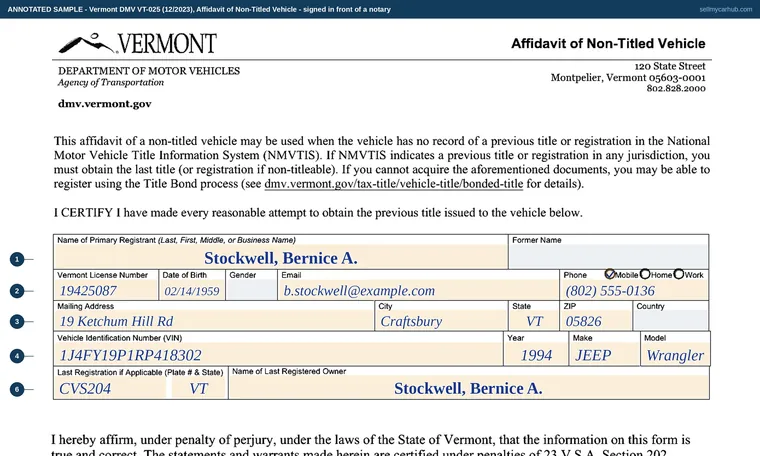
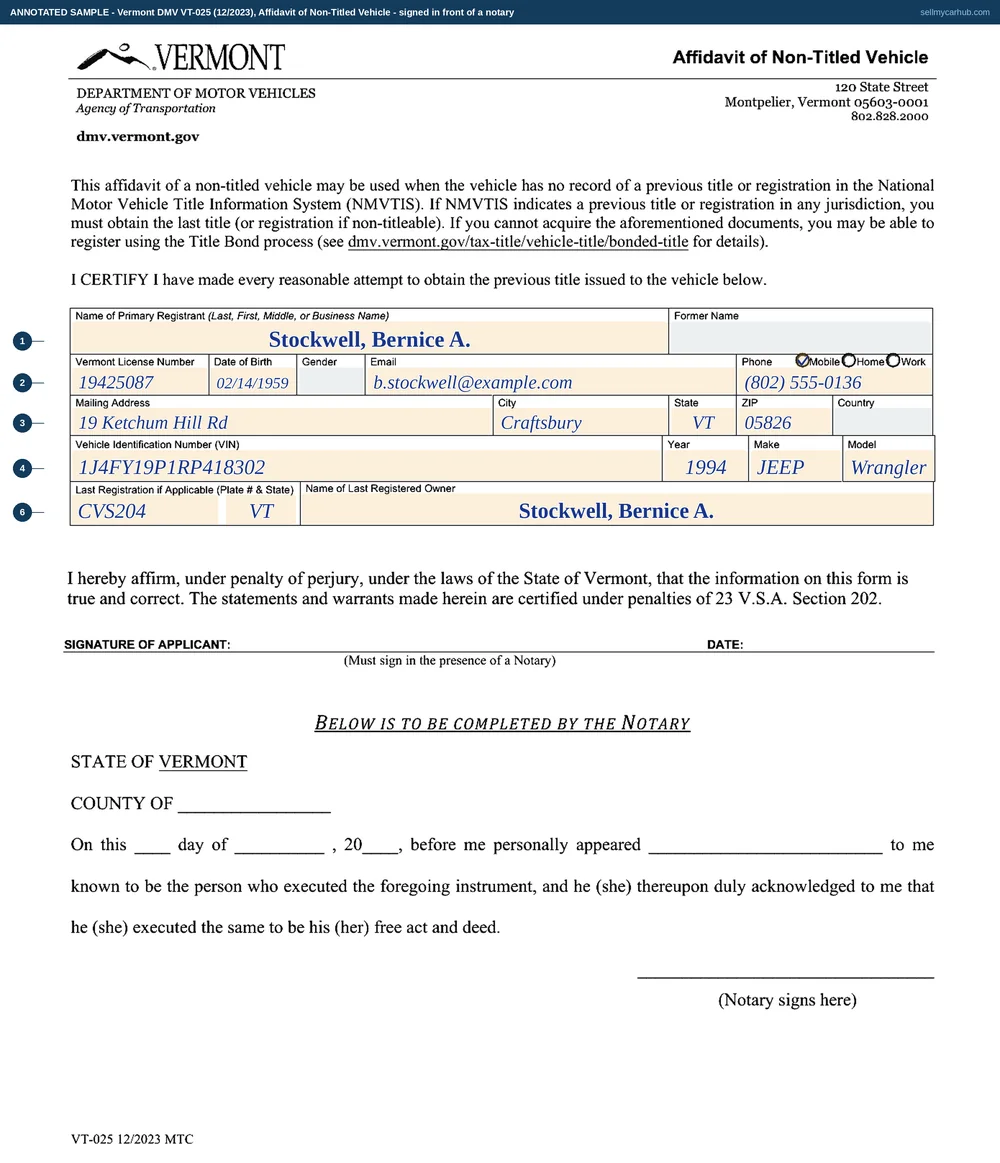
This is the actual VT-025, rendered from the PDF the Vermont Department of Motor Vehicles, Agency of Transportation publishes and completed end to end: letterhead, every field, and the blocks at the foot.
The person who will be registering the vehicle, last name first.
Watch out: On a car you are selling, this is the buyer's affidavit rather than yours. What you supply is the bill of sale and the last registration certificate that make it possible.
A Vermont credential. The department has no route here for a non-resident.
Watch out: The number is checked against the licence the notary is looking at. A mismatch stops the affidavit before the DMV ever sees it.
A full address, with a country box for the border cases.
Watch out: A PO box here is fine, because this affidavit is not the registration application. The VD-119 travelling with it is stricter.
The vehicle. This VIN is the one that was run through NMVTIS and came back with nothing.
Watch out: Have the VT-010 verification done first if you can. It reads the number off the vehicle itself, which is exactly what an affidavit about a vehicle with no record needs behind it.
The last plate the vehicle wore and the state that issued it, where anybody remembers.
Watch out: If you can find the old registration certificate at all, you probably do not need this form - a Vermont-registered untitled car moves on the certificate and a bill of sale.
Who had it before. On a barn find that may be two owners back.
Watch out: Write what you actually know and nothing more. This is an affidavit, and a guess written into it is a guess sworn to.
Signed in the presence of a notary, not before.
Watch out: Take photo identification, the unsigned form and the VT-010 to the notary in one trip. A Vermont bank or town clerk's office will usually do it.
State, county, the date, the name of the person who appeared and the notary's signature.
Watch out: The notary fills this in, not you. A block completed in advance is the one thing guaranteed to void the affidavit.
| On the form | What to put in it |
|---|---|
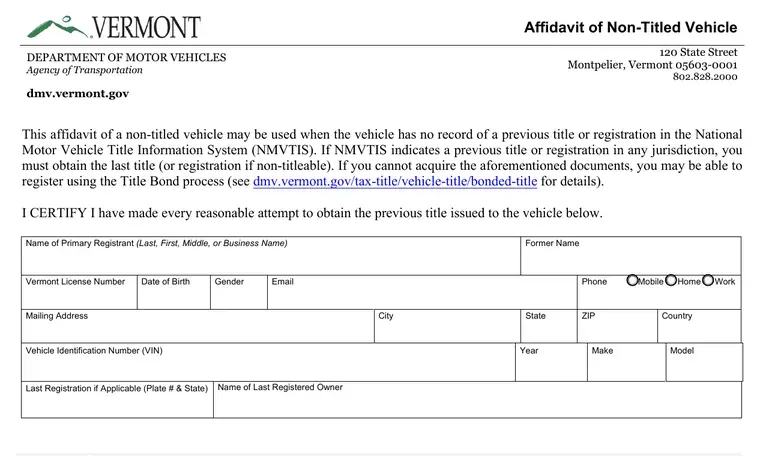
| Name of Primary Registrant (Last, First, Middle, or Business Name), and Former Name | The applicant, in one long box, with a former-name box beside it. |
| Vermont License Number, Date of Birth, Gender, Email, Phone | A Vermont credential and contact details, with Mobile, Home and Work ticks beside the number. |
| Mailing Address, City, State, ZIP, Country | A full address line. The country box exists because Vermont borders Quebec. |
| Vehicle Identification Number (VIN), Year, Make, Model | The vehicle, in four boxes. It is the number that will be run through NMVTIS. |
| Last Registration if Applicable (Plate # & State), and Name of Last Registered Owner | Two boxes that matter more than their size suggests - they are what the department will search against if the affidavit is questioned. |
| I CERTIFY I have made every reasonable attempt to obtain the previous title issued to the vehicle below | The operative sentence, printed above the vehicle block rather than beside the signature. |
| SIGNATURE OF APPLICANT, and DATE | With the instruction underneath in brackets: must sign in the presence of a Notary. |
| BELOW IS TO BE COMPLETED BY THE NOTARY | A full acknowledgement block - state, county, day, month, year, the name of the person who appeared, and the notary's signature. |
| Page 2: I own a vehicle registered in Vermont in my name, but not previously titled | The first of two scenarios, answered in one line: you may obtain a title by completing the appropriate form and paying the applicable title fee. |
| Page 2: I bought a vehicle not previously titled | The second scenario, split by where it was last registered - Vermont, or anywhere else, in which case the department runs the NMVTIS inquiry and the answer decides which route you are on. |
| Page 2: the VIN verification requirement | Visual verification of the vehicle identification number on DMV form VT-010 is required when using this form or the title bond process. |
Every line here was read off VT-025 (12/2023) itself — the PDF is here — and off the Vermont Department of Motor Vehicles, Agency of Transportation pages. This is plain-language help with a form, not legal advice, and where our wording and the agency's differ, theirs governs.
Back to all Vermont seller paperwork, or what selling a car in Vermont involves.