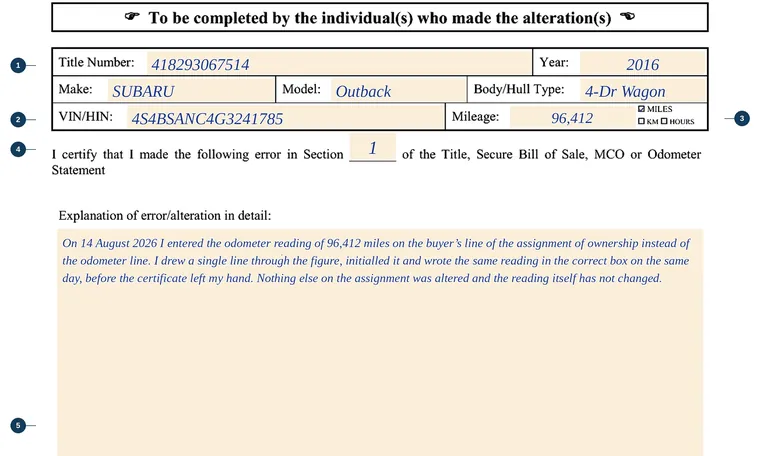
What Vermont does instead of letting you cross something out. A certificate of title with an erasure or an alteration on it is not accepted at face value - VT-004's instructions say a Title Alteration Statement is required to explain why the alterations were made - and this is that statement. Its most important line is the smallest: it is to be completed by the individual or individuals who made the alteration, which means that if the buyer wrote over your date of sale, the buyer signs this, not you.
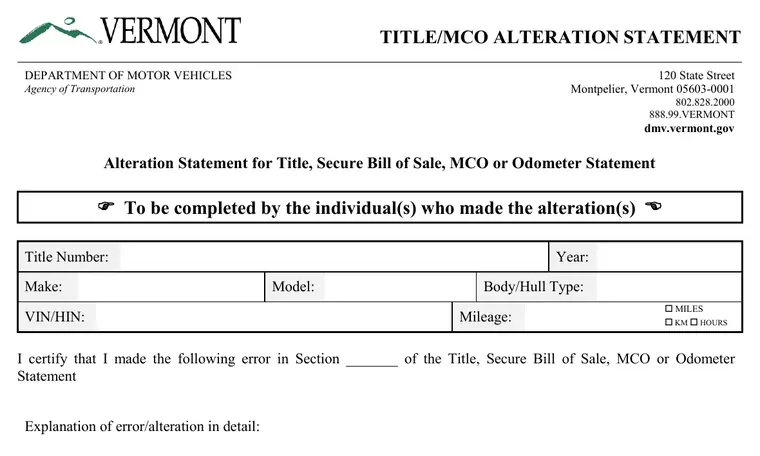
Written against VN-020 (10/2017), issued under 23 V.S.A. s. 202, s. 203, s. 2082, s. 2083 and s. 3829, and 32 V.S.A. s. 8901 to s. 8915. This form is dated 10/2017 and is one of the older documents in the Vermont set. It still cites 32 V.S.A. s. 8901 to s. 8915, which is current, but check the department's own forms index for a newer printing before you rely on a saved copy.
Two documents, and they are not the same thing. Take the blank VN-020 from the dmv.vermont.gov copy so you get the revision that is current today, then print our VN-020 guide and keep it beside you while you fill theirs in.
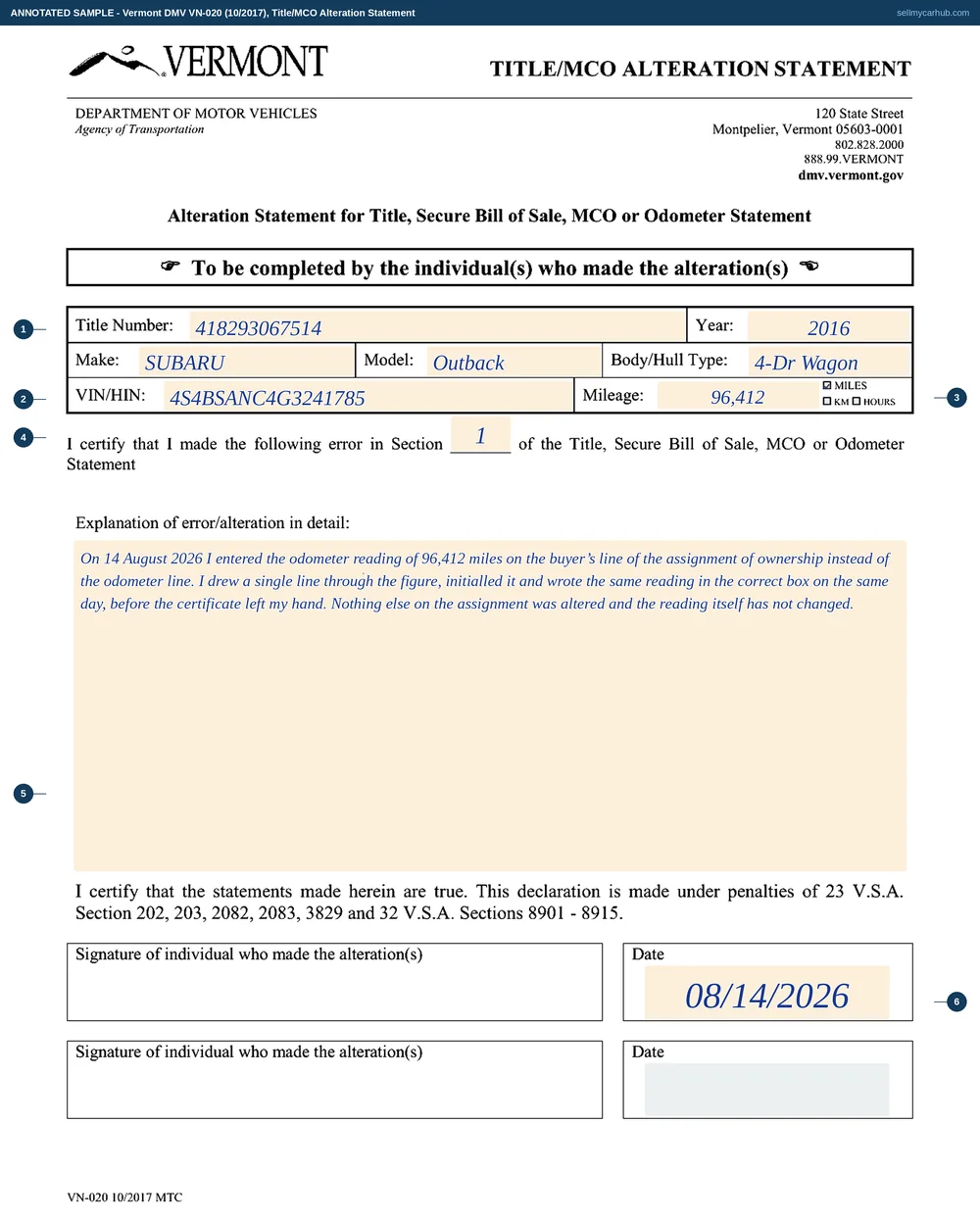
This is the actual VN-020, rendered from the PDF the Vermont Department of Motor Vehicles, Agency of Transportation publishes and completed end to end: letterhead, every field, and the blocks at the foot.
The certificate carrying the alteration, and the vehicle's model year.
Watch out: A Vermont title number is twelve characters on certificates issued after 13 November 2023 and thirteen before it. If yours is a different length, you are reading the wrong number off the page.
Three boxes describing the vehicle, so the statement identifies its own subject.
Watch out: Copy them from the certificate rather than from the bill of sale. This document is about the certificate.
The identification number, and a reading with one of three units ticked.
Watch out: If the alteration is to the mileage itself, write the correct figure here and explain the wrong one below. Do not leave the box empty to avoid the question.
One small box in the middle of the certifying sentence.
Watch out: Sections are numbered on the certificate itself. If you are not sure which one you wrote in, take the certificate to a DMV office and ask before you commit an answer to a sworn statement.
A full page for what happened.
Watch out: Write it as a sequence: what you meant to write, where you wrote it, what you did about it, and when. A clerk reading it should be able to reconstruct the certificate without seeing it.
The person whose pen made the mark. Not the owner by default, and not the buyer by default.
Watch out: If you made the mark and the car is jointly owned, you sign alone. This is not an ownership document and it does not need every owner.
For a second person who also wrote on the same document.
Watch out: It is common on a title where the seller crossed out a date and the buyer corrected an address. Both marks, both signatures, one form.
| On the form | What to put in it |
|---|---|
| Alteration Statement for Title, Secure Bill of Sale, MCO or Odometer Statement | The subheading, and the only place in the published Vermont set where the secure bill of sale is named as a document this applies to. |
| To be completed by the individual(s) who made the alteration(s) | A banner across the top of the form rather than a footnote. It decides who signs. |
| Title Number, and Year | The certificate the alteration is on, and the vehicle's model year. |
| Make, Model, Body/Hull Type | Three boxes describing the vehicle. |
| VIN/HIN, and Mileage with MILES, KM or HOURS | The identification number and a reading, so the statement stands on its own as a description of the vehicle. |
| I certify that I made the following error in Section ___ of the Title, Secure Bill of Sale, MCO or Odometer Statement | A single small box for a section number, in the middle of a printed sentence. |
| Explanation of error/alteration in detail | A full-page panel. Detail is the word the department uses and it is the word it means. |
| I certify that the statements made herein are true | The declaration, made under six statutory sections including the tax chapter. |
| Signature of individual who made the alteration(s), and Date | The first signature row. |
| A second Signature of individual who made the alteration(s), and Date | Because two people can each have written on the same certificate, and each of them has to account for their own marks. |
Every line here was read off VN-020 (10/2017) itself — the PDF is here — and off the Vermont Department of Motor Vehicles, Agency of Transportation pages. This is plain-language help with a form, not legal advice, and where our wording and the agency's differ, theirs governs.
Back to all Vermont seller paperwork, or what selling a car in Vermont involves.