The acknowledgement a buyer signs when they take on a salvage-titled vehicle. It is on this list because it is the seller who has to put it in front of them - and because it is one page that prevents an argument later.
Step 1 · the form itself
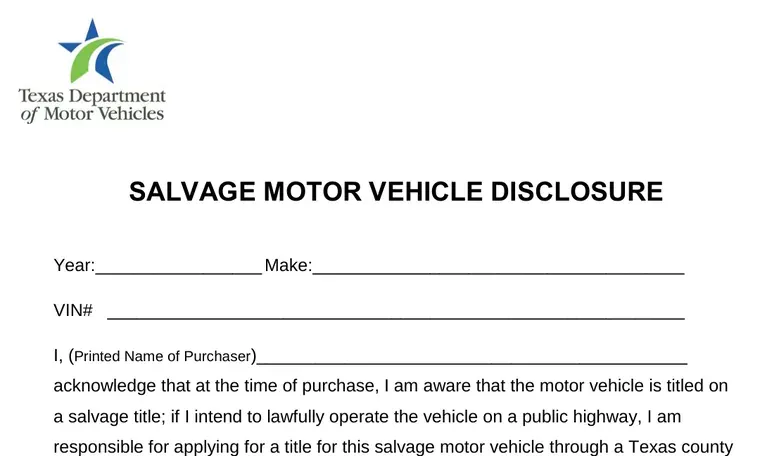
Blank ENF-SAL-221 — Disclosure of Salvage Motor Vehicle
PDF at txdmv.gov · new tab
View the blank ENF-SAL-221
Step 2 · how to fill it in
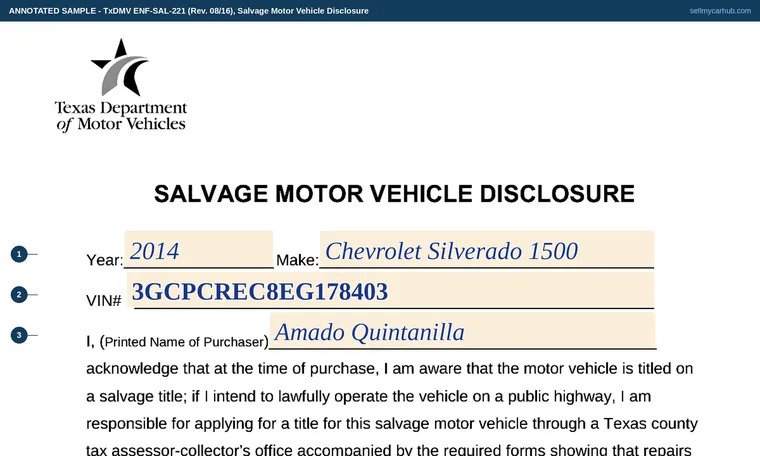
Our filled-in ENF-SAL-221 guide
PDF · 2 pages · 430 KB · new tab
See our filled-in example
Two documents, and they are not the same thing. Take the blank ENF-SAL-221 from the txdmv.gov copy so you get the revision that is current today, then print our ENF-SAL-221 guide and keep it beside you while you fill theirs in.
Written against ENF-SAL-221 (Rev 08/16), issued under Texas Transportation Code 501.0925. The sentence that matters is the last one: the buyer may not drive it on a public highway until a rebuilt salvage title and registration have been issued. Somebody driving a salvage car home from your driveway is doing something this form told them not to.
Last updated .
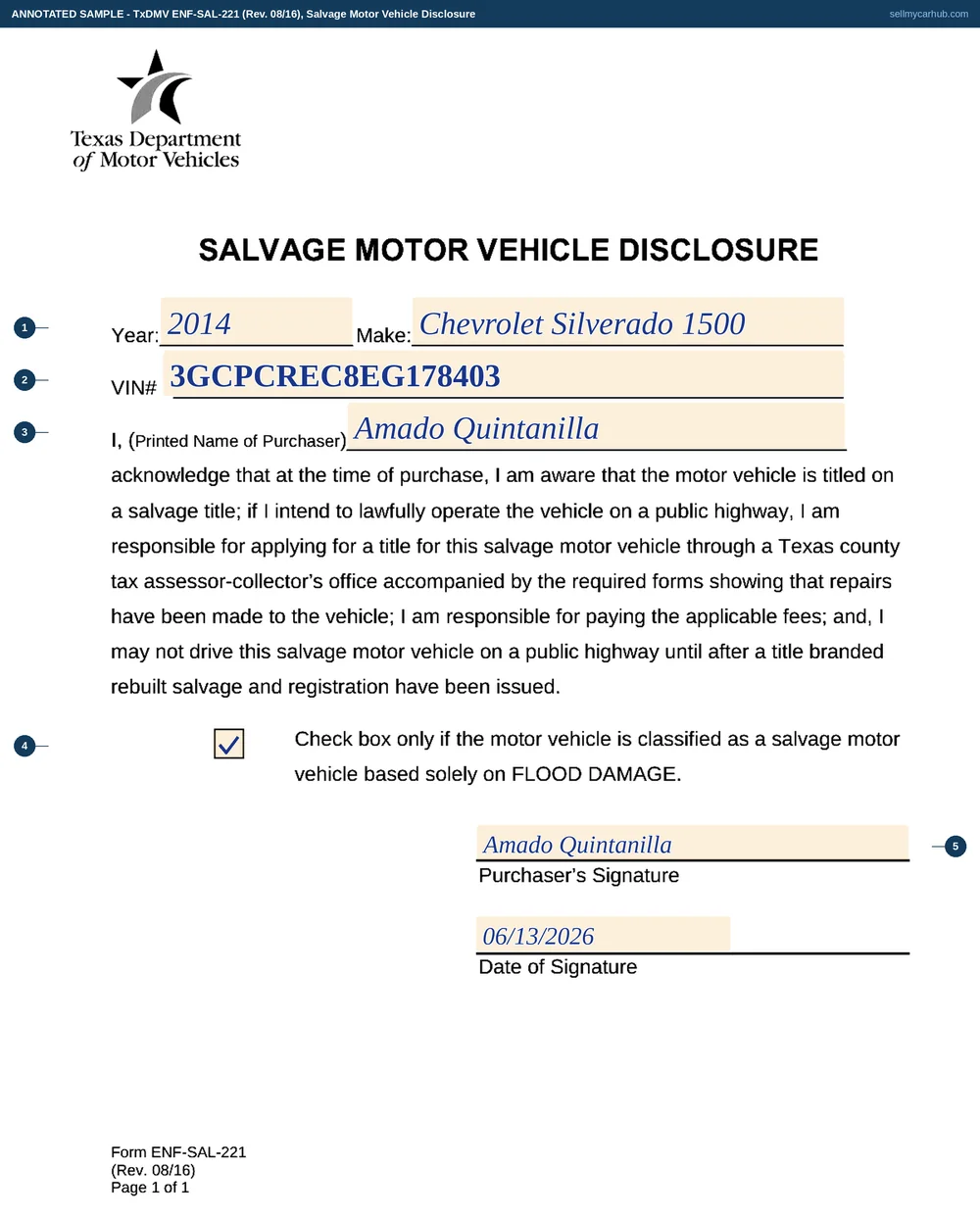
This is the actual ENF-SAL-221, rendered from the PDF the Texas Department of Motor Vehicles publishes and completed end to end: letterhead, every field, and the blocks at the foot.
Click or tap the picture to open it full size.
Download or print this example PDF · 2 pages · 430 KB
Two short lines at the top identifying the vehicle.
Watch out: This is all the vehicle description the form asks for - there is no model, body style or plate. Fill it before the buyer arrives so the conversation is about the car rather than the paperwork.
The vehicle identification number, on its own line.
Watch out: Copy it from the salvage title, then check it against the car. A disclosure attached to the wrong VIN protects nobody.
The buyer writes their own name into the sentence that begins the acknowledgement.
Watch out: The sentence is first person - I acknowledge that at the time of purchase, I am aware that the motor vehicle is titled on a salvage title. It is their statement, so it is their handwriting.
Ticked only where the vehicle is classified as a salvage motor vehicle based solely on flood damage.
Watch out: Solely is doing real work in that sentence. A car that was flooded and then also wrecked is not a flood-only salvage, and ticking the box anyway misdescribes it.
The buyer signs and dates, acknowledging what they have read above it.
Watch out: What they are signing includes the sentence that matters most to both of you: they may not drive this salvage motor vehicle on a public highway until after a title branded rebuilt salvage and registration have been issued. Somebody driving it away from your kerb is doing what this form told them not to.
| On the form | What to put in it |
|---|---|
| Year, make, VIN | Three lines identifying the car. Nothing else about the vehicle appears. |
| Printed name of purchaser | The buyer, not you. This is their acknowledgement. |
| What they are acknowledging | Three things, pre-printed: that they know the vehicle is on a salvage title; that if they intend to operate it lawfully they must apply for a title through a Texas county tax assessor-collector's office with forms showing repairs have been made, and pay the fees; and that they may not drive it on a public highway until a title branded rebuilt salvage and a registration have been issued. |
| The flood box | Ticked only where the vehicle is classified as salvage based solely on flood damage. |
| Purchaser's signature and date | Theirs. |
Every line here was read off ENF-SAL-221 (Rev 08/16) itself — the PDF is here — and off the Texas Department of Motor Vehicles pages. This is plain-language help with a form, not legal advice, and where our wording and the agency's differ, theirs governs.
Haven't found a buyer to sign it yet? Our page on cash for flood, hail and salvage-title cars in Houston covers cars that run and cars that don't.
Back to all Texas seller paperwork, or what selling a car in Texas involves.