Texas splits the job across two documents. You assign the Certificate of Title to the buyer, and the buyer files a Form 130-U at a county tax assessor-collector’s office. Every box below is transcribed from the TxDMV’s own detailed instructions for that form, revision 05/26 - the same revision as the form itself.
Last updated .
Your 4 boxes
As a private seller you complete these and nothing else:
There is no blank Texas title to download - yours came in the post from Austin. The 130-U you can download, and the TxDMV publishes a two-page instruction sheet for it that most people never open. This walkthrough is that sheet, turned into something you can follow while holding a pen.
Everything here is signed under one line: State law makes falsifying information a third degree felony.
The instructions open by telling the applicant to refer to the ownership document assigned to you by the seller. That is the title, properly assigned - the 130-U transcribes from it, it does not replace it.
The certificate itself
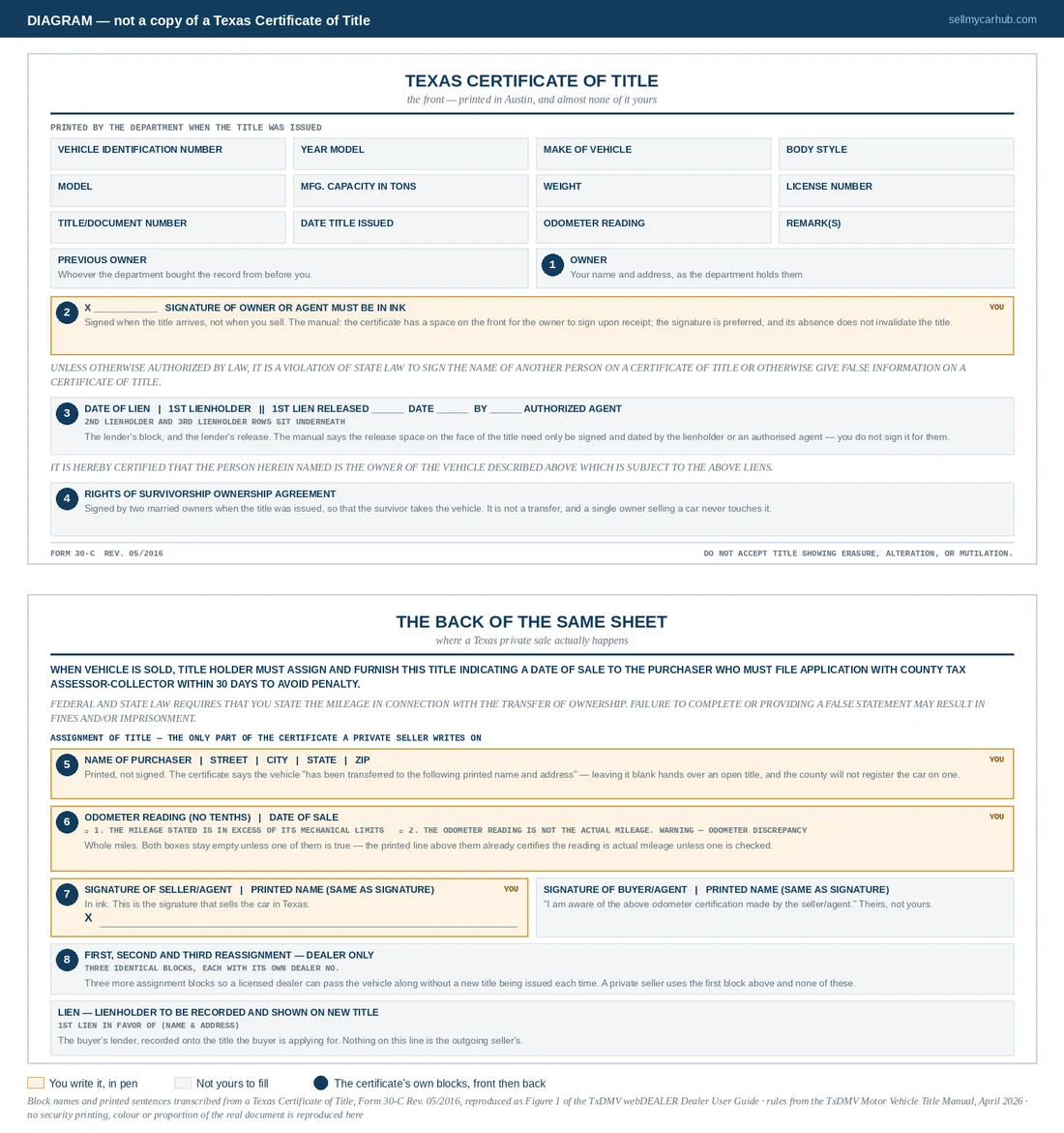
Where the Texas certificate hides the only lines that are yours
Texas issues its certificate on one sheet printed both sides, and a private seller writes on the back of it. Everything on the front was set in Austin the day the title was produced; the assignment of title on the reverse is the part that moves the truck. The eight markers below number the certificate’s own blocks in the order you meet them, front then back — they are a different set from the numbered 130-U boxes further down this page.
Amber — you write it, in pen
Grey — not yours to fill
Numbered — the certificate’s own blocks, front then back
Click or tap the picture to open it full size.
Drawn, not photographed, and it says so across the top. The TxDMV publishes no specimen certificate: the only pictures of a Texas title in its whole library are two photographs of real people’s issued documents behind the department’s own black bars, one of them stamped SURRENDERED. Every block name and every printed sentence here is transcribed from the current Form 30-C, Rev. 05/2016, as the TxDMV reproduces it in Figure 1 of its webDEALER Dealer User Guide; the rules attached to each block come from the Motor Vehicle Title Manual.
The document itself, filled in
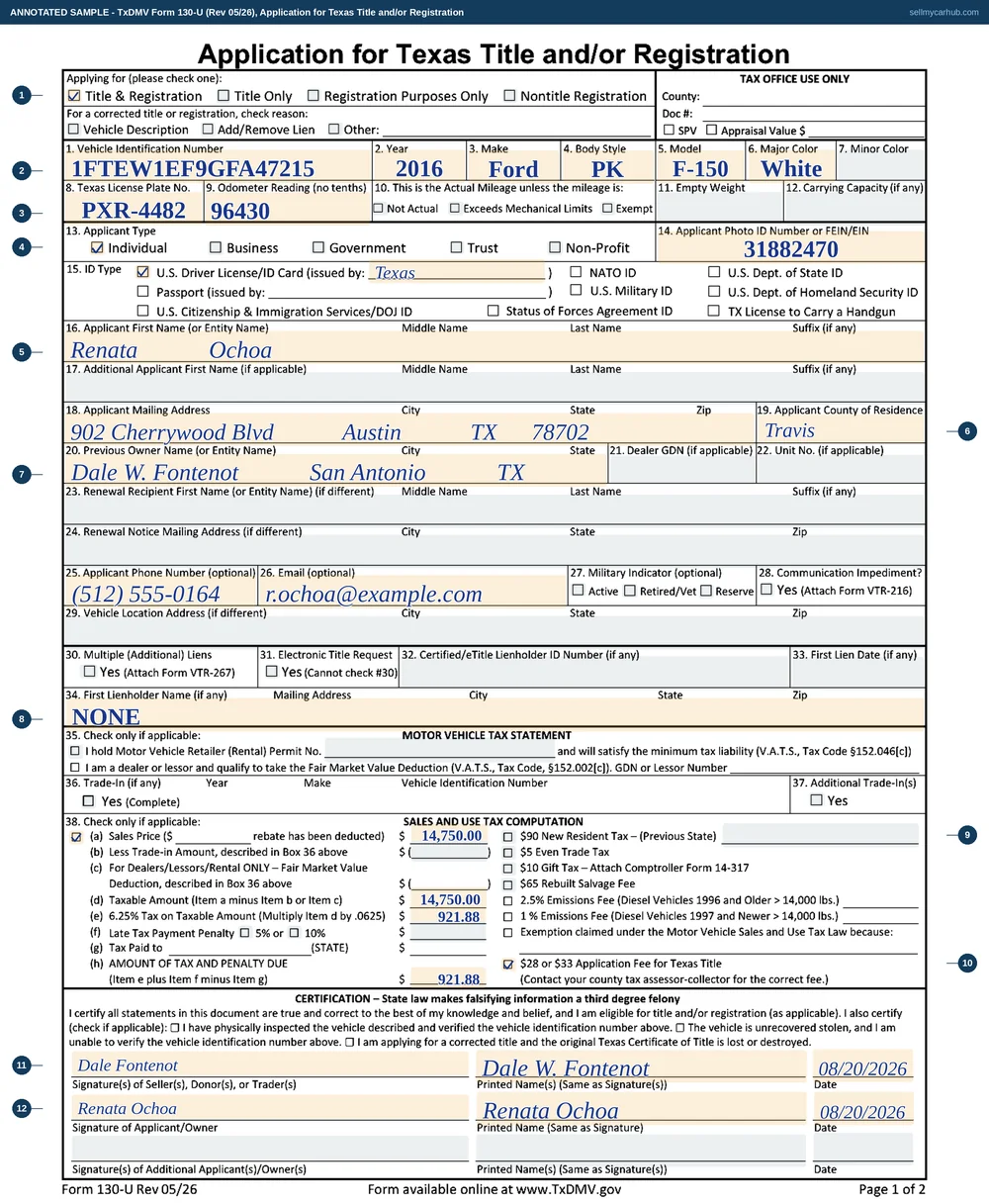
A real Form 130-U, completed for one private sale
The actual form from TxDMV.gov, filled in for a 2016 Ford F-150 sold in San Antonio to a buyer in Austin for $14,750. Amber is what gets written; the greyed blocks are deliberately left alone - no second owner, no lien, no trade-in, and none of the flat tax alternatives apply to an ordinary cash sale.
Click or tap the picture to open it full size.
Note box 34. Where there is no lien the instructions ask for the word NONE, not a blank. And note the odometer row: none of Not Actual, Exceeds Mechanical Limits or Exempt is ticked, because the reading is the true mileage and the truck is not old enough to be exempt.
Before you watch. The TxDMV does not publish a video on filling out the title itself. Plenty exist on YouTube and none of them are the agency - they are dealerships, title services and how-to channels, which is exactly why they are not embedded here.
Published by the TxDMV on its own channel, and the only one of its thirty videos aimed at a private seller rather than at dealers and motor carriers. It walks through the online transfer notification - the thirty-day filing that ends your exposure to what the buyer does next. There is a Spanish version on the same channel. Nothing loads from YouTube until you press play.
Step by step
Every box, in the order you meet it
0
You fill this in
Before any box: go with them
The TxDMV's first instruction to a Texas seller is to accompany the buyer to the county tax office to ensure a title application is actually filed.
Watch out: This is the step that decides everything below it. If the buyer never files, the vehicle stays in your name - and the TxDMV's own warning is that you could be held responsible for tickets, toll violations or even crimes committed with it. A tax office representative can also tell you both, before anything is submitted, whether the title being signed over is correct and whether it carries salvage or legal issues.
1
The buyer fills this in
Applying for: Title & Registration
One of four boxes at the very top. An ordinary private purchase is Title & Registration.
Watch out: Title Only means the plates and registration have to be surrendered under Transportation Code 501.0275. It is not the box for a car the buyer intends to drive.
2
The buyer fills this in
Boxes 1 to 7, the vehicle
VIN, year, make, body style, model and colours - all copied from the title you assigned, not from the car.
Watch out: Body style is an abbreviation: PK for a pickup, CP for a coupe, 2D for a two-door sedan. TxDMV publishes the full list as Form VTR-249.
3
You fill this in
Boxes 9 and 10, the odometer
Current mileage in whole numbers, no tenths, and then three tick boxes: Not Actual, Exceeds Mechanical Limits, Exempt.
Watch out: The instructions say the reading and the brand come from what the seller disclosed on the ownership document. Exempt is federal, and it is twenty years for anything built in 2011 or later - not ten.
4
The buyer fills this in
Boxes 13 to 15, who is applying
Individual, business, government, trust or non-profit; a photo ID number or an FEIN; and which of eleven ID types it came from.
Watch out: Every title application must include one of those IDs. A buyer who turns up at the county without one is turned away, whatever else is in order.
5
The buyer fills this in
Boxes 16 to 18, the buyer
Legal first, middle and last name with a suffix if there is one, a second applicant if the car is going into two names, and the mailing address.
Watch out: Legal name, as the instructions put it - not the version used on the classified advert.
6
The buyer fills this in
Box 19, county of residence
The county the buyer legally lives in.
Watch out: This is what decides whether the title fee is $28 or $33. It is not necessarily where the application gets filed - Texas accepts any of four counties: where the sale occurred, where the lienholder is, where the applicant lives, or any county willing to accept it.
7
You fill this in
Box 20, previous owner
Your name, city and state as they appear on the assigned title.
Watch out: Name, city and state only - the form does not want your street address, and adding one does not help.
8
The buyer fills this in
Boxes 30 to 34, liens
Whether there is more than one lien, whether an electronic title is wanted, the certified lienholder ID and first lien date, and the lienholder name and address.
Watch out: If there is no lien, the instructions say to indicate NONE. A blank is not the same answer - and box 31 cannot be ticked if box 30 is.
9
The buyer fills this in
Box 38, sales and use tax
The sales price on line (a), the taxable amount on (d), and 6.25 per cent of it on (e).
Watch out: The flat alternatives sit in the right-hand column. The gift one is narrow - immediate family, a guardian, a decedent estate or a qualifying 501(c)(3) - and it needs the Comptroller joint affidavit, Form 14-317, filed in person by the donor or the recipient.
10
The buyer fills this in
The title application fee
A tick box printed as $28 or $33 Application Fee for Texas Title.
Watch out: The form itself says to contact your county tax assessor-collector for the correct one. A separate $2.50 moves the current registration to the new owner, on top of this.
11
You fill this in
Signature of seller, donor or trader
Your signature, printed name and date, in the first of three rows. The TxDMV asks the seller to provide a signed 130-U with the sales price clearly shown - so this is your form too, not only theirs.
Watch out: This is the row that may be faxed or photocopied. It is the only signature on any Texas form here that may be, and it is why a seller who genuinely cannot get to the county office is not stuck.
12
The buyer fills this in
Signature of applicant / owner
The buyer signs, prints and dates the second row. A third row exists for an additional owner.
Watch out: Original ink, no exceptions - and then the whole package has to reach a county office within 30 days of the date of sale.
Before the pen
Read this before you sign anything
Six habits, and one of them is a genuine Texas oddity: your signature may be a photocopy and the buyer’s may not.
Black or blue ink
The power of attorney names them and rules everything else out. Nothing in Texas motor vehicle paperwork wants pencil.
No alterations
The VTR-271 says no alterations are allowed on the form. Not crossed out, not initialled, not tidied up - a fresh copy is free.
Your name as the title has it
The transfer notification asks for your first name as shown on the Texas title, not as you usually write it.
Whole miles, no tenths
Both the 130-U and the salvage application say it in the box label.
Original where it says original
A release of lien, a power of attorney and a certified copy application all require original ink. The buyer's signature on the 130-U does too - only yours may be faxed.
Read the line above the signature
State law makes falsifying information a third degree felony. It is printed on nearly every form here.
Three things people repeat about Texas titles that are not so
Three things repeated confidently about selling a car in Texas, and each one costs a seller either money or a wasted trip to a county office. Every correction below links the Texas source it comes from.
"A Texas title transfer costs $2.50."
That is the registration transfer fee. Form 130-U prints the actual title fee on its face - $28 or $33 Application Fee for Texas Title, with the instruction to contact your county tax assessor-collector for the correct one - and then adds that a $2.50 transfer fee is paid to transfer current registration to the new owner in addition to the title application fee. Quoting $2.50 understates it more than tenfold.
"You need a safety inspection before the buyer can register it."
Not since 1 January 2025. The TxDMV's registration page states that as of that date non-commercial vehicles are no longer required to obtain a safety inspection prior to vehicle registration. House Bill 3297 made the change, and its own text reads: this Act takes effect January 1, 2025. Emissions inspections continue in seventeen counties, and commercial vehicle rules did not change.
That is the rule in California and it is the opposite of Texas. The TxDMV states that the seller has the option to remove their license plates and registration sticker from the vehicle, and the transfer notification asks whether you did. Leave them on and they are still registered to you.
Three signature rows sit at the foot of the 130-U, and the title itself has to be properly assigned before any of them matter:
Seller(s), donor(s) or trader(s)
The signature, printed name and date of everyone shown as an owner on the title being surrendered.
Applicant / owner
The buyer signs, prints their name and dates it. This is the one signature Texas will not accept as a copy.
Additional applicant(s) / owner(s)
A third row, for a car going into two names.
Yours may be a fax, theirs may not
The form says an application may be reproduced or faxed and the seller’s signature may be reproduced or faxed - but a completed form must contain the original signature of the buyer.
A company or business
Signs in the entity name, and box 14 takes an FEIN or EIN rather than a photo ID number.
Where a lien is being released
The lienholder signs the title’s own release section, a VTR-266, or their letterhead. All three need original ink and a date; a copy is accepted on none of them.
Once it is signed
Signing is the middle of the job. In Texas the plates come off with you, and the clock that matters to you is the thirty-day transfer notification - not the buyer’s thirty days to file, which is a different thirty days entirely.