Sell My Car Hub

How to fill out Texas Form 130-U

The form the whole Texas transfer runs on. The buyer files it at a county tax assessor-collector's office with the signed title, and it does three jobs at once: applies for the title, transfers the registration, and computes the motor vehicle sales tax.
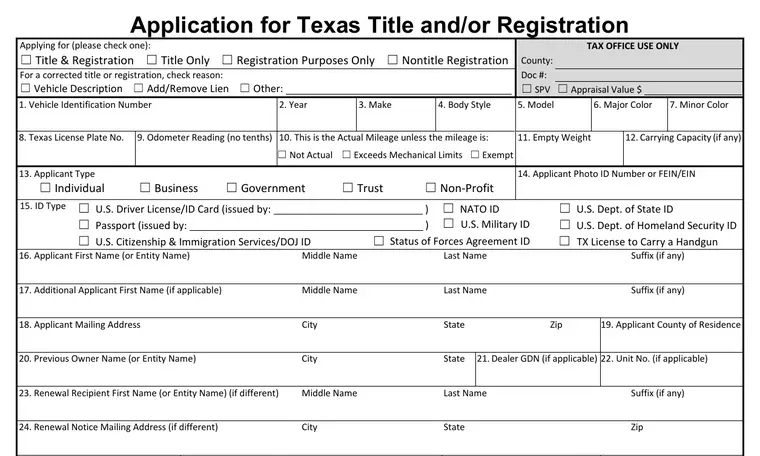
Two documents, and they are not the same thing. Take the blank Form 130-U from the txdmv.gov copy so you get the revision that is current today, then print our Form 130-U guide and keep it beside you while you fill theirs in.

Written against Form 130-U (Rev 05/26), issued under Texas Transportation Code 501.0234 and Tax Code 152. Texas revises this form often - the copy in the glovebox is very likely out of date. Check the revision in the footer against the one on TxDMV.gov before you fill anything in.

Last updated .
Filled in

What a completed one looks like

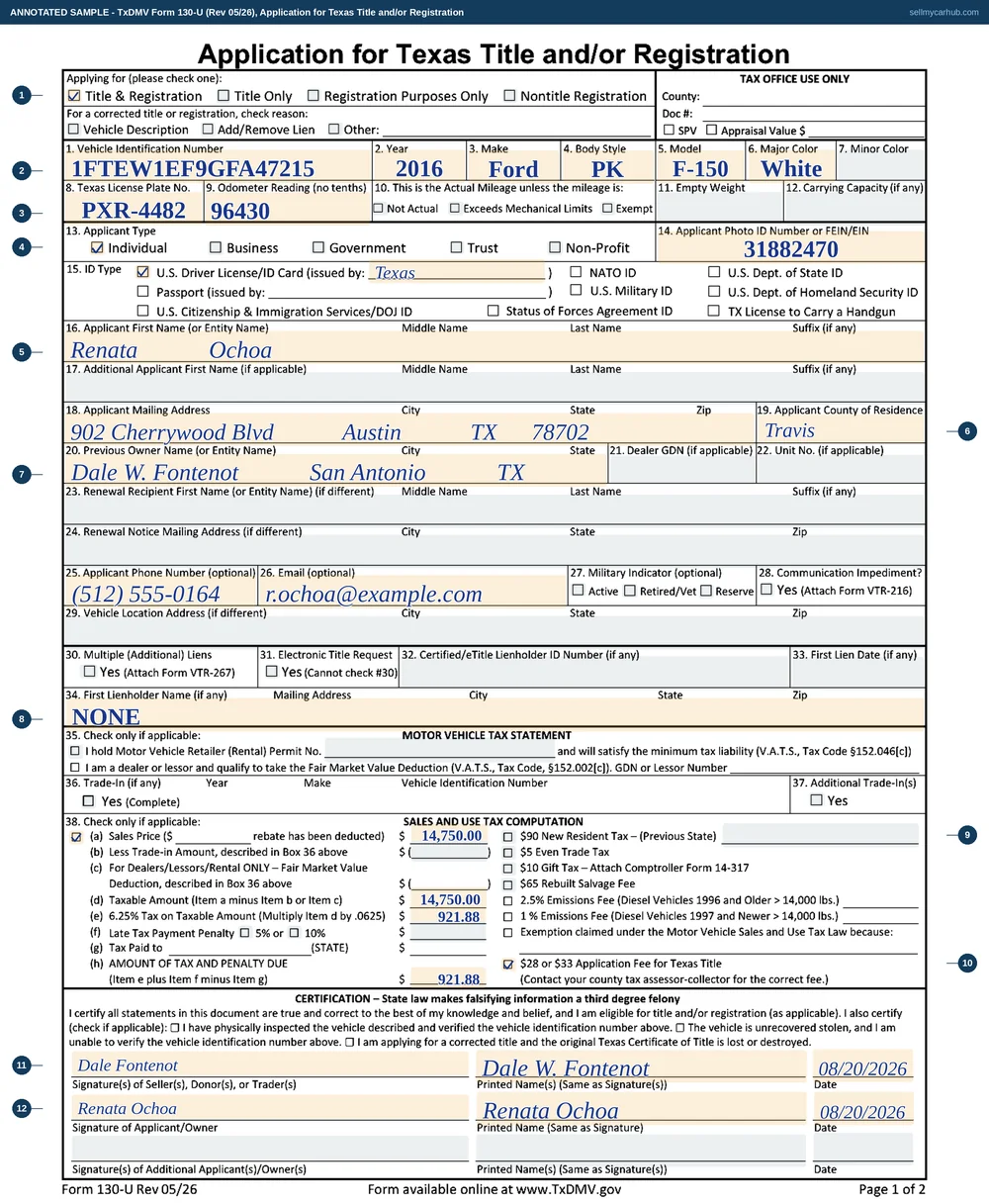
This is the actual Form 130-U, rendered from the PDF the Texas Department of Motor Vehicles publishes and completed end to end: letterhead, every field, and the blocks at the foot.

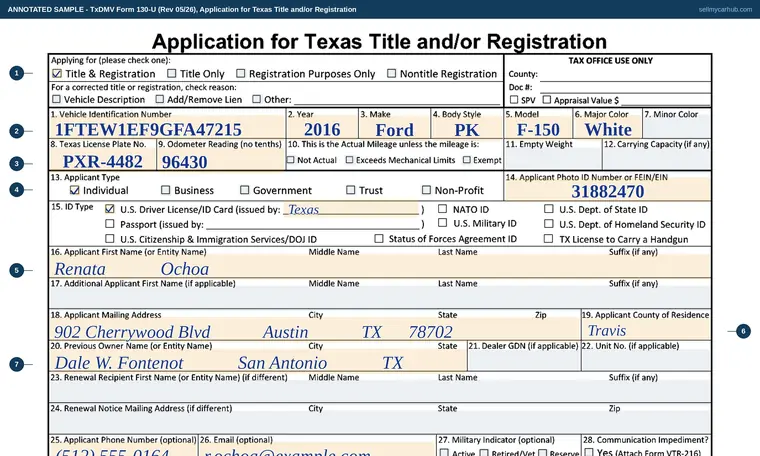
A Texas Form 130-U filled in for one private sale: the Title & Registration box ticked, VIN 1FTEW1EF9GFA47215, a 2016 Ford F-150 in white, plate PXR-4482, an odometer reading of 96430 with none of the three mileage boxes ticked, Individual ticked as the applicant type, buyer Renata Ochoa of Austin in Travis County, previous owner Dale W. Fontenot of San Antonio, the word NONE on the first lienholder line, a sales price of 14,750 dollars carrying 921.88 dollars of tax, the title application fee box ticked, and both parties signed, printed and dated 20 August 2026.

Click or tap the picture to open it full size.

Download or print this example PDF · 3 pages · 640 KB

The actual Form 130-U at revision 05/26. Two details worth copying: box 34 carries the word NONE rather than a blank, because the instructions ask for it in writing where there is no lien; and the odometer row leaves all three mileage boxes empty, because the printed line already certifies the reading as actual mileage unless one of them is ticked.
Field by field

Every line, in the order you meet it

  1. 1
    The buyer fills this in

    Applying for

    Four boxes across the head of the form. A private purchase the buyer intends to drive is Title & Registration.

    Watch out: Title Only is the box for a vehicle whose registration is being given up, not for an ordinary sale. Nontitle Registration is narrower still.

  2. 2
    The buyer fills this in

    Boxes 1 to 7, the vehicle

    VIN, year, make, body style, model and the two colour boxes, copied off the assigned title rather than off the car.

    Watch out: Body style is the department's abbreviation, not a word - PK for a pickup. Getting it wrong is one of the commonest reasons a county hands the form back.

  3. 3
    You fill this in

    Boxes 9 and 10, the mileage

    Odometer reading with no tenths, and three boxes: Not Actual, Exceeds Mechanical Limits, Exempt.

    Watch out: The reading and the brand both come from what you disclosed when you assigned the title. If the two documents disagree, the county believes neither.

  4. 4
    The buyer fills this in

    Boxes 13 to 15, applicant type and ID

    Individual, business, government, trust or non-profit, then a photo ID number or an FEIN, and which of the listed identification types it came from.

    Watch out: A buyer who arrives at the county office without the identification named in box 15 is turned away, however complete the rest of the package is.

  5. 5
    The buyer fills this in

    Boxes 16 to 18, the buyer

    Legal first, middle and last name with any suffix, a second applicant if the vehicle is going into two names, and the mailing address.

    Watch out: Legal name as it reads on the identification in box 15. A nickname on this line and a full name on the licence is a mismatch a clerk has to resolve.

  6. 6
    The buyer fills this in

    Box 19, county of residence

    The county the buyer legally lives in, which is what the department reads to set the title application fee.

    Watch out: It is not necessarily the county where the paperwork is filed, and it is not your county either. Ask the buyer rather than guessing from the address.

  7. 7
    You fill this in

    Box 20, previous owner

    Your name or entity name, city and state, as they appear on the title you assigned.

    Watch out: City and state only. There is no room for a street address here and adding one helps nobody.

  8. 8
    The buyer fills this in

    Boxes 30 to 34, liens

    Additional liens, an electronic title request, the certified lienholder identification number, the first lien date, and the first lienholder's name and address.

    Watch out: Where there is no lender at all, box 34 wants the word NONE written in it. A blank box reads as an unanswered question rather than as an answer.

  9. 9
    The buyer fills this in

    Box 38, sales and use tax

    The sales price, any trade-in deduction, the taxable amount, and 6.25% of it.

    Watch out: The flat alternatives run down the right-hand column, and the $10 gift tax is the one people reach for wrongly - it needs Comptroller Form 14-317 and a qualifying relationship, not simply a low price.

  10. 10
    The buyer fills this in

    The title application fee box

    A tick box printed on the face of the form as $28 or $33 Application Fee for Texas Title.

    Watch out: Which of the two applies is a county question - the form itself says to contact your county tax assessor-collector for the correct fee.

  11. 11
    You fill this in

    Signature of seller, donor or trader

    The first of the three certification rows: your signature, your printed name and the date.

    Watch out: This is the one signature in the Texas set that may be reproduced or faxed. The buyer's may not, and the form says so in the same paragraph.

  12. 12
    The buyer fills this in

    Signature of applicant or owner

    The buyer signs, prints and dates the second row; a third row waits for a second owner.

    Watch out: Original ink from the buyer, and then the whole package has to reach a county office. The certification above these rows is the third-degree-felony line.

At a glance

What goes where

On the formWhat to put in it
The four boxes at the topTitle & Registration, Title Only, Registration Purposes Only, or Nontitle Registration. An ordinary private sale is the first one. Title Only means surrendering the plates and registration under Transportation Code 501.0275.
1 to 12, the vehicleVIN, year, make, body style, model, major and minor colour, Texas plate number, odometer reading with no tenths, empty weight and carrying capacity.
10, the mileage tick boxesThree of them: Not Actual, Exceeds Mechanical Limits, Exempt. The printed line reads that the reading is the actual mileage unless one is ticked, so leaving all three empty is itself a statement.
13 to 15, who is applyingApplicant type - individual, business, government, trust, non-profit - then a photo ID number and which of eleven listed ID types it came from. The form says every title application must include one of them.
16 to 19, the buyerFirst, middle, last name and suffix, a second applicant if there is one, the mailing address, and the county of residence. That county line decides the title fee.
20, previous ownerYou. Name or entity name, city and state - not a full address.
30 to 34, liensWhether there are multiple liens, whether an electronic title is requested, the lienholder ID and first lien date, and the first lienholder's name and address.
38, the tax computationSales price, less any trade-in, taxable amount, then 6.25% of it. Beside it sit the flat alternatives: $90 new resident tax, $5 even trade tax, $10 gift tax with Comptroller Form 14-317 attached, $65 rebuilt salvage fee.
The title fee boxPrinted on the form as $28 or $33 Application Fee for Texas Title, with the instruction to contact your county tax assessor-collector for the correct one.
The signature blockThree rows: signature of seller, donor or trader with printed name and date; signature of the applicant or owner; and additional applicants.

What gets this one rejected

Every line here was read off Form 130-U (Rev 05/26) itself — the PDF is here — and off the Texas Department of Motor Vehicles pages. This is plain-language help with a form, not legal advice, and where our wording and the agency's differ, theirs governs.

Forms that go with this one

The buyer files this at the county tax office, and our page answers whether Houston sellers should go along to the Harris County Tax Office with a private buyer.

Back to all Texas seller paperwork, or what selling a car in Texas involves.

Want the paperwork handled instead?

Get My Instant Offer → Online · about 2 minutes · free

Or send the details — we'll come to you

If working out the tax line and the right county office is the part you would rather skip, tell us about the car instead.

or call/text (877) 405-1808