Not the seller's form, but the answer to the question every Tennessee seller gets asked at the kerb: how does the buyer drive it home when the plate is going in your boot. Thirty days of legal operation for $10, applied for in person at a county clerk, with one further thirty-day permit available if the original problem has not been resolved.
Written against RV-F1314401 (Rev 3-24), issued under Tenn. Code Ann. 55-3-118(b). This belongs to the buyer, and it is worth knowing about only so you can answer them without inventing something. A seller who lets the plate go with the car to solve the same problem has created a different one.
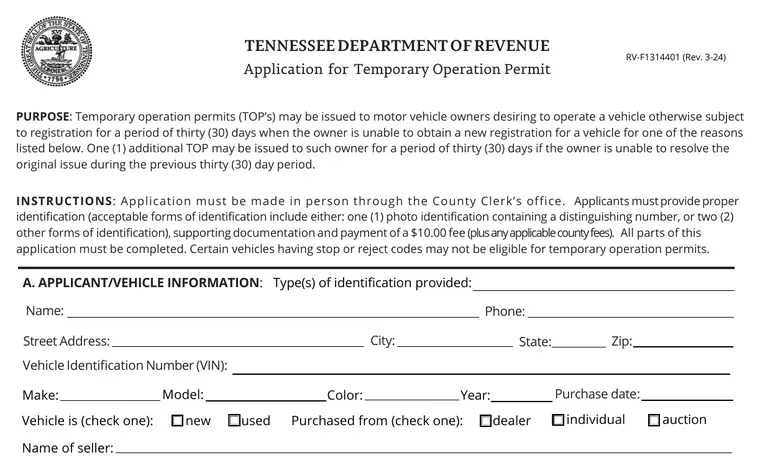
Two documents, and they are not the same thing. Take the blank RV-F1314401 from the tn.gov copy so you get the revision that is current today.
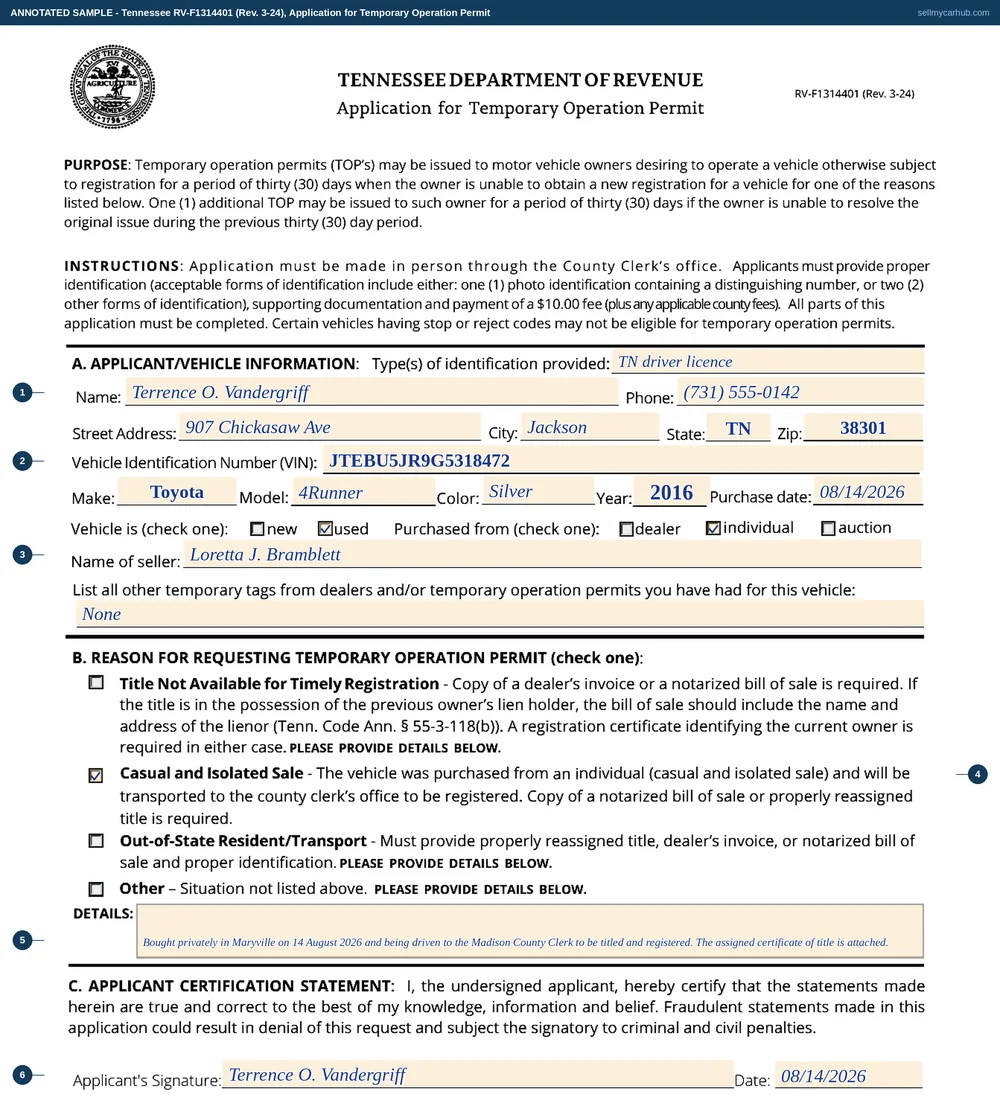
This is the actual RV-F1314401, rendered from the PDF the Tennessee Department of Revenue publishes and completed end to end: letterhead, every field, and the blocks at the foot.
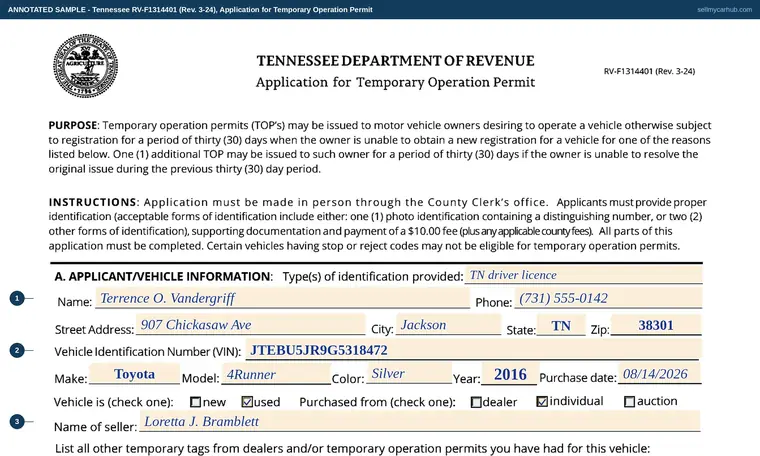
The applicant is the person who now owns the vehicle and cannot yet register it. The seller appears only as the name of the seller.
Watch out: If a seller finds themselves filling this in, something has gone wrong upstream - most often a plate that was left on the car and now needs cancelling instead.
Identification types, name and address, then vehicle identification number, make, model, colour, year and purchase date.
Watch out: The purchase date should match the date of sale in the assignment. A permit dated before the sale is a question the clerk asks out loud.
Two ticks and the seller's name, which is what makes this a private purchase rather than a dealer one.
Watch out: Auction is a third option and it is not a synonym for a private sale. Ticking it changes what documents the clerk expects to see.
Casual and isolated sale is the private-purchase box, and it needs a notarised bill of sale or a properly reassigned title with it.
Watch out: A properly reassigned title is the ordinary answer - it is the certificate the seller has just signed. The notarised bill of sale is the alternative for a title still sitting with a lienholder.
A short explanation of why the vehicle cannot be registered yet and what is being done about it.
Watch out: Where the car is going and which clerk it is going to answers the clerk's real question, which is whether this is a journey with an end.
The certification statement, a signature and a date, with $10 and identification.
Watch out: In person, with the identification in hand. The clerk is checking the documents and the record before the permit is issued, and a posted application is simply returned.
| On the form | What to put in it |
|---|---|
| A. Applicant and vehicle information | Types of identification provided, name, phone, street address, city, state and ZIP; then vehicle identification number, make, model, colour, model year and purchase date. |
| New or used, and where it came from | Two ticks for new or used, and three for dealer, individual or auction, plus the name of the seller. |
| Previous permits | One line asking for all other temporary tags from dealers and temporary operation permits the applicant has had for this vehicle. |
| B. Reason for requesting | Four options. Title not available for timely registration, which needs a dealer's invoice or a notarised bill of sale and, where a lienholder holds the title, the lienor's name and address. Casual and isolated sale, needing a notarised bill of sale or a properly reassigned title. Out-of-state resident or transport. Or other, with details. |
| Details | A block for the explanation, which the form asks for on three of the four options. |
| C. Applicant certification | The true-and-correct statement, then the signature and date. |
Every line here was read off RV-F1314401 (Rev 3-24) itself — the PDF is here — and off the Tennessee Department of Revenue pages. This is plain-language help with a form, not legal advice, and where our wording and the agency's differ, theirs governs.
Back to all Tennessee seller paperwork, or what selling a car in Tennessee involves.