For a vehicle you own and cannot prove you own: no certificate, no assigned title, nothing but a receipt. Tennessee splits that problem by value and by age. A vehicle worth $3,000 or less, or any vehicle at least thirty years old whatever it is worth, goes down this route. Anything newer and worth more goes to the surety bond instead, and the form prints the chart that makes the decision.
Written against RV-F1310401 (Rev 2-23), issued under Tenn. Code Ann. 55-3-103. The Department's own note on its forms page is that applications submitted this way are stringently examined due to the potential for fraud, and that most requests are rejected due to improper documentation. Read page two before you start block A.
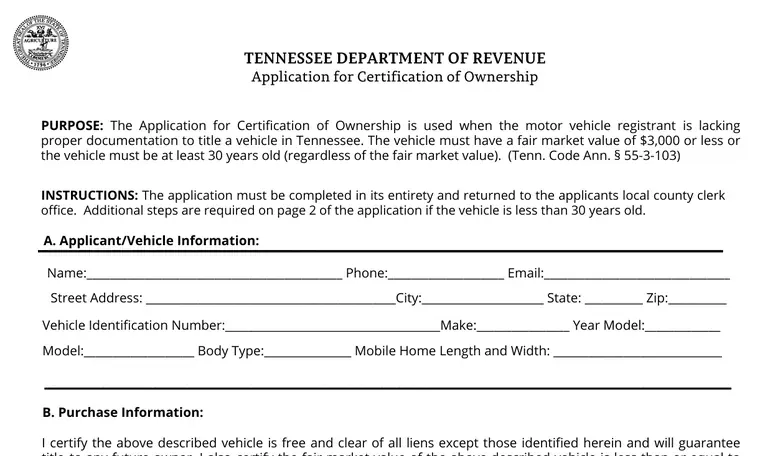
Two documents, and they are not the same thing. Take the blank RV-F1310401 from the tn.gov copy so you get the revision that is current today.
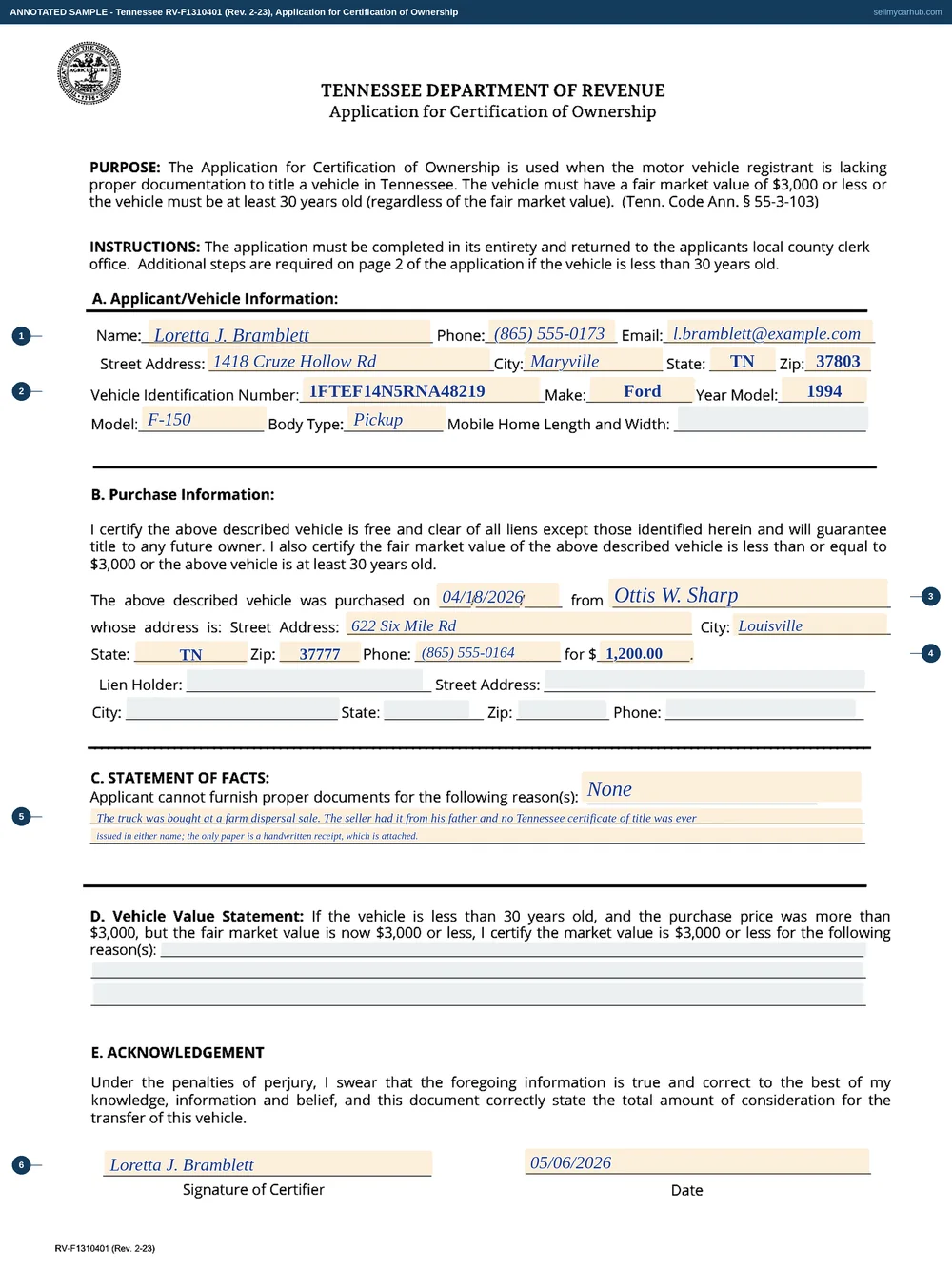
This is the actual RV-F1310401, rendered from the PDF the Tennessee Department of Revenue publishes and completed end to end: letterhead, every field, and the blocks at the foot.
Page two prints it: $3,000 or less, or thirty years or older, is this form. $3,001 and above and under thirty years old is a bond.
Watch out: Value is fair market value, which the form defines as the price the vehicle would fetch between a willing buyer and a willing seller. What you paid for it is a different number and block D exists precisely for that gap.
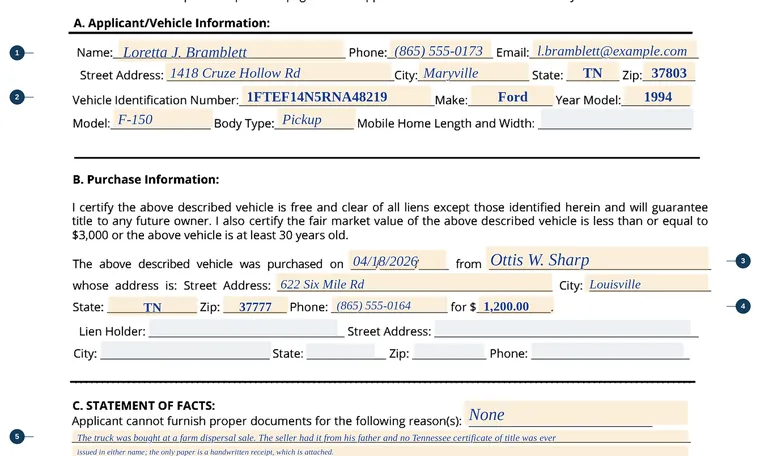
Your details, then vehicle identification number, make, year model, model and body type.
Watch out: If the VIN plate is missing or unreadable, this form is not the next step - a replacement VIN application is, and it goes in first.
The date of purchase, the seller's name, full address and telephone, and what you paid. The certification above it warrants the vehicle free of liens and guarantees title to any future owner.
Watch out: Write a real address and a real telephone number if you have them. Where the previous owner is known, page two wants certified letters going to them, and a blank here reads as an unknown owner.
Three lines to explain what happened to the title.
Watch out: Say what actually happened and keep it factual. The one explanation that is specifically ruled out is that the seller did not furnish a title when you bought it - the Department calls that a civil matter between the two of you.
For a vehicle under thirty years old bought for more than $3,000 that is now worth $3,000 or less.
Watch out: This is the flood, fire and long-abandoned block. A dealer appraisal or a written valuation attached to it does more work than three lines of prose.
The signature of the certifier and the date, at the foot of page one.
Watch out: Then read page two once more before you seal the envelope. Most rejections here are documents that were never enclosed rather than answers that were wrong.
| On the form | What to put in it |
|---|---|
| A. Applicant and vehicle information | Name, phone, email, street address, city, state and ZIP; then vehicle identification number, make, year model, model, body type and a mobile home length and width. |
| B. Purchase information | A printed certification that the vehicle is free and clear of all liens except those identified, that the applicant will guarantee title to any future owner, and that the value is $3,000 or less or the vehicle is at least thirty years old - followed by the date of purchase, who it was bought from, that person's full address and telephone, the price, and a lienholder block. |
| C. Statement of facts | Three lines under the heading: applicant cannot furnish proper documents for the following reason(s). |
| D. Vehicle value statement | Only for a vehicle under thirty years old bought for more than $3,000 whose value has since fallen to $3,000 or less, with three lines to say why. |
| E. Acknowledgement | The perjury sentence, the signature of the certifier and the date. |
| Page two, the supporting documents | Five numbered requirements that apply only to a vehicle under thirty years old: notification, VIN verification, a notarised bill of sale or statement, photographs for a rebuilt vehicle, and a certified copy of a lost manufacturer's statement of origin. |
| The notification rule | Certified letters with return receipt requested to all known parties with a legal interest, with the green cards submitted; or, where the previous owner is unknown, a newspaper notice in the county of application giving make, model, year and vehicle identification number and asking any interested party to make contact within ten business days. |
| The chart | $0.00 to $3,000.00, certification of ownership. $3,001.00 and above, corporate surety bond or personal bond with two solvent personal sureties. Thirty years or older regardless of value, certification of ownership. |
Every line here was read off RV-F1310401 (Rev 2-23) itself — the PDF is here — and off the Tennessee Department of Revenue pages. This is plain-language help with a form, not legal advice, and where our wording and the agency's differ, theirs governs.
Back to all Tennessee seller paperwork, or what selling a car in Tennessee involves.