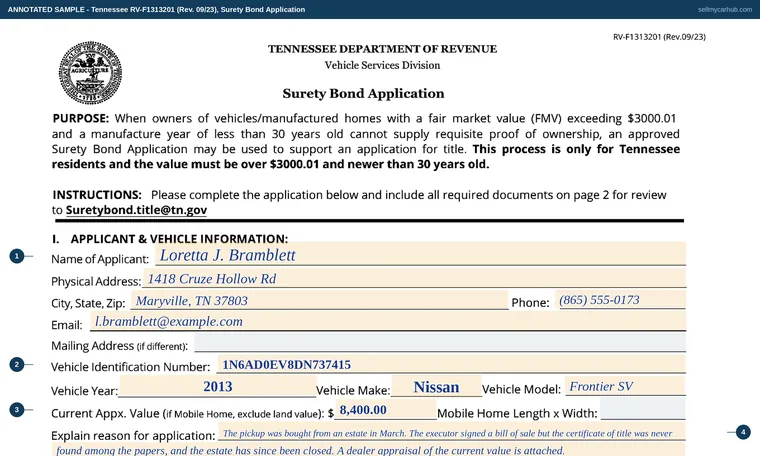
The other half of the no-title problem: a vehicle over the $3,000 line and under thirty years old, where a certification of ownership is not available. A bond stands behind the title for three years so that anyone with a better claim has something to claim against. Tennessee writes the personal version itself at no cost to the applicant, which is unusual, and it wants two landowners to sign it with you.
Written against RV-F1313201 (Rev 09/23), issued under Tenn. Code Ann. 55-3-103. A corporate bond costs a premium and a personal bond costs two favours. Both take time - this is a Nashville review, not a counter transaction - so start it before you advertise the car, not after somebody has agreed to buy it.
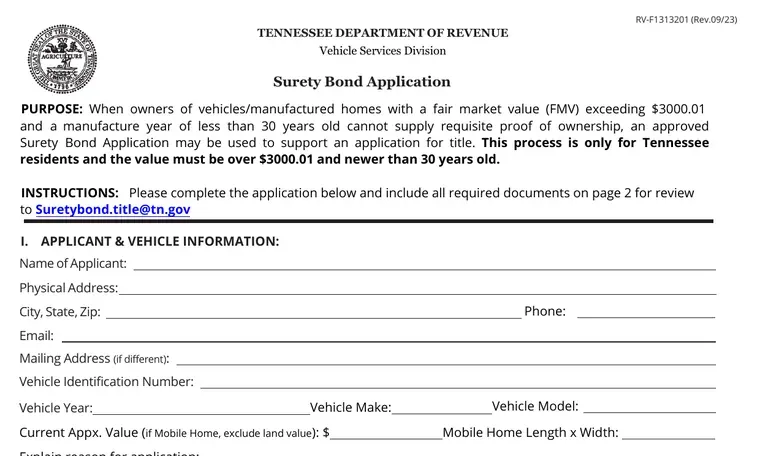
Two documents, and they are not the same thing. Take the blank RV-F1313201 from the tn.gov copy so you get the revision that is current today.
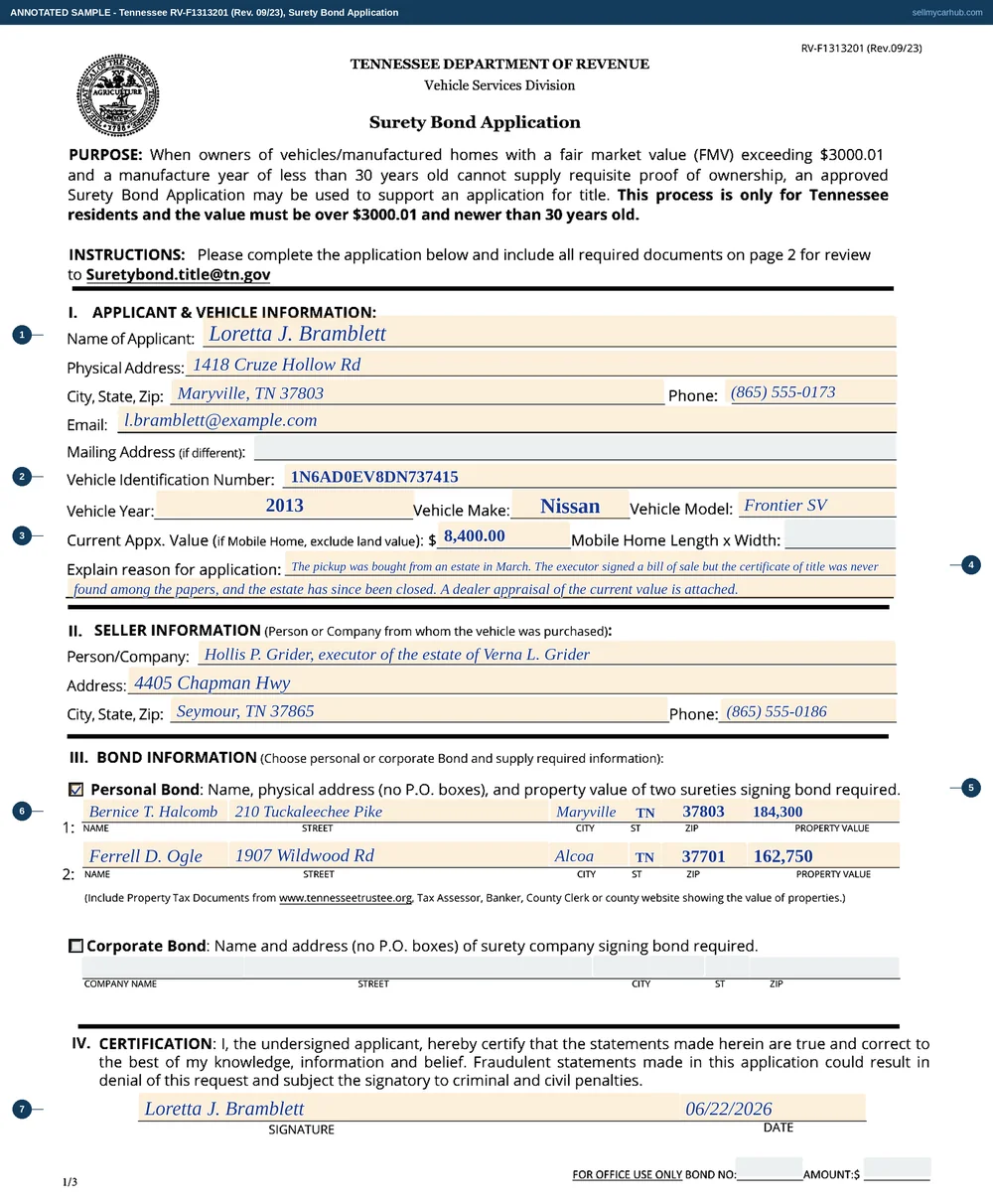
This is the actual RV-F1313201, rendered from the PDF the Tennessee Department of Revenue publishes and completed end to end: letterhead, every field, and the blocks at the foot.
Over $3,000.01 in fair market value and under thirty model years old. Below or older, and this is the wrong form.
Watch out: The value has to be supported. Either a bill of sale from the last registered owner or a written appraisal from a dealer or a valuation site goes in with the application.
Your details, then the vehicle identification number, year, make, model and current approximate value.
Watch out: The value you write is what the bond is measured against and what the sales tax is later calculated on. Rounding it down is not a saving, it is a rejection risk.
Two lines describing why you cannot supply proof of ownership.
Watch out: Two lines is not much, so lead with the fact and not the history. An estate that closed, a lienholder that dissolved, a title that never arrived after a duplicate was ordered - the clerk reading it wants the shape of the gap.
The person or company and their full address and phone number.
Watch out: If you cannot name them, say so in block I rather than leaving block II empty. An unexplained blank in a fraud-sensitive process is worse than an awkward answer.
Two sureties who own Tennessee land, or one bonding company. Tick one and complete only that half.
Watch out: The personal route costs nothing but asks two people to put their property behind your title for three years. Ask them before you write their names down.
Name, physical street address, city, state, ZIP and property value for each, with a recent property tax bill for each attached.
Watch out: Property values come from tennesseetrustee.org, the assessor or the county website. A number remembered from a conversation is not general tax certification.
Signature and date in block IV, then the whole thing to the surety bond mailbox at the Vehicle Services Division.
Watch out: The approval letter is the thing that unlocks the county clerk. Without it the clerk has nothing to process, and the letter also tells you what the sales tax will be.
| On the form | What to put in it |
|---|---|
| I. Applicant and vehicle information | Name, physical address, city, state, ZIP, phone, email and a mailing address if different; then vehicle identification number, year, make, model, current approximate value, and a mobile home length and width. |
| Explain reason for application | Two lines, and the only place on the form where the story gets told. |
| II. Seller information | The person or company the vehicle was bought from, with address, city, state, ZIP and phone. |
| III. Bond information | Two mutually exclusive routes. Personal bond needs the name, physical address - no post office boxes - and property value of two sureties. Corporate bond needs the name and address of the surety company. |
| IV. Certification | The applicant certifies the statements are true, with a signature and a date, and a for-office-use box holds the bond number and amount. |
| Page two, the required documents | A bill of sale from the last registered owner stating why the vehicle was not titled in their name; or, in its absence, a written appraisal of current value from a local licensed dealer or a valuation website such as Kelley Blue Book or J.D. Power. |
| The sureties' conditions | Two people other than the applicant who own land in Tennessee, who do not share an address with each other or with the applicant, and who supply general tax certification - a recent property tax bill - from tennesseetrustee.org, the assessor or the county website. |
| Proof of residency | Two documents from the Department's published list, because the process is only open to Tennessee residents. |
Every line here was read off RV-F1313201 (Rev 09/23) itself — the PDF is here — and off the Tennessee Department of Revenue pages. This is plain-language help with a form, not legal advice, and where our wording and the agency's differ, theirs governs.
Back to all Tennessee seller paperwork, or what selling a car in Tennessee involves.