A short affidavit signed by both owners of a jointly titled vehicle, electing that when one of them dies the other simply keeps it. It is the decision that determines whether a family ever has to deal with an estate to sell a car, and it can only be made while both people are alive to sign.
Written against MVR-620 (Rev 4/26), issued under N.C. General Statute 20-72.1. This is the cheapest piece of paperwork on this whole site and the one most likely to save a family a month. If a car is in two names and the survivorship box was never ticked, it is worth fixing on a quiet afternoon rather than at the worst possible moment.
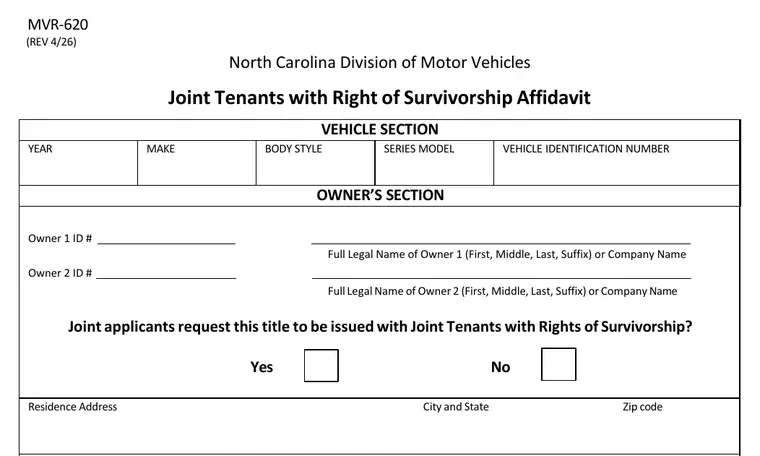
Two documents, and they are not the same thing. Take the blank MVR-620 from the ncdot.gov copy so you get the revision that is current today, then print our MVR-620 guide and keep it beside you while you fill theirs in.
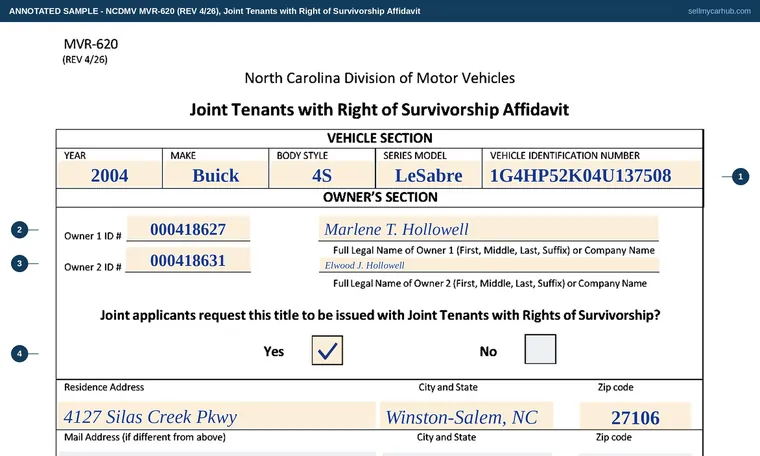
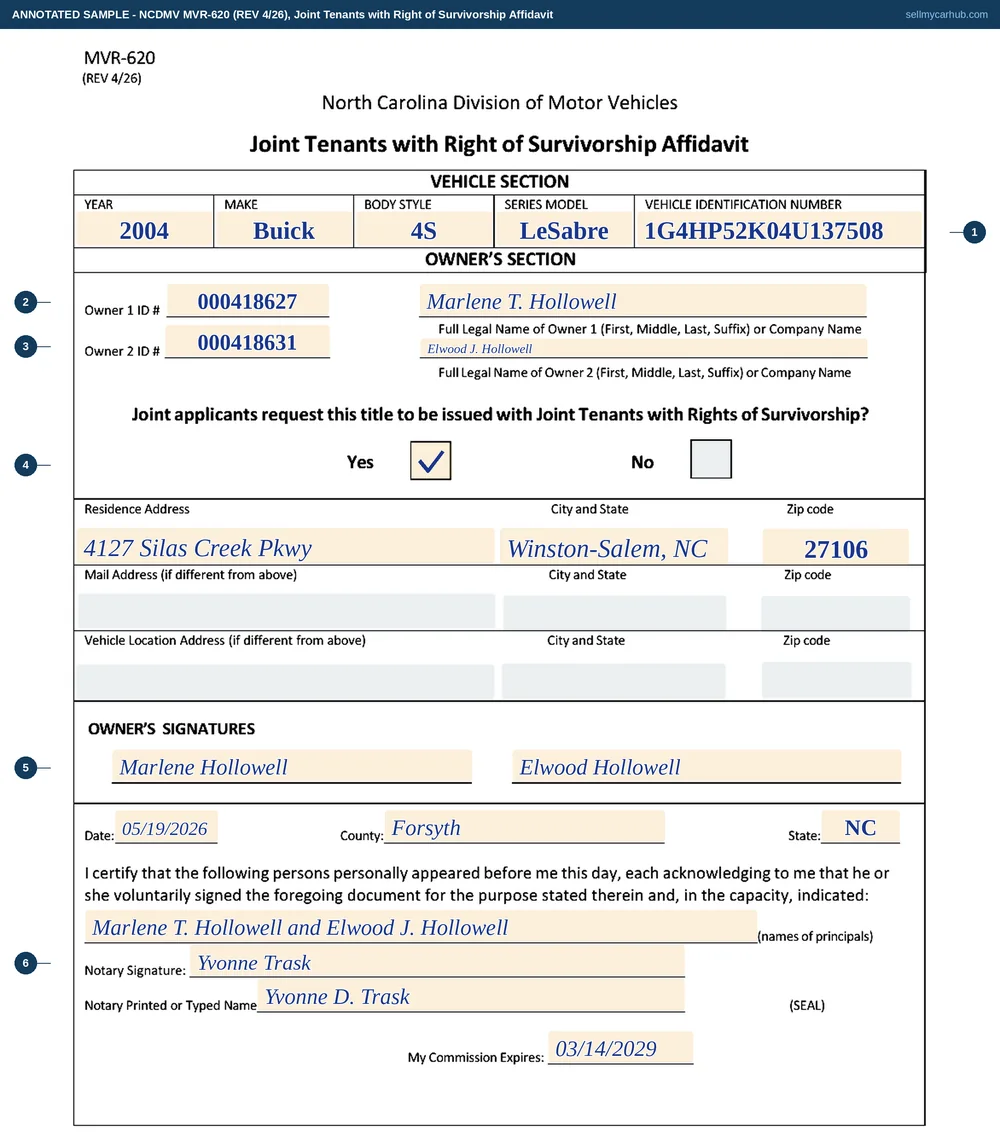
This is the actual MVR-620, rendered from the PDF the North Carolina Division of Motor Vehicles publishes and completed end to end: letterhead, every field, and the blocks at the foot.
The row above the owner boxes: year, make, body style, series model, then the seventeen characters of the VIN.
Watch out: Copy the VIN off the certificate. This affidavit attaches to a specific vehicle rather than to the two people signing it.
Identification number and full legal name.
Watch out: Full legal name as the licence has it, and the same version that appears on the title. A married name on one document and a maiden name on the other is a correction before it is an election.
The second owner's identification number and full legal name.
Watch out: Both people have to exist on the title for survivorship to mean anything. If the car is in one name, this form is not the way to add the second.
Yes or No: joint applicants request this title to be issued with Joint Tenants with Rights of Survivorship.
Watch out: Yes is the answer that lets a survivor keep the car without the estate. No leaves the deceased owner's share to be dealt with by the clerk of court.
Two lines, side by side, signed in front of the same notary where possible.
Watch out: Both signatures are acknowledged. If the two owners cannot appear together, each acknowledgment has to be complete in its own right.
The names of both principals, the notary's signature and printed name, the seal and the commission expiry.
Watch out: Check that the notary has written both names into the certificate. A certificate naming one principal only acknowledges one signature.
| On the form | What to put in it |
|---|---|
| Vehicle section | The vehicle the two owners hold between them: year, make, body style, series model and the vehicle identification number. |
| Owner's section | Owner 1 ID number and full legal name, then Owner 2 ID number and full legal name. Both are required — this form has no meaning with one owner on it. |
| The election | One question with a Yes and a No box: joint applicants request this title to be issued with Joint Tenants with Rights of Survivorship. |
| Addresses | Residence address with city, state and ZIP, a mail address if different, and a vehicle location address if different again. |
| Owners' signatures | Two signature lines side by side, one for each owner. |
| Date, county and state | Where and when the acknowledgment was taken. |
| Notary block | Names of the principals — both of them — then the notary's signature, printed or typed name, seal and commission expiry. |
Every line here was read off MVR-620 (Rev 4/26) itself — the PDF is here — and off the North Carolina Division of Motor Vehicles pages. This is plain-language help with a form, not legal advice, and where our wording and the agency's differ, theirs governs.
Back to all North Carolina seller paperwork, or what selling a car in North Carolina involves.